
Short Answer
In the sweltering summer of 1969, the world held its breath as three men set out for the moon. For eight days, from July 16 to July 24, newspapers were the chronicle of the age, their front pages a daily record of triumph and tension. In living rooms across America, families gathered around television sets, but it was the morning paper that preserved the moment in ink. The headlines of July 1969—bold, breathless, and sometimes contradictory—captured the awe of the first lunar landing and the anxiety of a nation locked in the Cold War space race. This article reconstructs that experience through the newspapers of the time, showing how contemporaries read, understood, and remembered the Apollo 11 mission.
What Happened?
Apollo 11 launched from Kennedy Space Center on July 16, 1969, carrying astronauts Neil Armstrong, Edwin “Buzz” Aldrin, and Michael Collins. The mission’s objective was to land two men on the lunar surface and return them safely to Earth. The spacecraft entered lunar orbit on July 19, and on July 20, the lunar module Eagle separated from the command module Columbia. At 4:17 p.m. EDT, Armstrong and Aldrin touched down in the Sea of Tranquility. Six hours later, Armstrong stepped onto the surface, followed by Aldrin, while Collins orbited above. The astronauts spent 21 hours on the moon, collecting samples and deploying experiments. They rejoined Collins on July 21, and after a successful ascent and trans-Earth injection, the command module splashed down in the Pacific Ocean on July 24, 1969.
Newspapers tracked every phase. The Gazette (Cedar Rapids, Iowa) published front pages from July 15 through July 24, chronicling the journey from pre-launch preparations to the triumphant return. The Dayton Daily News on July 21, 1969, ran the headline “Moon Pioneers Back in Orbit,” reflecting the astronauts’ return to lunar orbit after their moonwalk. The New York Times had previewed the mission on July 17 with an article titled “Apollo 11 Man and the Moon,” setting the stage for the historic event.
How It Was Seen at the Time
Contemporaries understood Apollo 11 as a monumental achievement of human will and technology, but also as a high-stakes gamble. The language of newspaper coverage was dramatic and often reverent. The Dayton Daily News headline “Moon Pioneers Back in Orbit” captured the sense of pioneering adventure, while British papers like the Daily Mail and Daily Express on July 21, 1969, devoted multiple pages to the landing, emphasizing the human drama. The Gazette ran a photograph of Buzz Aldrin standing beside the solar wind experiment, a visual testament to the mission’s scientific purpose. The prevailing mood was one of collective pride and relief—pride in American achievement, relief that the astronauts were safe.
“Moon Pioneers Back in Orbit” — Dayton Daily News, July 21, 1969
Yet the coverage also reflected the tension of the era. The New York Times article from July 17, 1969, titled “Apollo 11 Man and the Moon,” hinted at the philosophical and existential dimensions of the journey, framing it as a step not just for America but for all humanity.
Contemporary Newspaper Coverage
American and British newspapers covered Apollo 11 with extraordinary intensity. The Gazette published front pages from July 15 to July 24, 1969, each day’s edition capturing a new milestone: the launch on July 16, the lunar orbit insertion on July 19, the landing on July 20, the moonwalk on July 21, and the splashdown on July 24. The Dayton Daily News devoted eleven pages on July 21, 1969, to the story, with the headline “Moon Pioneers Back in Orbit.” The Journal Herald (Dayton) also ran extensive coverage on July 21, 25, and 30, 1969.
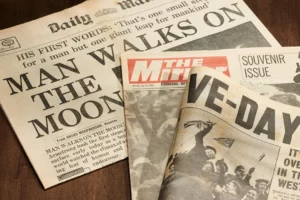
British newspapers were equally engaged. The Daily Mail and Daily Express each published two-page spreads on July 21, 1969, with re-scanned portions along the central fold. The Daily Mirror had produced a multi-page insert on July 11, 1969, before the launch, and the Daily Mail followed with its own insert on the same day. These British papers often emphasized the global significance of the event, framing it as a triumph for all mankind rather than solely an American victory.
“The Daily Express of July 21, 1969, devoted two full pages to the moon landing, with dramatic photographs and detailed accounts of the astronauts’ first steps.”
Different Perspectives
American Coverage
American newspapers tended to emphasize national pride and technological prowess. The Gazette and Dayton Daily News highlighted the astronauts’ heroism and the success of the mission. Headlines were often triumphant, and editorials praised the achievement as a victory in the space race against the Soviet Union.
British Coverage
British newspapers, while celebrating the achievement, also focused on the human-interest angle and the global implications. The Daily Mail and Daily Express on July 21, 1969, featured extensive photo spreads and personal stories, often noting that the moon landing was a moment for all humanity, not just America. This perspective reflected Britain’s role as an observer rather than a participant in the space race.
What People Knew at the Time
| What People Knew Then | What We Know Now |
|---|---|
| The astronauts landed safely and walked on the moon. | We have detailed telemetry and post-mission analyses of the landing site, including the near-exhaustion of fuel during descent. |
| The mission was a complete success. | Later reviews revealed minor technical issues, such as the broken circuit breaker on the ascent stage, which were resolved in real time. |
| The moon was a barren, lifeless place. | Subsequent missions and analyses have revealed the moon’s complex geology and the presence of water ice in shadowed craters. |
| The space race was a competition between the U.S. and the U.S.S.R. | Historians now view the space race as part of a broader Cold War rivalry, with significant scientific and diplomatic consequences. |
Timeline
- July 16, 1969: Apollo 11 launches from Kennedy Space Center.
- July 19, 1969: Spacecraft enters lunar orbit.
- July 20, 1969: Lunar module Eagle lands in the Sea of Tranquility; Armstrong and Aldrin become the first humans on the moon.
- July 21, 1969: Astronauts lift off from the moon and dock with the command module; newspapers report “Moon Pioneers Back in Orbit.”
- July 24, 1969: Command module splashes down in the Pacific Ocean; astronauts are recovered and placed in quarantine.
Aftermath
The immediate aftermath of Apollo 11 was a period of celebration and reflection. The astronauts were hailed as heroes, and their quarantine was widely covered. Newspapers continued to publish retrospective pieces for weeks. The Dayton Daily News on November 19, 1969, reported on the next mission, Apollo 12, with the headline “Conrad, Bean Stroll on Moon,” showing that lunar exploration had become a routine—though still extraordinary—event. The success of Apollo 11 solidified American leadership in space and set the stage for subsequent missions, though the public’s attention would soon shift to other concerns.
The newspapers of July 1969 offer a unique window into how contemporaries experienced one of the defining moments of the twentieth century. They reveal not only the facts of the mission but also the hopes, fears, and language of the era. The bold headlines and breathless prose remind us that history is not just a sequence of events but a story told in real time, with all its excitement and uncertainty.
FAQ
What did newspapers report on July 21, 1969, the day after the moon landing?
Newspapers on July 21, 1969, reported the successful moonwalk and the astronauts' return to lunar orbit. The Dayton Daily News ran the headline 'Moon Pioneers Back in Orbit,' while British papers like the Daily Mail and Daily Express devoted multiple pages to the event.
How did British newspapers cover Apollo 11 compared to American ones?
British newspapers, such as the Daily Mail and Daily Express, emphasized the global significance of the moon landing and often framed it as a triumph for all humanity. American papers, like the Gazette and Dayton Daily News, focused more on national pride and technological achievement.







Leave a Reply