
Short Answer
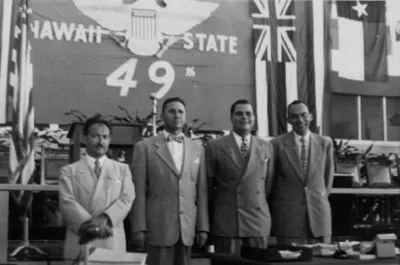
On a warm April morning in 1950, the members of Hawaii’s Constitutional Convention gathered in Honolulu, carrying with them the hopes of a territory that had waited more than half a century for statehood. Governor Ingram M. Stainback welcomed the delegates with a sense of destiny, declaring that “today is a momentous day in the history of Hawaii, a day looked forward to by the people of Hawaii since the Newlands Resolution of 1898.” The convention, authorized by Act 334 of the 1949 Session Laws, was tasked with drafting a constitution that would serve as the foundation for a future state. The delegates—lawyers, educators, businessmen, and community leaders—knew they were writing more than a legal document; they were crafting the blueprint for Hawaii’s entry into the Union. The air was thick with optimism, but also with the weight of a long struggle for self-governance that stretched back to the monarchy.
What Happened?
The 1950 Constitutional Convention was the culmination of decades of political effort. Hawaii had been a U.S. territory since 1900, when the Organic Act established a government under congressional control. The Newlands Resolution of 1898 had annexed the islands, and the Organic Act of 1900 had provided a territorial government, but full statehood remained elusive. In 1949, the territorial legislature passed Act 334, calling for a constitutional convention to draft a state constitution. Delegates were elected, and the convention convened in Honolulu in April 1950.
The convention’s proceedings were recorded in a multi-volume journal, later published under the supervision of the Attorney General’s Office and the Public Archives. The opening session featured Governor Stainback’s message, in which he assured the delegates of his full support and reminded them of the historical significance of their task. The convention organized itself into committees, with Benjamin O. Wist serving as chairman. Other members included J. Garner Anthony, Marguerite K. Ashford, Alexander Castro, Frank C. Luiz, Chuck Mau, Frederick Ohrt, Tom T. Okino, Harold S. Roberts, Arthur K. Trask, and Arthur D. Woolaway.
Over the following months, the delegates debated and drafted a constitution that included a bill of rights, provisions for the executive, legislative, and judicial branches, and a framework for local government. The document was submitted to the voters on November 7, 1950, and was adopted by the people. However, statehood did not come immediately. The constitution was later amended in 1959 to meet federal requirements, and on June 27, 1959, three propositions were adopted by the people. Congress accepted, ratified, and confirmed the constitution by the Act of March 18, 1959, and it went into effect on August 21, 1959, upon the issuance of a presidential proclamation admitting Hawaii into the Union.
How It Was Seen at the Time
Contemporaries viewed the 1950 constitution as the final step toward statehood. The governor’s message captured the prevailing mood: “I wish to welcome the members of this Convention and assure you that I will be only too glad to assist you in any way within my power. Today is a momentous day in the history of Hawaii, a day looked forward to by the people of Hawaii since the Newlands Resolution of 1898 which effected the admission of Hawaii to the United States.” The delegates and the public alike believed that a state constitution would demonstrate Hawaii’s readiness for full participation in the American republic. The language of the time was filled with references to “destiny,” “heritage,” and “the philosophy decreed by the Hawaii State motto, ‘Ua mau ke ea o ka aina i ka pono.’” The constitution’s preamble, as later amended, reaffirmed the people’s belief in a government “of the people, by the people and for the people.”
Yet there was also a sense of caution. Some worried that the constitution might not be accepted by Congress, or that the federal government would impose conditions. The convention’s careful drafting reflected a desire to create a document that would be both progressive and acceptable to Washington. The prevailing mood was one of cautious optimism—hope tempered by the knowledge that statehood was not guaranteed.
Historical Snapshot
| Aspect | Detail |
|---|---|
| Date | Convention convened April 1950; constitution adopted November 7, 1950 |
| Place | Honolulu, Territory of Hawaii |
| People | Governor Ingram M. Stainback; Convention Chairman Benjamin O. Wist; delegates including J. Garner Anthony, Marguerite K. Ashford, and others |
| What Happened | Delegates drafted a state constitution, which was ratified by the voters and later amended for statehood |
| Why It Mattered | The constitution provided the framework for Hawaii’s admission as the 50th state in 1959 |
What People Knew at the Time
| What People Knew Then | What We Know Now |
|---|---|
| That the constitution was a necessary step toward statehood, but that Congress would have the final say. | That the constitution was indeed accepted, with amendments, and Hawaii became a state in 1959. |
| That the Newlands Resolution and Organic Act had established territorial status, but statehood was still uncertain. | That the 1950 constitution was the foundational document that enabled statehood, and it remains the basis of Hawaii’s government today. |
| That the convention was a historic event, but its long-term impact was not fully foreseen. | That the 1950 constitution has been amended multiple times, including by the 1978 convention, but its core principles endure. |
Official Reports
The official proceedings of the convention, published in 1960 under the supervision of the Attorney General’s Office and the Public Archives, provide a detailed record of the debates and decisions. The governor’s message, delivered on April 18, 1950, is a key primary source. In it, Governor Stainback emphasized the historical continuity from the Newlands Resolution to the present:
“The Newlands Resolution contemplated an Organic Act which would complete the incorporation of Hawaii as an integral part of the United States. This was enacted in April 1900 and under it Hawaii resembles in every respect the territories…”
The proceedings also list the committee members and their roles, offering insight into the organizational structure of the convention. The official record shows that the delegates took their task seriously, engaging in thorough debate over the structure of the future state government.
What People Expected Would Happen Next
Most contemporaries expected that the adoption of the constitution would quickly lead to statehood. The governor’s message implied that the convention was the final hurdle. However, the process took nearly a decade. After the 1950 ratification, the constitution was submitted to Congress, but action was delayed. It was not until 1959 that Congress passed the necessary legislation, and the people of Hawaii voted on three propositions to amend the constitution to meet federal requirements. The expectation of immediate statehood was thus disappointed, but the constitution remained the blueprint that eventually succeeded.
Aftermath
Following the adoption of the 1950 constitution, Hawaii continued as a territory for nine more years. In 1959, Congress passed the Hawaii Admission Act, and on June 27, 1959, Hawaii voters approved the three propositions that amended the constitution to comply with federal law. The constitution was then accepted, ratified, and confirmed by Congress on March 18, 1959, and went into effect on August 21, 1959, when President Dwight D. Eisenhower issued the proclamation admitting Hawaii as the 50th state. The 1950 constitution, with subsequent amendments, remains the governing document of the State of Hawaii.
How Historians See It Today
Contemporary observers saw the 1950 constitution as a triumphant step toward statehood, a fulfillment of the promise made in 1898. Modern historians, while acknowledging that optimism, also recognize the constitution as a product of its time—a document that reflected the political compromises and social values of mid-century Hawaii. Scholars note that the constitution established a strong executive and a professional legislature, and that it incorporated progressive provisions for education and public welfare. However, they also point out that the constitution did not address all the concerns of Hawaii’s diverse population, and that subsequent conventions, particularly in 1978, were needed to expand rights and address cultural issues. The primary sources—the proceedings, the governor’s message, and the constitution itself—remain essential for understanding both the hopes of the era and the enduring legacy of the document.
The 1950 Hawaii State Constitution stands as a testament to the perseverance of a people who believed in their right to self-governance. The primary sources from the convention reveal not only the legal debates but also the emotional investment of a generation that had grown up under territorial rule. The constitution’s adoption and eventual acceptance by Congress fulfilled the promise of the Newlands Resolution, and its principles continue to shape the Aloha State today.
FAQ
When was the 1950 Hawaii State Constitution adopted?
The constitution was adopted by the people of Hawaii at an election held on November 7, 1950, after being drafted by the Constitutional Convention that convened in April 1950.
What was the role of the 1950 constitution in Hawaii's statehood?
The 1950 constitution provided the framework for state government. It was later amended in 1959 to meet federal requirements, and Congress accepted it on March 18, 1959, leading to Hawaii's admission as the 50th state on August 21, 1959.














Leave a Reply