
Short Answer
Quick Snapshot
San Francisco in 1906 was a thriving Pacific coast metropolis, the commercial and financial hub of the American West, and a city of crowded neighborhoods, busy docks, cable cars, and ornate Victorian buildings. It was also a place shaped by immigration, labor politics, and the confidence of a port city that saw itself as the gateway to the Pacific.
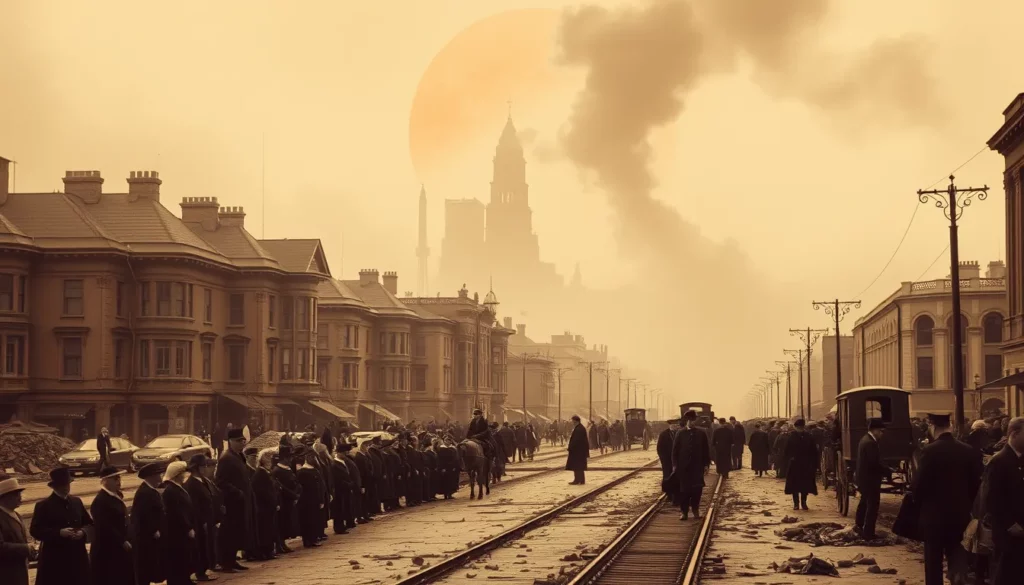
At 5:12 a.m. on April 18, 1906, a great earthquake ruptured the San Andreas Fault. The shaking damaged buildings across the city and ruptured water mains, leaving firefighters almost helpless as fires broke out. Over the next three days, flames burned through much of San Francisco, destroying thousands of buildings and leaving roughly two-thirds of the population homeless.
Yet 1906 was not only a story of ruin. It was also a year of survival, improvised relief, military patrols, tent camps, insurance disputes, and the first steps toward reconstruction. Newspapers, letters, photographs, and official reports preserve the voices of people who lived through the disaster and began to imagine the city anew.
San Francisco in 1906
This article treats San Francisco in 1906 as the history of the consolidated City and County of San Francisco, California, during the calendar year 1906, with the April 18 earthquake and subsequent fire as its central event.
San Francisco sits near the northern tip of a peninsula between the Pacific Ocean and San Francisco Bay. The city’s hills, waterfront, and narrow entrance through the Golden Gate gave it a distinctive geography. Its climate was mild and seasonal, with cool, foggy summers and rainy winters. In 1906 the built environment was dense and varied: commercial blocks and banks near Market Street, immigrant neighborhoods such as Chinatown and the Mission District, fashionable residences on Nob Hill, and working-class districts near the waterfront and industrial areas.
The atmosphere before April 18 was that of an ambitious Edwardian city. Ferries crossed the bay, streetcars and cable cars climbed steep streets, ships loaded and unloaded at the Embarcadero, and theaters and restaurants served a growing population. The earthquake and fire abruptly turned that urban confidence into smoke, rubble, and refugee camps.
Population & Economy
The 1900 federal census counted 342,782 residents in San Francisco, and by early 1906 the population was commonly estimated at around 400,000. The city was ethnically diverse, with large Irish, German, Italian, Scandinavian, Jewish, Chinese, and Japanese communities, alongside native-born residents and migrants from across the United States.
San Francisco’s economy rested on shipping, trade, finance, and manufacturing. The port linked California agriculture and western resources to Pacific and Atlantic markets. Banks and brokerage houses concentrated downtown, while factories, workshops, warehouses, and railroad yards employed skilled and unskilled workers. The cost of living varied sharply by neighborhood and occupation; a loaf of bread cost only a few cents, but rents and wages differed widely across the city’s wards.
The disaster struck every part of that economy. Docks, offices, stores, factories, and rooming houses were destroyed or damaged. Relief officials faced the task of feeding and sheltering not only residents but also refugees who had fled into surrounding towns and military reservations.
Government & Politics
San Francisco was a consolidated city and county governed by a mayor and Board of Supervisors. In 1906 Eugene A. Schmitz, a musician and Union Labor Party politician, was mayor. George C. Pardee was governor of California. City politics were turbulent: labor unions, business interests, reform groups, and accusations of corruption all competed for influence, and graft prosecutions were already shadowing local government.
After the earthquake, normal government was overwhelmed. Mayor Schmitz imposed a dawn-to-dusk curfew and ordered that looters be shot, while Brigadier General Frederick Funston and federal troops took charge of security and relief in the devastated districts. Only a small number of looters were actually shot, but the emergency measures revealed how quickly civil authority could give way to military command and public fear.
Industry
San Francisco’s industries in 1906 included shipbuilding and repair, shipping and warehousing, banking, printing and publishing, sugar and coffee processing, garment making, food processing, and construction. The Union Iron Works was among the city’s notable industrial employers, and the waterfront supported stevedores, sailors, shipwrights, and merchants. Market Street and adjacent blocks held department stores, hotels, banks, and newspaper offices.
The fire destroyed many workplaces and scattered workers and owners across the bay. Rebuilding would eventually create enormous demand for lumber, brick, steel, labor, and contractors, but in the immediate aftermath industry was paralyzed by destroyed premises, disrupted transport, and the flight of residents.
Education
San Francisco had an extensive public school system, private academies, parish schools, and specialized institutions. Nearby were the University of California at Berkeley and Stanford University in Palo Alto, while Hastings College of the Law operated in San Francisco. Libraries and literary societies, including the Mechanics’ Institute, served the city’s reading public.
Literacy was relatively high for the era, especially among native-born and European immigrant groups, though access to schooling varied by class and ethnicity. The earthquake damaged schools and disrupted instruction, and relief and rebuilding needs competed with education for public attention in the months that followed.
Transportation
People moved through San Francisco by foot, horse-drawn vehicle, cable car, electric streetcar, and ferry. The United Railroads and other companies operated streetcar lines, while cable cars climbed the steep hills. Ferries connected the city to Oakland, Alameda, Sausalito, and other bay communities, and railroads linked San Francisco to the transcontinental network through Oakland and the East Bay.
The earthquake twisted streetcar rails, cracked streets, and damaged wharves and ferry approaches. The Ferry Building remained a landmark even amid the ruins, and the harbor became a route for evacuation and relief supplies as rail and road connections were disrupted.
Everyday Life
Daily life in 1906 San Francisco mixed Victorian and Edwardian customs with the practical rhythms of a port city. Families rented flats or rooms, shopped at neighborhood markets, attended churches and schools, and gathered in saloons, cafés, and fraternal halls. Wealthier residents attended the opera and theaters; working people relied on streetcars, cheap meals, and crowded boardinghouses.
Clothing followed the fashions of the period: long skirts, high collars, hats, and formal public dress for many middle-class residents, with working clothes for laborers and domestic servants. Entertainment included vaudeville, drama, music, and public celebrations. On the night of April 17, the tenor Enrico Caruso performed in Bizet’s Carmen; the next morning he experienced the earthquake and later vowed never to return to San Francisco.
The disaster shattered ordinary routines. Residents fled with whatever they could carry, cooked in the streets, slept in parks, and depended on relief committees, neighbors, and soldiers for food, water, and shelter.
Major Events
The central event was the Great San Francisco Earthquake and Fire of April 18–21, 1906. Modern estimates place the earthquake at about magnitude 7.9, though older accounts used figures as high as 8.3. The rupture along the San Andreas Fault extended for roughly 270 miles, and the ground moved dramatically near the fault. In the city, survivors saw streets crack, chimneys fall, and buildings collapse.
Fire followed the shaking. Overturned stoves, broken electrical lines, and damaged chimneys ignited blazes, while more than 300 ruptures in the water mains left firefighters without adequate water. The fire burned for three days, consuming more than 28,000 buildings and causing damage estimated at $500 million, a sum comparable to the federal budget of that year. Officials reported 311 deaths, but modern historians believe approximately 3,000 people died.
“The streets were instantly full of throngs of people, many in their night clothes,” wrote Eleanor Watkins, the wife of a San Francisco surgeon, in a letter soon after the quake. “The great fire had begun, though no one realized what it would be.”
Mayor Schmitz imposed a curfew, and soldiers under General Funston patrolled the streets. Firefighters and troops dynamited buildings in an effort to create firebreaks, though the explosions sometimes spread the flames. The Old Mint survived with relatively little damage because of its granite foundation and because employees used basement cisterns to keep the building wet. About 250,000 people were left homeless and sheltered in tents and temporary wooden structures in parks and military reservations. Relief arrived from states and foreign countries, with Japan giving nearly $250,000, more than all other foreign donors combined.
What Newspapers Were Reporting
San Francisco’s newspapers, including the San Francisco Chronicle, The Call, the San Francisco Examiner, and the Bulletin, struggled to report amid destroyed offices, disrupted telegraph lines, and chaotic transport. Emergency editions and bulletins carried news of the earthquake, the spread of fire, the destruction of City Hall and downtown blocks, and the movement of refugees.
Headlines emphasized ruins, fire, relief, and official orders. Papers printed lists of the dead and missing, appeals for food and clothing, announcements of curfews, and reports on military patrols and relief stations. Outside newspapers also covered the disaster, helping to mobilize donations from across the United States and abroad.
What People Were Talking About
Public conversation after April 18 centered on survival and uncertainty. Residents asked whether their homes had burned, where relatives had gone, and whether insurance would pay. Rumors spread about looters, dynamite, martial law, and the safety of the water supply. Relief committees debated how to house refugees and whether to rebuild immediately or wait.
There was also controversy over Chinatown. Some city leaders and reformers proposed relocating Chinese residents away from the destroyed district, but Chinese community leaders and property owners resisted. Letters and diaries from the period show a mixture of gratitude for relief, fear of disease and disorder, anger at loss, and determination to rebuild.
Historical Photographs
The visual record of 1906 is extensive. Photographers such as Arnold Genthe and Willard Worden documented ruined streets, collapsed buildings, smoke-darkened skies, and refugee camps. Images survive of City Hall in ruins, the damaged Ferry Building, the Old Mint, Market Street, and tent cities in Golden Gate Park and the Presidio.
Collections held by the Library of Congress, the California Geological Survey, and the Museum of the City of San Francisco preserve these photographs. Artists also recorded the event: W.A. Coulter sketched the fire from repeated ferry crossings and later painted a large San Francisco fire scene on a salvaged window shade. These images are essential evidence of the disaster’s scale and of the ways residents experienced it.
Documents & Primary Sources
Historians rely on a wide range of primary sources for San Francisco in 1906:
- Federal census records and San Francisco city directories for population, occupations, and addresses.
- Sanborn fire insurance maps and property records for the built environment before and after the fire.
- Newspapers such as the San Francisco Chronicle, The Call, and the San Francisco Examiner.
- Letters and diaries, including Eleanor Watkins’s account quoted by the California Geological Survey.
- The Lawson Report of the State Earthquake Investigation Commission, published after the disaster.
- Relief records, military correspondence, Red Cross files, and municipal documents.
- Photographs, paintings, and the Chabot Observatory seismogram.
1906 Timeline
| Date | Event |
|---|---|
| April 18, 5:12 a.m. | A major earthquake ruptures the San Andreas Fault and damages San Francisco. |
| April 18, morning | Fires break out; ruptured water mains hamper firefighting. |
| April 18, evening | Troops arrive; Mayor Schmitz imposes a curfew and orders looters shot. |
| April 19–20 | The fire continues; dynamiting creates firebreaks but sometimes spreads flames. |
| April 21 | The great fire burns out after destroying much of the city. |
| Late April | Refugees shelter in parks and military reservations; relief committees organize. |
| Summer 1906 | Reconstruction begins; insurance claims and relief work continue. |
What Changed Next
San Francisco rebuilt rapidly, though not without conflict. New fire limits and building regulations altered construction practices, and the city later built a high-pressure auxiliary water system to improve firefighting. The disaster also advanced scientific understanding of earthquakes. The Lawson Report documented the rupture, and in 1910 Harry Fielding Reid used evidence from 1906 to develop the elastic rebound theory.
The city’s population recovered within years, and by 1915 San Francisco hosted the Panama-Pacific International Exposition, showcasing a rebuilt and modernized city. Chinatown survived relocation pressures, though the disaster accelerated changes in housing, land use, and municipal government. The memory of 1906 remained central to San Francisco’s identity: a story of catastrophe, relief, and stubborn renewal.
Sources
- California Geological Survey, The 1906 Great San Francisco Earthquake, https://www.conservation.ca.gov/cgs/pages/earthquakes/earthquake-san-francisco-1906.aspx.
- PBS American Experience, The San Francisco Earthquake, https://www.pbs.org/wgbh/americanexperience/features/ansel-san-francisco-earthquake/.
- Philip L. Fradkin, The Great Earthquake and Firestorms of 1906: How San Francisco Nearly Destroyed Itself.
- Gladys Hansen and Emmet Condon, Denial of Disaster: The Untold Story and Photographs of the San Francisco Earthquake and Fire of 1906.
- State Earthquake Investigation Commission, The California Earthquake of April 18, 1906: Report of the State Earthquake Investigation Commission.
FAQ
What was the population of San Francisco in 1906?
The 1900 census counted 342,782 residents, and by early 1906 the population was commonly estimated at around 400,000.
What major events happened in San Francisco in 1906?
The central events were the April 18 earthquake, the three-day fire that followed, the evacuation and relief of about 250,000 homeless residents, and the beginning of reconstruction.
What primary sources are available for studying San Francisco in 1906?
Researchers use newspapers, letters and diaries, photographs, census records, city directories, Sanborn fire maps, relief and military records, and the Lawson Report on the earthquake.
How did daily life in San Francisco in 1906 differ from today?
Residents relied on cable cars, streetcars, ferries, and horse-drawn transport rather than automobiles and modern communications; housing was dense and often wooden, and firefighting depended on limited water mains and manual equipment.










Leave a Reply