
Short Answer
Quick Snapshot
In 1975 Phnom Penh was the capital of the U.S.-backed Khmer Republic and a city transformed by war. Once a graceful riverine capital, it had become a besieged enclave dependent on airlifted rice, fuel, and ammunition. Refugees crowded its streets, hospitals, and pagodas, while Khmer Rouge forces closed the roads and the Mekong supply route. The city was one of the last strongholds of the Lon Nol government.
The decisive event came on 17 April 1975, when Khmer Rouge forces entered Phnom Penh, the Khmer Republic surrendered, and the city was quickly emptied of its population. This article focuses on that capture and its immediate aftermath, while also describing the wartime city that existed in early 1975. It does not treat the whole history of the Khmer Rouge regime, but uses the fall as the central lens.
For contemporaries, the fall was both an end and a beginning: an end to five years of civil war and a beginning of forced evacuation, executions, and the radical transformation of Cambodian society. The primary record—wire reports, embassy cables, photographs, memoirs, and later forensic documentation—shows how quickly the capital’s ordinary life was overturned.
Phnom Penh in 1975
Phnom Penh lies at the confluence of the Mekong, Bassac, and Tonle Sap rivers. In 1975 it was a low-rise city of boulevards, markets, pagodas, villas, and crowded refugee settlements. The dry season brought heat and dust; by May the rains usually slowed military operations. In early 1975, however, the rains had not yet arrived, and the city’s perimeter was shrinking. The atmosphere was one of exhaustion, fear, inflation, and rumors. The city was not simply a battlefield; it was a crowded refuge and a political capital whose fate was being decided on its outskirts.
Phnom Penh’s symbolic status was enormous. It was the seat of the Khmer Republic and the location of the presidential palace, ministries, the National Assembly, foreign embassies, Pochentong Airport, and the Olympic Stadium. Its fall would signal the collapse of the republican government. The city also held Cambodia’s largest concentration of educated professionals, civil servants, soldiers, merchants, students, and foreign residents.
Population & Economy
Estimates of Phnom Penh’s population in 1975 vary because civil-war refugees had swollen the city dramatically. Before the war the capital had perhaps several hundred thousand inhabitants; by 1975 many accounts put the figure near two million, though historians caution that no reliable census was possible. The population included long-term residents, displaced peasants, government workers, military families, Chinese and Vietnamese communities, and foreigners.
The wartime economy was distorted. Normal trade was crippled after the Khmer Rouge cut the Mekong supply route in February 1975. Food, fuel, medicine, and ammunition arrived mainly by air through Pochentong Airport under a U.S.-organized airlift. Prices rose sharply, scarcity was general, and the government and foreign agencies struggled to feed the city. Rice, kerosene, cooking oil, and medicine were especially scarce. The economy depended less on production than on war logistics, foreign aid, and the black market. Cost-of-living figures are unreliable, but contemporary reports describe extreme inflation and chronic shortages rather than a functioning peacetime market.
Government & Politics
Phnom Penh was the capital of the Khmer Republic, a government supported by the United States and led by Lon Nol. But by 1975 Lon Nol’s authority was fragile. On 1 April 1975 he resigned and left Cambodia; Saukham Khoy became acting head of state, while Long Boret served as prime minister in the final weeks. Real power was fragmented among military commanders, political factions, and the embassy of the United States. The Khmer Rouge, led by Pol Pot and other senior figures, had rejected negotiations and demanded surrender.
The political climate in the capital was defined by defeatism, fear of retaliation, and last-minute diplomacy. Some officials hoped the Khmer Rouge would accept a negotiated transfer of power. Others expected evacuation or execution. The United States, constrained by the Case-Church Amendment, had limited options and prepared to evacuate its nationals and allied Cambodians. The city’s government therefore faced military encirclement and diplomatic abandonment at the same time.
Industry
Phnom Penh’s peacetime industries—rice milling, textiles, food processing, small manufacturing, transport, and commerce—had been disrupted by war. In 1975 the city’s largest employers were the state, the military, foreign aid agencies, and the airlift. Workshops and markets still operated in parts of the city, but production was constrained by fuel shortages, insecurity, and the influx of refugees. The port and river trade had been crippled by Khmer Rouge mines and attacks. Pochentong Airport became the economic lifeline, with contracted aircraft such as C-130s and DC-8s bringing supplies from Thailand.
Small-scale trade continued in markets and along streets, often run by women and family enterprises. Military spending and foreign assistance sustained much of the urban economy, but these were wartime expedients rather than a stable industrial base. When the city fell, most formal industry and commerce stopped almost immediately.
Education
Education in Phnom Penh had expanded in the decades before 1975, but the civil war severely disrupted schools and universities. The Royal University of Phnom Penh and other institutions had trained teachers, doctors, engineers, and civil servants, yet by 1975 many students had been mobilized, displaced, or killed. Schools operated irregularly; some were used as shelters or hospitals. Literacy was higher in the capital than in rural areas, but the war undercut the school system and created a generation whose education was interrupted.
After 17 April 1975, the Khmer Rouge evacuation ended formal education in the city for the duration of their regime. Teachers and students were among those forced into the countryside. The collapse of education in 1975 was therefore both a wartime consequence and a prelude to the Khmer Rouge campaign against educated elites and urban life.
Transportation
Movement in and around Phnom Penh was dominated by military needs. Roads such as Route 1, Route 4, and Route 5 were contested or cut. The Mekong River route, once vital for rice, fuel, and munitions, was effectively closed by February 1975 after Khmer Rouge attacks and mining. Pochentong Airport became the main link to the outside world, handling U.S.-organized supply flights and the April evacuation. Within the city, people traveled by foot, bicycle, cyclo, motorcycle, and private car, but fuel shortages made motor transport increasingly difficult. Military vehicles and checkpoints were common.
The railway and river port had been disrupted; bridges and roads were vulnerable to sabotage and shelling. The Monivong Bridge and the Chrouy Changvar peninsula were strategic points. For ordinary residents, transport meant negotiating roadblocks, scarce buses, and the constant risk of artillery or rocket fire.
Everyday Life
Daily life in early 1975 Phnom Penh was shaped by scarcity and fear. Families crowded into apartments, villas, pagodas, and makeshift shelters. Food was rationed or bought at inflated prices. Rice was the staple, supplemented by fish, vegetables, and whatever could be found. Electricity and water were unreliable. Hospitals were overwhelmed by wounded soldiers and civilians. Many people listened to foreign radio broadcasts for news of the front and the possibility of evacuation.
Social customs continued under pressure. Weddings, funerals, and religious observances took place amid uncertainty. Markets remained important social spaces. Foreigners and Cambodian elites gathered in hotels and embassies, while poorer residents faced the greatest risks. Clothing reflected the mix of urban and rural life: sarongs, shirts, trousers, uniforms, and whatever imported clothing could be obtained. Entertainment was limited; cinemas and restaurants operated irregularly. The dominant shared experience was waiting—for the front to move, for supplies to arrive, or for the end to come.
Major Events
The fall of Phnom Penh was the culmination of the Cambodian Civil War. In January 1975 Khmer Rouge forces attacked Neak Luong and other points on the Mekong supply route. On 27 January a convoy of survivors reached Phnom Penh after a costly journey. In February, mines and ambushes forced the Khmer Republic to abandon attempts to reopen the river route, making the capital dependent on air supply. Khmer Rouge artillery and rockets increasingly threatened Pochentong Airport. On 1 April Lon Nol resigned. On 12 April the United States evacuated its nationals and allied Cambodians in Operation Eagle Pull.
On 17 April 1975 the Khmer Rouge entered Phnom Penh. The republican government surrendered and senior officials were captured. Khmer Rouge forces ordered the city evacuated, sending residents into the countryside. Captured Khmer Republic soldiers were taken to the Olympic Stadium, where many were executed. Foreign nationals took refuge in the French embassy until 30 April, when they were transported to Thailand. Within days, the capital was largely empty.
What Newspapers Were Reporting
In the final weeks, Phnom Penh’s own press was severely constrained. Khmer-language newspapers such as Koh Santepheap had operated before the fall, but wartime censorship, shortages, and the collapse of the government limited publication. Foreign correspondents and wire services provided much of the surviving reporting. The Guardian’s archive of 18 April 1975 reported:
After almost exactly five years of war, Phnom Penh surrendered yesterday to Communist-led Khmer insurgent forces.
The same account described insurgents entering the city and Cambodians waving flags and white surrender flags.
Other international reports focused on the U.S. evacuation, the fate of the Lon Nol government, and the forced emptying of the capital. Headlines emphasized the speed of the collapse and the uncertainty surrounding the Khmer Rouge. Local radio and official announcements, where they survived, reflected the government’s desperate final appeals. After 17 April, independent newspapers in Phnom Penh ceased to operate.
What People Were Talking About
Conversations in Phnom Penh in April 1975 centered on survival. People asked whether the Khmer Rouge would negotiate, whether foreign evacuation planes would take Cambodians, and whether known officials or soldiers would be punished. Rumors spread about revenge killings, forced marches, and the end of money and markets. Embassy staff and journalists debated whether to remain or leave. Cambodian families faced agonizing choices about separation.
Later memoirs and oral histories collected by the Documentation Center of Cambodia describe confusion and disbelief as the evacuation began. Some residents welcomed the end of fighting; others feared what would follow. The most common concerns were food, safety, and the whereabouts of relatives. Public debate was limited by fear and the rapid collapse of normal communications.
Historical Photographs
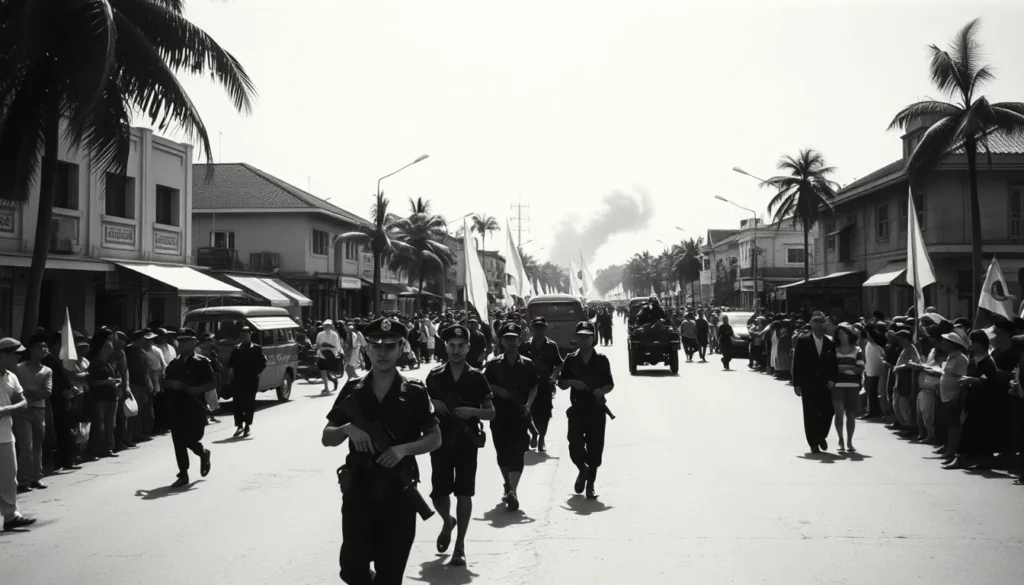
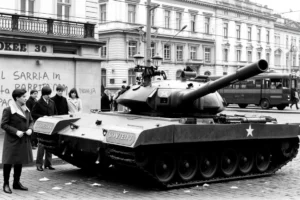
Photographs of Phnom Penh in 1975 are among the most important visual records of the fall. Aerial reconnaissance images show the Esso Shell oil storage tanks ablaze and the Monivong Bridge, indicating the strategic destruction around the capital. Other images show MONATIO militia parading in Phnom Penh, Khmer Rouge troops entering the city, white flags hung by residents, and crowds being evacuated. Photographers such as Roland Neveu and journalists who remained in the city documented the surrender and the first days of Khmer Rouge control.
These photographs are significant because they capture the speed of the transition: a crowded capital became an empty city within days. They also reveal the presence of foreign journalists and the role of visual evidence in later trials and historical accounts. Alongside photographs, newsreel footage and embassy aerial images provide visual documentation of the siege and evacuation.
Documents & Primary Sources
Historians studying Phnom Penh in 1975 rely on several kinds of primary sources. U.S. government records include embassy cables, military reports, and documents relating to Operation Eagle Pull and the airlift. Khmer Republic government records are fragmentary but include decrees, military orders, and official correspondence. Khmer Rouge edicts and radio broadcasts from April 1975 document the order to evacuate the city. Maps and aerial photographs show the defensive perimeter, airport, bridges, and supply routes.
Personal sources include memoirs, diaries, letters, and oral histories from Cambodian survivors, journalists, aid workers, and diplomats. The Documentation Center of Cambodia holds interviews, prison records, and photographs from the Khmer Rouge period. Foreign newspaper archives, such as The Guardian and The New York Times, preserve contemporary reporting. Together these sources allow historians to reconstruct both the high politics of the fall and the everyday experiences of the city’s inhabitants.
1975 Timeline
| Date | Event |
|---|---|
| 12 January | Khmer Rouge attack Neak Luong and press the Mekong supply route. |
| 27 January | Survivors of a 16-ship convoy reach Phnom Penh after attacks. |
| 3 February | Convoy hits Khmer Rouge mines; river supply becomes increasingly untenable. |
| 17 February | Khmer Republic abandons attempts to reopen the Mekong supply line; airlift becomes vital. |
| 5 March | Khmer Rouge artillery shells Pochentong Airport from Toul Leap. |
| 22 March | Rockets hit supply aircraft; airlift is briefly suspended and then resumed. |
| 1 April | Lon Nol resigns and leaves Cambodia; Saukham Khoy becomes acting head of state. |
| 12 April | United States evacuates nationals and allied Cambodians in Operation Eagle Pull. |
| 17 April | Khmer Rouge enter Phnom Penh; Khmer Republic surrenders; forced evacuation begins. |
| 30 April | Foreign nationals sheltering in the French embassy are transported to Thailand. |
What Changed Next
In the days and weeks after 17 April, Phnom Penh was emptied. The Khmer Rouge abolished money, markets, and formal education in the city and forced residents into rural communes. The capital became a ghost city, maintained only by a small number of workers and officials. The Khmer Rouge established Democratic Kampuchea in 1976, and their radical policies caused mass death through execution, overwork, starvation, and disease. The urban population that had survived the fall was dispersed across the countryside.
In 1979, Vietnamese forces invaded Cambodia and drove the Khmer Rouge from Phnom Penh. People gradually returned to the city, but the trauma of 1975 remained central to Cambodian memory. The fall of Phnom Penh thus marked the end of the civil war and the beginning of one of the twentieth century’s most destructive revolutionary regimes.
Sources
- Fall of Phnom Penh, Wikipedia, https://en.wikipedia.org/wiki/Fall_of_Phnom_Penh.
- From the archive, 18 April 1975: Khmer Rouge take over Cambodia, The Guardian, https://www.theguardian.com/world/2015/apr/18/khmer-rouge-cambodia-1975.
- David P. Chandler, The Tragedy of Cambodian History: Politics, War, and Revolution since 1945.
- Ben Kiernan, How Pol Pot Came to Power: Colonialism, Nationalism, and Communism in Cambodia, 1930-1975.
- Elizabeth Becker, When the War Was Over: Cambodia and the Khmer Rouge Revolution.
FAQ
What was the population of Phnom Penh in 1975?
Estimates vary, but by early 1975 Phnom Penh may have held around two million people, swollen by refugees from the civil war.
What major events happened in Phnom Penh in 1975?
The Khmer Rouge cut the Mekong supply route, Lon Nol resigned on 1 April, the United States evacuated nationals on 12 April, Khmer Rouge forces captured the city on 17 April, and the capital was forcibly evacuated.
What primary sources are available for studying Phnom Penh in 1975?
Sources include U.S. embassy cables, Khmer Rouge broadcasts and edicts, contemporary newspapers, photographs, memoirs, oral histories, and records held by the Documentation Center of Cambodia.
How did daily life in Phnom Penh in 1975 differ from today?
In 1975 the city was besieged, short of food and fuel, dependent on airlift, and fearful of attack. After 17 April it was forcibly emptied and urban life was abolished under the Khmer Rouge; today Phnom Penh is a functioning capital with markets, traffic, schools, and government institutions.











Leave a Reply