
Short Answer
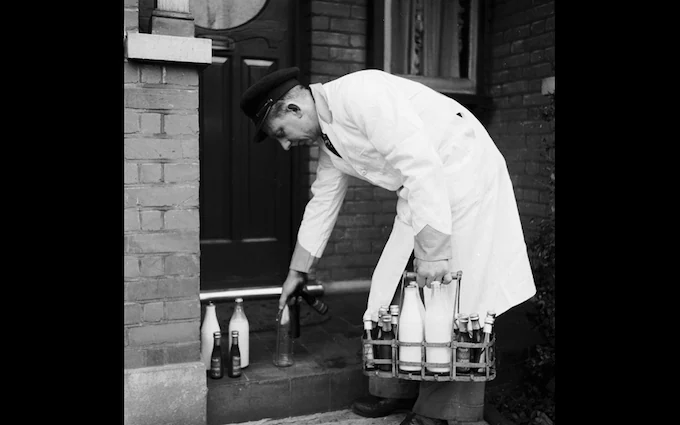
In the early half-light of a 1950s British morning, the first sound of the day was often the gentle clink of glass bottles on a doorstep. By the time families stirred, fresh milk had arrived as if by magic—a daily ritual that stitched neighbourhoods together and gave the milkman a place in the nation’s heart. He was the man who knew everyone, who never missed a day, and who carried the essential breakfast staple through rain, snow, and even the rubble of war. This was the era when the milkman was not just a tradesman but a quiet, reliable thread in the fabric of everyday life.
What Happened?
In the 1940s and 1950s, milk was sold in dedicated dairy shops and delivered to doorsteps from local milk depots. The shops, often part of the United Dairies (UD) chain, were immaculate—white paintwork, white tiles, and counters—staffed by women in clean white overalls. But wartime rationing meant there was no rich milk or cream, only standard butter and hard cheese, and even those were severely limited per person.
Delivery was the heart of the system. From depots, milkmen made their rounds using horse-drawn wagons or carts, later replaced by motorised vans. They carried bottles of fresh milk to every home, collecting the empty bottles left on doorsteps. According to a contemporary recollection, the milkman was “always on time, always cheery” and seemed to know everyone and what they liked best. The service was so dependable that even during the harsh winter of 1947, milkmen were photographed tugging ice-cold pints through snowdrifts, and during the Blitz, one was seen picking his way through bomb-strewn rubble to deliver.
The daily delivery was a national fixture. As one 1950s social history notes, “Milk was delivered each day by the milkman.” This was not a luxury but a necessity, and the milkman was its trusted courier.
How It Was Seen at the Time
Contemporaries viewed the milkman as a reassuring constant. He was not merely a tradesman but a neighbour who knew the rhythm of each street. A recollection from the era captures this sentiment:
“The milkman—always on time, always cheery—seemed to know everyone and what they liked best. There was something about this ritual, a kind of quiet magic, that stitched neighborhoods together and left a mark on childhoods everywhere.”
The dairy shop itself was a symbol of cleanliness and order. The United Dairies shop was described as “very clean-looking with white paintwork and white tiles,” a reassuring sight in a time of rationing and shortages. The milkman and the dairy shop were together a daily proof of normalcy and reliability.
Historical Snapshot
| Aspect | Detail |
|---|---|
| Date | 1940s–1950s (peak era) |
| Place | United Kingdom, especially towns and suburbs |
| People | Milkmen, dairy shop assistants (women), households |
| What Happened | Daily doorstep milk delivery from local depots; milk sold in specialised dairy shops |
| Why It Mattered | Provided fresh milk to every home, created a daily neighbourhood ritual and a trusted local figure |
Daily Life
The day began with the milkman. Families would leave their empty bottles on the doorstep overnight; the milkman would collect them and replace them with full ones. The milk float—whether horse-drawn or motorised—moved quietly along the street, the hum of its engine or the clop of hooves a familiar dawn sound. The milkman knew each household’s order: some wanted an extra pint, some wanted it daily, some took cream (though cream was scarce in the early 1950s).
The dairy shop was another focal point. In the early 1940s, a young child remembered the United Dairies shop as “very clean-looking with white paintwork and white tiles on the walls and shop counter,” with assistants in white overalls. The shop sold standard butter and hard cheese, but rationing limited how much each person could buy. The milkman’s round was not just a delivery; it was a social interaction, a moment of daily contact that made the milkman a familiar and trusted face.
Eyewitness Accounts
Firsthand recollections are rich. One woman, who grew up in the early 1940s, described her local dairy shop:
“I can just remember our dairy shop when I was a young child in the early 1940s. It was called the United Dairies or just the UD, and was very clean-looking with white paintwork and white tiles on the walls and shop counter. The assistants were women dressed in clean white overalls. I wish I could say that the shop sold various types of milk, butter and cream, but this was wartime—which was all I knew at the time—so there was no rich milk or cream. There was standard butter and hard cheese—but rationing allowed for very little per person.”
Another account, from a 1950s childhood, describes the morning magic:
“The gentle clink of glass bottles on doorsteps at dawn—if you grew up in postwar Britain, you probably remember it. In the 1950s, families would stumble to the front door, often still rubbing sleep from their eyes, to find fresh milk waiting outside. The milkman—always on time, always cheery—seemed to know everyone and what they liked best.”
Contemporary Terminology
The vocabulary of the milkman’s world was specific and familiar:
- Milkman: The delivery man who made the daily rounds.
- Milk float: The vehicle used for delivery, often a small electric or horse-drawn cart.
- Doorstep: The place where bottles were left; the term also referred to the delivery itself.
- Empties: The empty bottles left out for collection.
- United Dairies (UD): A major dairy company whose shops were common in Britain.
- Dairy shop: A shop dedicated to selling milk, butter, and other dairy products.
What People Knew at the Time
| What People Knew Then | What We Know Now |
|---|---|
| Milk was delivered daily to every home; it was a reliable, taken-for-granted service. | Doorstep delivery was a product of a particular era, gradually declining with the rise of supermarkets and refrigeration. |
| The milkman was a trusted local figure, part of the neighbourhood’s daily rhythm. | Historians see the milkman as an emblem of postwar British social cohesion and the rise of consumer culture. |
| Rationing limited the variety of dairy products; milk was still a precious commodity. | Rationing was gradually lifted (sweet rationing ended in 1953, meat in 1954), leading to greater abundance and choice. |
In the end, the milkman’s daily delivery was more than a transaction; it was a moment of human connection and trust. The primary sources show us a Britain where the morning milk was a constant, a quiet promise of continuity in a rapidly changing world. The milkman was a living thread in the daily tapestry, and his story is a window into the everyday life of postwar Britain.
FAQ
Why was the milkman so important in 1950s Britain?
The milkman provided a reliable daily delivery of fresh milk to every home, which was essential before widespread refrigeration. He was also a trusted local figure who knew his customers and contributed to the social fabric of the neighbourhood.
What vehicles did milkmen use?
In the 1940s and 1950s, milkmen used horse-drawn wagons or carts, and later motorised vans. Some also used hand-pushed floats, as seen in photographs of the era.










Leave a Reply