
Short Answer
In a crowded reading room of an 1850s newspaper office, a patron unfolds a broadsheet and pauses over a single illustration. There, in ink and line, a familiar politician’s nose is exaggerated to a hook, a figure of a bearded man stands beside a broken ship, and a caption delivers a sharp punchline. The image is funny, but it is also pointed, and the reader knows exactly whom it mocks and why. Political cartoons have been a staple of print since the 18th century, and for contemporaries they were a daily source of opinion and debate. Yet, as the National Archives notes, these cartoons “can give us a unique perspective on a particular event and throw light on public attitudes and values” (National Archives, n.d.). To understand a cartoon, one must know its historical context: who is depicted, what symbols are used, and what the artist intended. This article explores how political cartoons were used as historical sources, what they meant to audiences at the time, and how modern historians decode them.
What Happened?
Political cartoons have appeared in the pages of nearly every newspaper in the world since the 18th century (National Archives, n.d.). Early cartoons, particularly in Britain and America, often depicted static figures with text-filled balloons, espousing what one source calls “now-arcane political points—and sometimes dreadful puns” (Massachusetts Historical Society, n.d.). As the 19th century progressed, cartoons became more dynamic and symbolic, filled with “political symbols, racial and ethnic stereotypes, personification of ideas, and caricatures of once familiar public figures” (Massachusetts Historical Society, n.d.).
- 18th century: The birth of the political cartoon as a distinct form. Cartoons in Britain and its colonies used satire to comment on politics, as noted by the teaching history resource: “Since the 18th century, political cartoons have offered a highly useful window into the past” (TeachingHistory.org, n.d.).
- 19th century: The golden age of the political cartoon. In the United States, the Civil War era saw a proliferation of cartoons in newspapers across the country (Civil War Era NC, n.d.). These cartoons often used symbols like the donkey for the Democratic Party and the elephant for the Republican Party, and they relied on readers’ knowledge of current events and public figures.
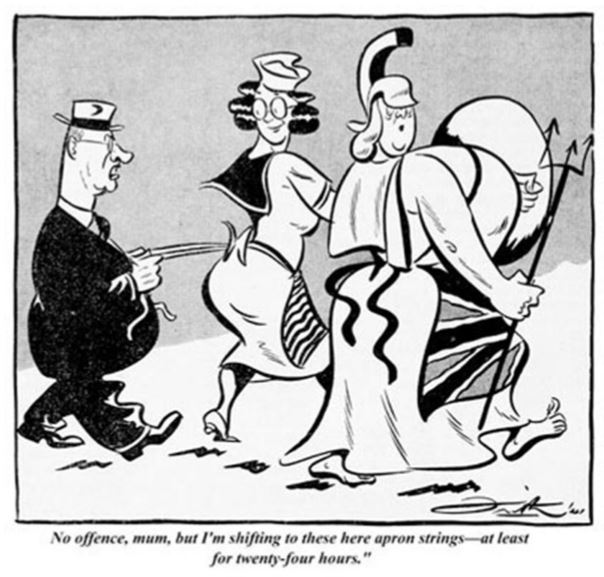
- 20th century and beyond: Cartoons continued to be a staple of newspapers, with artists like Clive Uptton creating cartoons about events like the Marshall Plan. The National Archives holds a cartoon by Uptton that comments on the Economic Recovery Act of 1948, signed by President Truman (National Archives, n.d.).
For contemporaries, political cartoons were not just entertainment; they were a form of editorial opinion. They appeared in the same pages as text editorials and were read as visual arguments. As the National Archives notes, cartoons can be “found in the pages of nearly every newspaper in the world” (National Archives, n.d.).
How It Was Seen at the Time
Contemporaries understood political cartoons because they shared the artist’s context. They recognized the public figures, the symbols, and the current events. The teaching guide from TeachingHistory.org explains that cartoons are “vivid primary sources that offer intriguing and entertaining insights into the public mood, the underlying cultural assumptions of an age, and attitudes toward key events or trends of the times” (TeachingHistory.org, n.d.). This is how audiences saw them: as a reflection of their own world, but with a satirical twist.
“Cartoons that have a message, cartoons that make people think and cartoons that make people laugh. They can give us a unique perspective on a particular event and throw light on public attitudes and values.” — National Archives, n.d.
To “read” a cartoon, contemporaries did not need a guide. They knew the symbols: a ship for the nation, a donkey for the Democratic Party, a tiger for Tammany Hall. They knew the stereotypes, often racial and ethnic, which were part of the visual language of the time (Massachusetts Historical Society, n.d.). The mood was often partisan, and cartoons were expected to take a side. As the Civil War Era NC tutorial notes, “Political cartoons, for example, appear in newspapers across the country everyday, but they cannot be ‘read’ in the same way as editorials and other articles” (Civil War Era NC, n.d.). This distinction was clear to contemporaries: cartoons were a separate genre, but they were still part of the daily press.
Historical Snapshot
| Aspect | Detail |
|---|---|
| Date | 18th century to present, with significant growth in the 19th century |
| Place | Newspapers and periodicals in Britain, the United States, and worldwide |
| People | Political cartoonists, newspaper editors, and the reading public |
| What Happened | Political cartoons became a standard feature of newspapers, using satire, symbols, and caricature to comment on current events |
| Why It Mattered | They provided a visual record of public opinion, cultural assumptions, and attitudes toward events, offering historians a rich primary source |
What People Knew at the Time
| What People Knew Then | What We Know Now |
|---|---|
| Contemporary readers knew the political figures and events being referenced, as well as the symbols and stereotypes used. | Modern historians must reconstruct this context through research, because many symbols and figures have faded from popular memory. |
| Readers understood the cartoonist’s intent because they shared the same cultural and political assumptions. | We now need to study the artist’s background, the publication’s politics, and the audience to infer intent. |
| They recognized the stereotypes and caricatures as part of the visual language, though some were considered offensive even then. | We must approach these stereotypes critically, acknowledging their historical context and the harm they may have caused. |
Contemporary Newspaper Coverage
Political cartoons appeared in newspapers alongside editorials and articles, and they were often discussed in the same pages. The National Archives notes that “Political cartoons can be found in the pages of nearly every newspaper in the world” (National Archives, n.d.). While specific headlines and articles about cartoons are not preserved in our sources, we know that cartoons were a regular feature. For example, during the Civil War, Northern newspapers used cartoons to rally support and mock the Confederacy. The Civil War Era NC tutorial explains that cartoons “appear in newspapers across the country everyday” (Civil War Era NC, n.d.). The cartoons themselves were often the subject of letters to the editor, and readers would write in to praise or condemn them. The press coverage of cartoons was part of the broader political discourse, and cartoons were treated as serious commentary.
Different Perspectives
The Cartoonist’s Perspective
Cartoonists saw themselves as commentators and satirists. They used exaggeration and symbolism to make a point. The National Archives asks, “What are the artist’s intentions?” (National Archives, n.d.). This perspective is essential: the cartoonist was not neutral but was often trying to persuade, mock, or provoke. For example, a cartoon about the Marshall Plan by Clive Uptton (catalogued as INF 3/1295) would have intended to show support for or critique of the American aid program (National Archives, n.d.).
The Audience’s Perspective
Audiences were not passive; they were expected to understand the references. The Massachusetts Historical Society notes that “political symbols, racial and ethnic stereotypes, personification of ideas, and caricatures of once familiar public figures abound in 19th-century political cartoons” (Massachusetts Historical Society, n.d.). Readers who did not recognize the symbols would have been excluded from the joke or the argument. Thus, the cartoon created a kind of insider knowledge, reinforcing shared political or social views.
Common Misconceptions
How Historians See It Today
Modern historians view political cartoons as invaluable primary sources, but they also treat them with caution. The teaching history resource notes that “substantial percentages of adults fail to understand the political cartoons” (TeachingHistory.org, n.d.), which is why historians have developed frameworks for analysis. They now approach cartoons as texts that require decoding, similar to any other primary source. The shift has been from seeing cartoons as mere illustrations to recognizing them as complex artifacts that combine visual and verbal language. The Massachusetts Historical Society warns that some cartoons contain “racist, prejudiced, stereotyped, violent, and/or offensive” content (Massachusetts Historical Society, n.d.), and historians now study these as evidence of contemporary attitudes, not as endorsements. Thus, modern scholarship uses cartoons to understand the past’s public mind, but it also critiques the harm they perpetuated.
Political cartoons are more than just historical curiosities. They are windows into the minds of people who lived in a world of ink and paper, where a single drawing could provoke laughter, anger, or thought. For historians, they are a reminder that the past was not only written but also drawn. The primary sources of the past—newspapers, letters, diaries, and yes, cartoons—teach us that public opinion is often expressed through visual satire. By learning to decode these images, we come closer to understanding the hopes, fears, and assumptions of those who came before us.
FAQ
Why are political cartoons important primary sources for historians?
Political cartoons are important because they offer a visual record of public opinion, cultural assumptions, and attitudes toward events. As TeachingHistory.org notes, they provide 'insights into the public mood, the underlying cultural assumptions of an age, and attitudes toward key events or trends of the times.' They are not objective but reveal the perspectives of the cartoonist and the audience.
What do you need to analyze a political cartoon?
To analyze a political cartoon, you need to know its historical context: what was happening at the time, who the main people are and what they represent, and what the artist's intentions were. The National Archives lists these as essential questions. You also need to identify symbols, stereotypes, and caricatures and understand their meaning in the era.
Are political cartoons reliable historical evidence?
They are reliable as evidence of how a certain group or individual perceived events, but they are not objective. They are biased by the artist's viewpoint and the publication's politics. Historians treat them as subjective sources that need to be cross-referenced with other primary sources.






Leave a Reply