
Short Answer
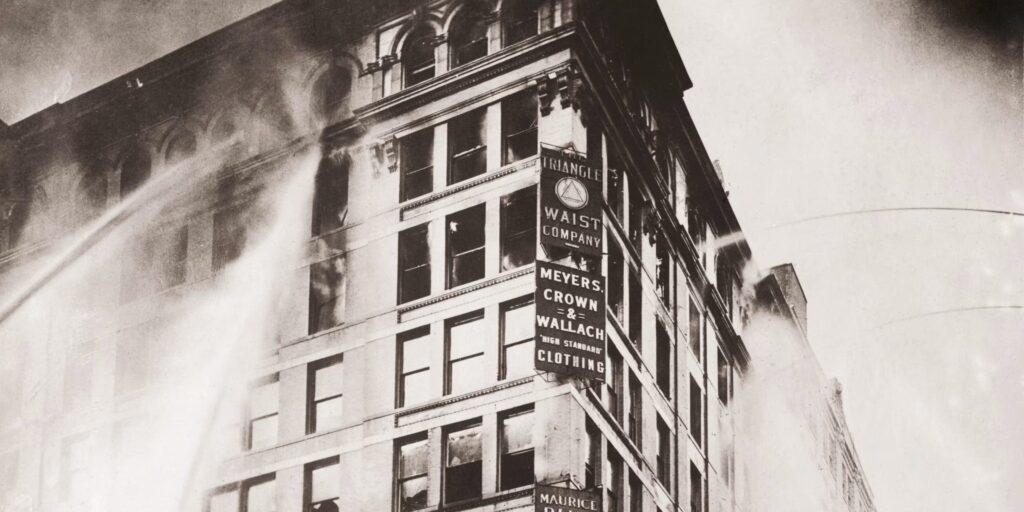
On the afternoon of Saturday, March 25, 1911, the Triangle Waist Company, a garment factory occupying the top three floors of the ten-story Asht Building in Greenwich Village, New York, was in the final minutes of its workweek. Some 600 workers, mostly young immigrant women and girls, were preparing to leave when a fire broke out on the eighth floor. Within half an hour, the blaze had consumed the factory, and 146 workers were dead—either burned, suffocated, or killed by leaping from the windows to the pavement below. The New York Times reported the next day: “Nothing like it has been seen in New York since the burning of the General Slocum.” The fire would become a national scandal and a turning point in the fight for labor reform.
What Happened?
The fire began just before closing time, around 4:40 p.m., on the eighth floor of the Asht Building at the corner of Greene Street and Washington Place. The Triangle Waist Company, which manufactured shirtwaists, occupied the eighth, ninth, and tenth floors. The fire spread rapidly through the factory, which was full of cut fabric, sewing machines, and other combustible materials. The building itself was fireproof, but its contents were not.
Workers on the ninth and tenth floors quickly discovered that the fire escapes were blocked or collapsed, and many of the doors were locked to prevent unauthorized breaks and theft. The fire department’s ladders reached only to the sixth floor, and the fire escape was a narrow, flimsy structure that collapsed under the weight of the fleeing workers. In desperation, dozens of workers jumped from the windows, while others were suffocated or burned inside.
The New York Times, in its March 26, 1911 edition, reported:
“Three stories of the ten-floor building at the corner of Greene Street and Washington Place were burned yesterday, and while the fire was going on 141 young men and women — at least 125 of them mere girls — were burned to death or killed by jumping to the pavement below.”
The fire was over in about half an hour, but the death toll was staggering. The official count later was set at 146 workers. Key events in chronological order:
- Fire breaks out on the eighth floor.
- Workers on the ninth and tenth floors are trapped due to locked doors and a collapsing fire escape.
- Fire department arrives, but ladders are too short.
- Many workers jump to their deaths.
- The fire is extinguished in about 30 minutes.
- 146 workers are confirmed dead.
How It Was Seen at the Time
Contemporary observers were horrified by the speed of the tragedy and the helplessness of the victims. The New York Times described the event as “nothing like it has been seen in New York since the burning of the General Slocum,” referencing the 1904 steamship disaster. The paper emphasized that the building was “fireproof,” yet the contents had burned, and the victims were trapped. The prevailing mood was one of outrage and disbelief. Many blamed the factory owners and the broader system of sweatshop labor that had been condemned in the 1909 strike at the same factory.
The public also feared that such a disaster could happen again, as factory safety regulations were minimal. The trial of the owners, Isaac Harris and Max Blanck, which began in December 1911, became a national spectacle. The trial transcript, preserved by Cornell University, contains the verbatim testimony of more than a hundred witnesses—survivors, firefighters, police officers, and engineers—and is the most extensive and reliable record of the fire.
Historical Snapshot
| Aspect | Detail |
|---|---|
| Date | March 25, 1911 |
| Place | Asht Building, 23 Washington Street, New York City |
| People | Workers (mostly immigrant women and girls), owners Isaac Harris and Max Blanck |
| What Happened | Fire broke out on the 8th floor; 146 workers died |
| Why It Mattered | Led to factory safety reforms and the creation of the New York State Factory Investigating Commission |
Contemporary Newspaper Coverage
The New York Times, on March 26, 1911, published a front-page story with the headline: “141 MEN AND GIRLS DIE IN WAIST FACTORY FIRE; TRAPPED HIGH UP IN WASHINGTON PLACE BUILDING; STREET STREWN WITH BODIES; PILES OF DEAD INSIDE.” The article described the scene:
“The whole story is fireproof. It shows now hardly any signs of the disaster that overtook it. The walls are as good as ever; so are the floors; nothing is the worse for the fire except the furniture and 141 of the 600 men and girls that were employed in its upper three stories.”
The Times also noted, “All Over in Half an Hour,” underscoring the speed of the tragedy. The coverage emphasized the youth of the victims and the horror of the jumps. The newspaper also reported that the fire department’s ladders were too short to reach the upper floors, a fact that would later become a focus of safety reforms.
Eyewitness Accounts
The most detailed eyewitness accounts are preserved in the trial of Isaac Harris and Max Blanck, who were charged with manslaughter. According to the Cornell University ILR School’s Triangle Fire archive, the trial record contains the verbatim testimony of more than 100 witnesses, including survivors, firefighters, police officers, and engineers. The site explains: “It is by far the most extensive and reliable record of the terrible fire.” In these pages, dozens of survivors give their sworn accounts of the blaze, describing the locked doors, the collapsed fire escape, and the panic that gripped the workers.
One survivor, quoted in the trial transcript, recalled the chaos and the decision to jump. The trial record also includes the testimony of firefighters who arrived too late and engineers who examined the burned building. These accounts provide a minute-by-minute reconstruction of the fire, from the initial smoke to the final collapse of the fire escape.
Aftermath
The trial of Harris and Blanck ended in December 1911 with their acquittal, a decision that shocked the public. However, the public outcry led to the creation of the New York State Factory Investigating Commission, which conducted a comprehensive investigation of factory conditions across the state. The commission’s findings prompted a series of new laws, including mandatory fire sprinklers, fire drills, and improved exit routes. The Triangle Fire also invigorated the labor movement, particularly the International Ladies’ Garment Workers’ Union (ILGWU), which had already led a major strike at the Triangle factory in 1909. The fire became a rallying point for those who demanded that workers’ lives be prioritized over profit.
How Historians See It Today
Modern historians view the Triangle Shirtwaist Fire as a watershed moment in American labor history. At the time, the public saw the fire as a terrible accident, but the trial and subsequent investigations revealed a pattern of negligence and disregard for worker safety. Historians now argue that the fire was the inevitable result of the sweatshop system, where owners often locked doors to prevent theft and to keep workers from leaving, and where fire escapes were inadequate. The fire’s legacy includes the development of the Occupational Safety and Health Administration (OSHA) in 1970, which traces its roots to the reforms sparked by this tragedy. The primary sources—the trial transcript, the newspaper reports, and the personal letters—allow historians to reconstruct the events with remarkable precision, and they remain a cornerstone of labor history.
Common Misconceptions
The Triangle Shirtwaist Factory Fire remains a landmark in the history of American labor. The primary sources—the trial testimony, the newspaper reports, and the letters of the era—reveal the raw grief and the determination of those who demanded change. The fire led to concrete improvements in factory safety and inspired generations of labor activists. The past is not a distant, but a collection of lived experiences. The Triangle Fire shows that progress, though often born from tragedy, is possible.
FAQ
How many workers died in the Triangle Shirtwaist Fire?
The official death toll was 146 workers, although the initial New York Times report on March 26, 1911, gave the number as 141. The trial record later confirmed 146 deaths.
Why were the doors locked in the factory?
According to the trial testimony, the doors were locked to prevent theft and to keep workers from taking unauthorized breaks. This practice was common in sweatshops of the era and contributed to the high death toll.












Leave a Reply