
Short Answer
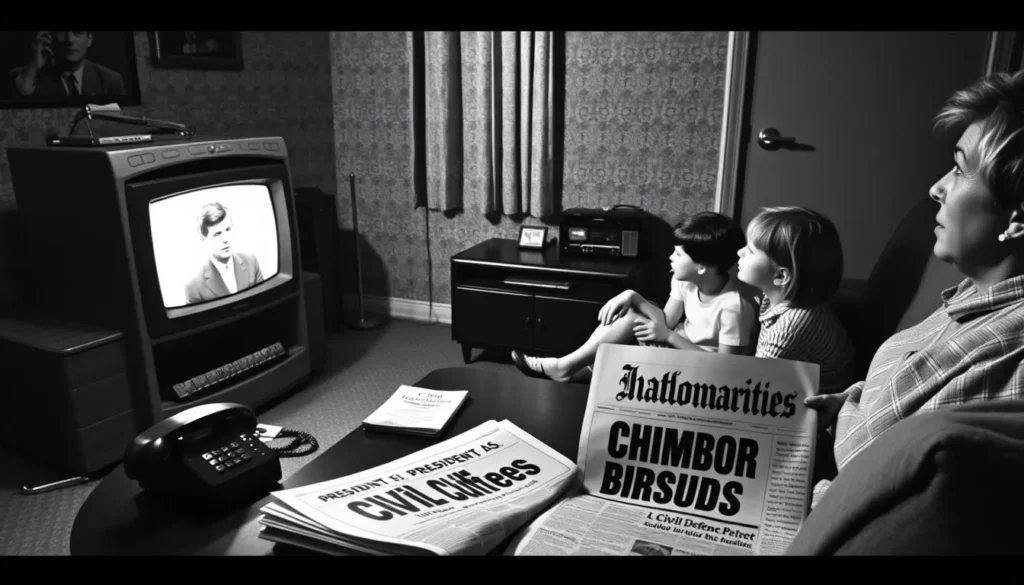
On the evening of October 22, 1962, ordinary Americans interrupted dinners, homework, and shift work to gather around television sets and radios. President John F. Kennedy began: “Good evening, my fellow citizens.” He told them that U.S. surveillance had found “a series of offensive missile sites” in Cuba and that the Soviet Union had lied about the purpose of its military build-up. In Miami, seven-year-old Marta Maria Darby remembered the adults saying “the world is going to end.” Across the country, families listened for the word “quarantine,” studied maps of the Caribbean, and wondered whether the next morning would bring war. The crisis was not only a diplomatic confrontation between Washington and Moscow; it was also a public-information event. What ordinary Americans were told—by the president, newspapers, radio, civil-defense officials, and rumor—shaped how they understood the most dangerous weeks of the Cold War.
What Happened?
The public learned of the crisis only after weeks of secret discovery. On October 14, 1962, a U.S. U-2 spy plane piloted by Maj. Richard Heyser photographed missile sites in Cuba. On October 16, Kennedy convened the Executive Committee of the National Security Council, known as ExComm. For six days, the administration debated air strikes, invasion, and blockade while the public remained uninformed.
- October 14: U-2 photographs reveal medium-range ballistic missile sites in Cuba.
- October 16: Kennedy forms ExComm and receives options for military action.
- October 22: Kennedy addresses the nation on television and radio, announcing a naval “quarantine” of Cuba and demanding removal of the missiles.
- October 24: The quarantine goes into effect; Soviet ships approaching the line slow or turn back.
- October 26: Khrushchev sends a long, emotional letter to Kennedy proposing mutual concessions.
- October 27: “Black Saturday.” A U-2 is shot down over Cuba, killing Maj. Rudolf Anderson; Robert Kennedy meets Soviet Ambassador Anatoly Dobrynin and conveys a secret assurance that U.S. Jupiter missiles in Turkey will be removed later.
- October 28: Khrushchev announces that the missiles will be dismantled and returned to the Soviet Union; the public hears the resolution through radio and television.
For ordinary Americans, the crisis was experienced as a sequence of official announcements, headlines, and rumors rather than as a clear diplomatic narrative. The government told them that offensive weapons existed, that a quarantine was in force, and that any missile launched from Cuba would be treated as a Soviet attack. It did not tell them about the secret ExComm debates, the full scale of the Soviet deployment, or the back-channel deal over Turkey.
How It Was Seen at the Time
Contemporary language was blunt and legalistic. Kennedy called the naval measure a “quarantine” rather than a “blockade,” because a blockade was traditionally an act of war. Newspapers often used the more familiar word “blockade” anyway. The public was told that the United States faced a direct nuclear threat, that Soviet ships would be challenged, and that the military was ready for retaliation. The mood was a mixture of resolve, fatalism, and improvisation.
“It shall be the policy of this Nation to regard any nuclear missile launched from Cuba against any nation in the Western Hemisphere as an attack by the Soviet Union on the United States, requiring a full retaliatory response upon the Soviet Union.” — President John F. Kennedy, October 22, 1962
Many Americans understood the crisis through civil-defense vocabulary: fallout shelters, sirens, CONELRAD, and duck-and-cover drills. Others heard it through family conversations about where to go if the bombing started. The official message was that survival might depend on preparation; the private message in many homes was that preparation might not be enough.
“I remember when the announcement happened and my family reacted with: The world is going to end.” — Marta Maria Darby, seven years old in Miami
Historical Snapshot
| Aspect | Detail |
|---|---|
| Date | October 14–28, 1962 |
| Place | Washington, Cuba, the Caribbean, and American homes |
| People | John F. Kennedy, Nikita Khrushchev, ExComm, and ordinary Americans |
| What Happened | U.S. surveillance discovered Soviet missile sites in Cuba; Kennedy announced a quarantine; Khrushchev agreed to remove the missiles. |
| Why It Mattered | The closest the Cold War came to nuclear war; public information and civil defense became central to daily life. |
Contemporary Newspaper Coverage
On October 23, 1962, The New York Times put the crisis across its front page under the banner headline “Kennedy Orders Blockade on Cuba,” even though the president had carefully called the measure a “quarantine.” The paper printed the text of Kennedy’s address and maps of the Caribbean. The Washington Post and the Miami Herald likewise filled their front pages with the confrontation, wire-service reports, and official statements. Local papers carried civil-defense notices alongside the diplomatic news.
“Within the past week, unmistakable evidence has established the fact that a series of offensive missile sites is now in preparation on that imprisoned island.” — President John F. Kennedy, October 22, 1962
Press coverage emphasized the immediacy of the danger: Soviet ships were approaching the quarantine line, U.S. forces were on alert, and the next move might be war. For readers far from Washington, the newspaper was often the first place where the scale of the confrontation became concrete. Headlines used words such as “blockade,” “missiles,” “retaliation,” and “crisis,” while inside pages carried photographs of missile sites, maps of Cuba, and instructions for civil defense.
Eyewitness Accounts
Marta Maria Darby was seven years old and living in Miami when the crisis broke. Her account, recorded by NPR in 2012, captures how official warnings filtered into family life. The adults in her household did not speak in the language of ExComm or strategic balance; they spoke of the end of the world and of where a strike might fall first.
“I remember when the announcement happened and my family reacted with: The world is going to end… I didn’t sleep for days. It was quite frightening.” — Marta Maria Darby, interviewed by NPR in 2012
She also remembered the sudden arrival of duck-and-cover drills at school. The drills were meant to teach children what to do in a nuclear attack, but even a child could see the gap between the exercise and the weapon.
“They would … say OK, when you hear the alarm, you dive under your desk. And I remember, even as a child, thinking, like, really? This is going to prevent a bomb from destroying us?” — Marta Maria Darby
Her account shows that what ordinary Americans were told did not simply arrive as information. It was translated into family anxiety, school routine, and whispered speculation about whether Cuban Americans might face suspicion or internment.
What People Knew at the Time
| What People Knew Then | What We Know Now |
|---|---|
| The United States had discovered Soviet missile sites in Cuba and demanded their removal. | The Soviet deployment included dozens of missiles, tactical nuclear weapons, and troops; the U.S. public was told only part of the picture. |
| Kennedy had ordered a quarantine and warned that a missile launch from Cuba would bring full retaliation. | Kennedy secretly assured the Soviets that U.S. Jupiter missiles in Turkey would be removed after the crisis. |
| Civil-defense drills and fallout shelters might help families survive a nuclear attack. | Duck-and-cover and improvised shelters offered limited protection against blast, fire, and fallout in target areas. |
The public knew enough to be frightened and not enough to understand how close the crisis came to spinning out of control. Ordinary Americans were told that the fate of the world rested on the removal of missiles from Cuba. They were not told that a secret bargain over Turkey, or a single submarine commander’s decision, might also shape the outcome.
What People Feared
Fear was rational and widespread. A Gallup poll cited by the BBC found that one in five Americans thought a third world war was about to break out. Radio stations carried advertisements with tips on how to survive a nuclear holocaust. Families stocked canned goods, discussed evacuation routes, and wondered whether Washington, New York, or Miami would be hit first. The BBC reported that U.S. officials themselves prepared farewell letters and evacuation plans for their families.
“I didn’t think any of us were going to survive. It didn’t make a lot of sense to do any planning because it wasn’t going to work.” — Gen. William Y. Smith, then a Pentagon staff officer
Some fears were less rational but no less real. Cuban-American children in Miami worried that they might be treated like Japanese Americans during the Second World War. Darby recalled whispers that “maybe they’ll take us away and hide us somewhere.” No mass internment occurred, but the fear revealed how thoroughly the crisis had unsettled assumptions about loyalty and belonging.
What the Sources Got Wrong
Contemporary official statements and press accounts contained errors and omissions. Soviet diplomats had repeatedly assured U.S. officials that the arms sent to Cuba were defensive. On September 4, 1962, Ambassador Anatoly Dobrynin told Attorney General Robert Kennedy that the Soviet Union would not place offensive missiles in Cuba. On October 18, Foreign Minister Andrei Gromyko told Kennedy that Soviet aid to Cuba was defensive. Those assurances were false, and the public learned on October 22 that offensive missile sites existed.
The press also simplified the legal language of the crisis. Kennedy called the naval measure a “quarantine” to avoid the formal meaning of blockade, but many newspapers used “blockade” because it was more familiar. That was not a lie, but it blurred the legal distinction the administration was trying to preserve. Civil-defense materials, meanwhile, often implied that ducking under a desk or stocking a shelter could make survival likely. Later nuclear testing and historical analysis showed that such measures offered little protection against a direct blast or widespread fallout.
Most significantly, ordinary Americans were not told about the secret Turkey missile deal. The public understood the resolution as a Soviet withdrawal under pressure. The historical record later revealed that Kennedy had privately assured the Soviets that U.S. missiles in Turkey would be removed after the crisis, a concession that was kept out of the public settlement.
The primary sources from October 1962 show a public deliberately informed of danger but selectively informed of diplomacy. What ordinary Americans were told was enough to make them fear nuclear war, prepare for survival, and follow the headlines day by day. It was not the whole story. The gap between the official message and the secret record remains one of the most revealing features of the Cuban Missile Crisis.
FAQ
What did ordinary Americans learn from Kennedy’s October 22 speech?
They learned that U.S. surveillance had found offensive Soviet missile sites in Cuba, that Kennedy was imposing a “quarantine,” and that any missile launch from Cuba would be treated as a Soviet attack requiring full retaliation. The speech did not reveal the secret ExComm debates or the later deal over U.S. missiles in Turkey.
Did Americans know how close the crisis came to nuclear war?
Many feared it. A Gallup poll cited by the BBC found that one in five Americans thought a third world war was about to break out. But the public did not know details such as Soviet tactical nuclear weapons in Cuba, the secret back-channel negotiations, or the full danger of the October 27 U-2 shootdown.
What was duck-and-cover?
Duck-and-cover was a civil-defense drill in which schoolchildren were told to hide under desks when alarms sounded. Many children, like Marta Maria Darby, doubted it would protect them from a nuclear bomb, and later analysis confirmed that such drills offered little protection against blast or fallout.










Leave a Reply