
Short Answer
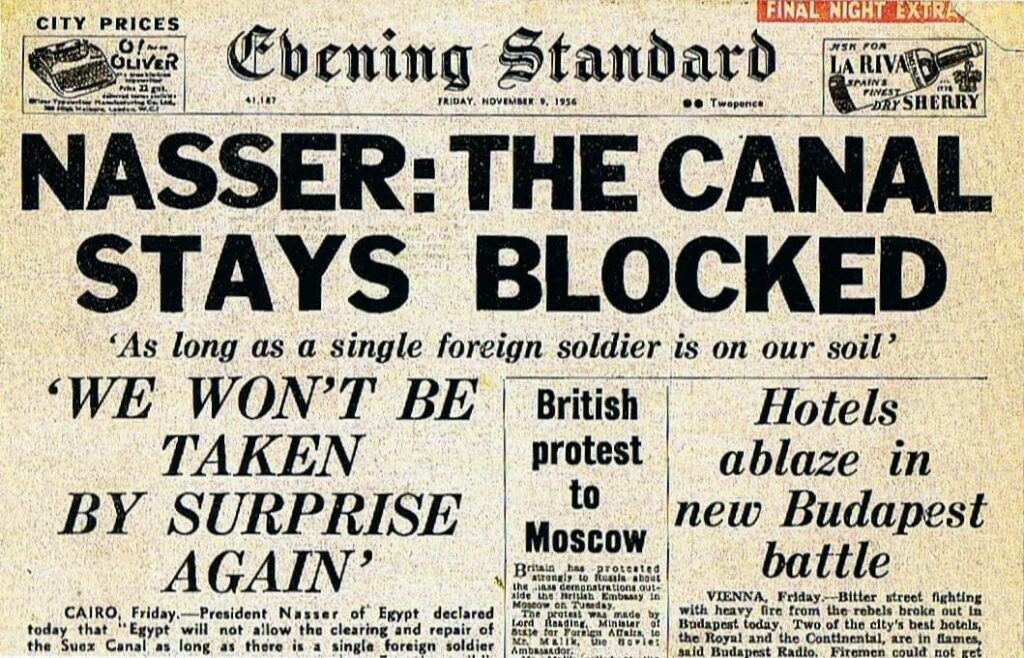
On the evening of July 26, 1956, Egyptian President Gamal Abdel Nasser stood before a crowd in Alexandria and declared that the Suez Canal—the lifeline of empire, the artery of global oil trade—belonged to Egypt. The announcement, broadcast across the world, caught governments and publics off guard. In London, Prime Minister Anthony Eden saw it as a personal affront; in Paris, the French government fumed over Nasser’s support for the Algerian revolt; in Washington, President Dwight Eisenhower urged calm. As the news spread, newspapers from Cairo to Chicago scrambled to make sense of a crisis that would topple a British prime minister, expose the limits of imperial power, and reshape the Middle East. For readers in the autumn of 1956, the Suez crisis was not a distant colonial footnote—it was a daily drama of ultimatums, troop movements, and oil shortages, played out in the pages of the world’s press.
What Happened?
The Suez Canal, opened in 1869, was built by French engineers and largely controlled by British and French interests. It served as a vital artery for oil and goods between Britain and its colonies. In July 1956, Nasser announced the nationalization of the canal, intending to use its revenues to fund the construction of the Aswan Dam, a key project for Egypt’s modernization (AP News, n.d.). The move was a direct challenge to British and French influence in the region.
Following the nationalization, Britain and France, joined by Israel, launched a military intervention. The key events unfolded as follows:
- July 26, 1956: Nasser nationalizes the Suez Canal Company, seizing control of the waterway.
- October 29, 1956: Israel invades the Sinai Peninsula, with collusion from Britain and France.
- October 31, 1956: Britain and France issue an ultimatum and begin bombing Egyptian positions.
- November 5–7, 1956: Anglo-French forces land in Port Said and advance along the canal.
- November 6, 1956: Under intense diplomatic and economic pressure, Britain and France agree to a ceasefire.
- December 1956: Anglo-French forces withdraw, followed by Israeli forces.
- March 1957: Egypt reopens the canal to traffic.
The military operation was a success, but the political consequences were devastating for Britain and France. The United States and the Soviet Union pressured them to withdraw, and the United Nations played a decisive role in establishing a peacekeeping force.
How It Was Seen at the Time
Contemporary observers viewed the crisis through the lens of the Cold War and the decline of European empires. In Britain, Prime Minister Anthony Eden was determined to topple Nasser, whom he compared to Hitler. The press, however, was not uniformly bellicose. According to a 1994 study of government-press relations during the Suez crisis, Eden’s propaganda strategy was remarkably successful in enlisting Fleet Street’s support, despite his reputation as a press victim. The study notes:
“Fleet Street was on the whole consistently more aggressive than was public opinion. This has implications not only for our understanding of the Suez crisis, but also for the much-vaunted strength and independence of Britain’s press.” (Government manipulation of the press, 1994)
In the United States, newspapers largely viewed Nasser’s nationalization as an act of sovereign right, though they were concerned about the canal’s importance to the global economy. The Washington Post and New York Times editorialized in favor of diplomatic solutions. In Egypt, the press celebrated Nasser’s move as a victory over colonialism, with state-run outlets hailing the return of the canal to Egyptian hands.
Contemporary Newspaper Coverage
Newspapers around the world devoted enormous attention to the crisis. A search of historical newspapers reveals over 7 pages from 1956–1957 tagged with “Suez Canal Crisis” in the History Worm archive, including titles such as the Chicago Tribune, Washington Post, Los Angeles Herald, San Francisco Call, and The Times Dispatch (History Worm, n.d.). The coverage was intense, with front-page headlines and extensive editorials.
One notable example is the Associated Press wire story published on the nationalization, which reported that Nasser’s move was “to help fund construction of the Aswan Dam” (AP News). The story framed the nationalization as a decisive break with Egypt’s colonial past. The Daily Worker and other left-wing papers in Britain expressed sympathy for Nasser, while conservative papers like the Daily Telegraph called for decisive action. The press in France, especially Le Monde, was deeply concerned about Nasser’s support for the Algerian insurgency and demanded a firm response.
An important academic study of press performance during the crisis, later published by Harold Evans (who was a journalist at the time), analyzed the factual accuracy of twenty days of coverage. The study found that newspapers often mixed fact with commentary, and that many papers gave disproportionate space to non-factual material in their news columns (Evans, 1965). This suggests that even contemporary readers were exposed to a blend of information and editorial interpretation.
Different Perspectives
The British Government and Press
The British government, led by Eden, saw the nationalization as a direct threat to British interests. The press, with few exceptions, supported the government’s stance, albeit with varying degrees of enthusiasm. The Daily Express and Daily Mail were bellicose, while the Manchester Guardian and Observer were more cautious. Eden’s propaganda strategy, as documented by historians, involved briefing editors and using official channels to shape coverage (Government, 1994).
The Egyptian View
Egyptian newspapers, such as Al-Ahram, celebrated the nationalization as a triumph. Nasser’s speech was broadcast live on radio, and the Egyptian public saw him as a hero who had reclaimed Egyptian dignity. The nationalization was framed as a step toward economic independence and the construction of the Aswan Dam, which was a symbol of modernization.
The American Perspective
The United States was officially neutral, but President Eisenhower was furious with the Anglo-French invasion, which he saw as a betrayal of the UN Charter. American newspapers, including the New York Times, were divided, but many questioned the wisdom of military action. The Washington Post editorialized that the invasion was a “reckless act” that threatened to destabilize the region.
The Israeli Perspective
Israel saw an opportunity to end the Egyptian blockade of the Gulf of Aqaba and to destroy guerrilla bases in the Sinai. The Israeli press portrayed the operation as a necessary defense measure, though it was later revealed that Israel had colluded with Britain and France.
What People Feared
Contemporaries feared several outcomes. The most immediate was the disruption of oil supplies. The canal was a critical route for Middle Eastern oil to Europe, and any closure threatened to cause fuel shortages and economic recession. The British government even considered rationing petrol. There was also fear of a wider war, potentially drawing in the United States and the Soviet Union. In Britain, many worried about the nation’s international standing and its relationship with the United States. In the Middle East, there was fear that the invasion would bring back colonial rule, and Nasser’s supporters feared an assassination or coup.
What People Expected Would Happen Next
In the immediate aftermath of the nationalization, many observers expected a quick diplomatic resolution. The British and French believed that Nasser would be forced to back down under pressure. When the invasion came, they expected a swift victory and the overthrow of Nasser. Instead, the international community, including the United States and the Soviet Union, demanded a ceasefire. Many commentators predicted that the crisis would lead to a permanent breakdown in Anglo-American relations, but in fact the two countries repaired their alliance. Others expected that the crisis would embolden Arab nationalism, which it did, and that the canal would be closed for a long time, but it reopened in March 1957.
Aftermath
The immediate aftermath was a political catastrophe for Britain. Prime Minister Eden resigned in January 1957, citing ill health. The crisis marked the end of Britain’s status as a global imperial power. France, too, was humiliated, and the episode hardened French resolve to pursue its own nuclear deterrent. For Egypt, Nasser emerged as a hero of the Arab world, and the canal was reopened under Egyptian control. The United Nations established a peacekeeping force (UNEF) to patrol the Sinai, a precedent for future peacekeeping missions. The crisis also accelerated the process of decolonization across Africa and Asia.
How Historians See It Today
Contemporary observers saw the Suez Crisis as a Cold War flashpoint and a test of the Anglo-American alliance. Historians today, however, view it as a watershed moment in the collapse of European empires and the rise of post-colonial nationalism. The role of the press has been re-examined. Early studies, like Harold Evans’s thesis, focused on the performance of newspapers in reporting the facts. More recent scholarship, such as the 1994 article on government manipulation, emphasizes the extent to which the British government actively sought to shape press coverage. Historians now also stress the importance of the crisis in the Middle East, and how it radicalized the Arab world. The crisis is often seen as a turning point after which the United States and the Soviet Union dominated the Middle East, and it also highlighted the limits of military force in the post-war era.
In conclusion, the Suez Crisis, as seen through contemporary newspapers, was a moment of high drama and uncertainty. The press, with all its biases and errors, captured the fear, the hopes, and the confusion of a world in transition. The primary sources—the newspapers, the speeches, the government documents—reveal a world that was still clinging to the old order while being forced to acknowledge the new. The crisis was not just a military defeat for Britain and France; it was a media event that shaped public opinion and accelerated the course of history.
FAQ
What was the immediate cause of the Suez Crisis?
The immediate cause was Egyptian President Gamal Abdel Nasser's nationalization of the Suez Canal Company on July 26, 1956. Nasser sought to use the canal's revenues to fund the construction of the Aswan Dam, which had been denied Western financing. Britain and France, which had controlled the canal, saw the move as a direct threat to their imperial interests and economic security.
How did the press report the Suez Crisis?
The press reported the crisis extensively, with newspapers such as the Washington Post, The Times, and the Daily Worker covering the events daily. The tone varied: British conservative papers were often aggressive and supportive of the government's military response, while left-wing papers and some American papers were critical. The press also reflected the government's propaganda efforts, as demonstrated by the 1994 study on the manipulation of the press.
What was the outcome of the Suez Crisis?
The outcome was a military failure for Britain and France. They were forced to withdraw under international pressure, including from the United States and the Soviet Union. The crisis led to the resignation of British Prime Minister Anthony Eden and marked the end of Britain's imperial era. Egypt retained control of the canal, and the canal was reopened in March 1957.












Leave a Reply