
Short Answer
In the early hours of January 31, 1968, as Vietnamese families gathered for the Lunar New Year—Tet—the crackle of firecrackers gave way to the rattle of machine guns and the thud of rockets. Communist forces launched a wave of coordinated surprise attacks across South Vietnam, turning cities and towns into battlefields. In Saigon, South Vietnamese Rangers dragged wounded comrades across streets swept by Viet Cong machine-gun fire. In the imperial city of Hue, U.S. and South Vietnamese Marines fought block by block to crush North Vietnamese remnants inside the Citadel. For Americans reading the morning papers, the images were jarring: a war they had been told was turning decisively in their favor had suddenly erupted at the heart of the South. This article reconstructs the Tet Offensive as it was experienced, reported, and recorded at the time—through the dispatches of a New Yorker correspondent, the lens of wire photographers, and the dry language of official military after-action reports.
What Happened?
Early on the morning of January 31, 1968, while Vietnamese civilians celebrated the Lunar New Year, Communist forces launched a wave of coordinated surprise attacks across South Vietnam. The campaign, described by the Associated Press as one of the largest of the Vietnam War, led to intense fighting and heavy casualties in cities and towns across the South. The attacks struck not only remote provinces but the capital, Saigon, and the ancient city of Hue, signaling a level of coordination that surprised both the American command and the South Vietnamese government.
- January 31, 1968: Communist forces launch coordinated surprise attacks across South Vietnam during the Tet holiday.
- Saigon: Viet Cong units infiltrate the capital; South Vietnamese Rangers engage in street fighting under heavy machine-gun fire.
- Hue: U.S. and South Vietnamese Marines struggle to crush North Vietnamese forces holding the Citadel; fighting continues through February.
- February 18, 1968: The U.S. Army II Field Force Vietnam ends its after-action reporting period for the offensive, covering 31 January to 18 February in the III Corps Tactical Zone.
How It Was Seen at the Time
For contemporaries, the Tet Offensive was not merely a military engagement but a psychological rupture. Robert Shaplen, writing in The New Yorker in the immediate aftermath, described a Saigon that was “militarily shattered, politically divided, and newly vulnerable to Hanoi’s terms” (March 2, 1968). Three weeks later, he reported that “Saigon’s allies divided, Hue in ruins, and Communist forces preparing their next move” (March 23, 1968). The language of the time was one of shock and uncertainty—the war was no longer a distant conflict but a present, visceral reality in the streets of the capital.
“In the aftermath of Tet, a correspondent finds Saigon’s allies divided, Hue in ruins, and Communist forces preparing their next move.”
— The New Yorker, March 23, 1968
Historical Snapshot
| Aspect | Detail |
|---|---|
| Date | January 31 – February 18, 1968 |
| Place | Republic of Vietnam (III Corps Tactical Zone, Saigon, Hue) |
| People | Communist forces (Viet Cong and North Vietnamese), U.S. Marines, South Vietnamese Marines and Rangers |
| What Happened | Coordinated surprise attacks across South Vietnam during the Tet holiday |
| Why It Mattered | It shattered the narrative of American progress, divided South Vietnam’s allies, and exposed Saigon to Hanoi’s terms |
Contemporary Newspaper Coverage
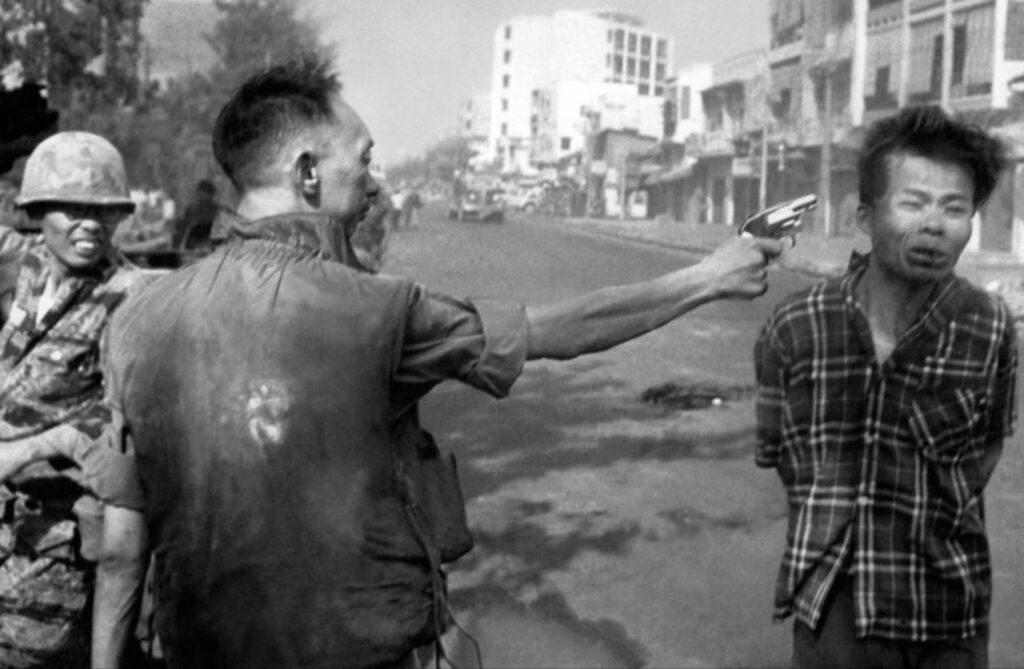
The American press covered the Tet Offensive with a mixture of urgency and bewilderment. The Associated Press provided wire reports and photographs from the ground, while The New Yorker ran a series of “Letter from Saigon” dispatches by Robert Shaplen, published on March 2 and March 23, 1968. Shaplen’s columns were among the most detailed contemporary accounts, tracing the offensive’s impact on the capital and the country. The AP photographs, taken in the field, offered raw, unposed images: South Vietnamese Rangers carrying a wounded comrade across a Saigon street under Viet Cong fire (February 6, 1968), and U.S. Marines being evacuated from battle areas near Hue’s University on a “mule” cart (February 20, 1968).
“A motorized cart, called a ‘mule,’ carries wounded U.S. Marines from battle areas to a first aid station near the University of Hue.”
— AP News, February 20, 1968
The tone of the coverage was somber and often critical, reflecting a growing gap between official optimism and on-the-ground reality.
Eyewitness Accounts
Photographs served as eyewitness evidence for millions who would never set foot in Vietnam. The AP photo of February 6, 1968, shows South Vietnamese Rangers struggling to carry a wounded comrade across a Saigon street under machine gun fire from the Viet Cong—a moment of raw combat that brought the war into American living rooms. A second photograph, taken on February 20, 1968, near the University of Hue, depicts U.S. Marines being transported from battle areas on a “mule” cart while their units continued to fight remnants of North Vietnamese forces in the Citadel. These images, circulated widely, gave the public a visceral sense of the violence that the official communiqués often sanitized.
Official Reports
The U.S. Army’s II Field Force Vietnam After Action Report, dated 31 January to 18 February 1968, provides the military’s official record of the campaign in the III Corps Tactical Zone, which included Saigon and surrounding provinces. The report was classified and later downgraded to unclassified. It lists the operation’s dates, location, and command structure, and serves as a stark counterpoint to the more emotional press coverage. While the press emphasized chaos and shock, the official report used the language of military operations, covering the same period with a focus on unit movements, command decisions, and combat statistics—a reminder that the war was simultaneously a lived catastrophe and a bureaucratic exercise.
What People Expected Would Happen Next
In the weeks after Tet, contemporaries were uncertain what the future held. Robert Shaplen’s March 23, 1968, dispatch reported that Communist forces were “preparing their next move,” suggesting that the offensive was not a one-time assault but the beginning of a new phase of the war. The same article noted that Saigon had become “newly vulnerable to Hanoi’s terms,” a phrase that captured the fear that South Vietnam’s political and military position was deteriorating. Many Americans and South Vietnamese expected further attacks, deeper political divisions, and a prolonged conflict. The hope of an early victory, which had been cultivated by official statements, had evaporated; what remained was the expectation of a long, grinding war.
Aftermath
The immediate aftermath of the Tet Offensive was one of physical destruction and political reckoning. Hue was left in ruins, its ancient Citadel reduced to rubble, as the AP reported that U.S. and South Vietnamese Marines were “struggling to crush the remnants of North Vietnamese forces” in the Citadel. Saigon’s streets were scarred by fighting, and the city’s political leadership was divided. The offensive also exposed the vulnerability of the South Vietnamese government, which had been presented as stable and secure. In the months that followed, the American public’s confidence in the war effort was shaken, and the political landscape in Washington began to shift. The military campaign officially ended on February 18, 1968, but its political consequences would last for years.
Seen through the lens of contemporary reports—the dispatches of Robert Shaplen, the photographs of AP, and the pages of the U.S. Army’s after-action reports—the Tet Offensive was a turning point not only in the Vietnam War but in how Americans understood the conflict. The primary sources reveal a moment of profound uncertainty: a war that seemed to be heading for victory suddenly looked unwinnable, and the language of official confidence was replaced by the language of division and ruin. The sources teach us that history is not only what happened, but what people believed was happening at the time—and that belief, with all its fears and errors, shaped the course of the war itself.
FAQ
What was the Tet Offensive?
The Tet Offensive was a coordinated series of surprise attacks by communist forces (Viet Cong and North Vietnamese) launched across South Vietnam on January 31, 1968, during the Tet Lunar New Year holiday. It was one of the largest military campaigns of the Vietnam War, leading to intense fighting in cities and towns, including Saigon and Hue.
How did the press report the Tet Offensive at the time?
The press reported the offensive with a mix of shock and urgency. The New Yorker published 'Letter from Saigon' dispatches by Robert Shaplen, describing Saigon as 'militarily shattered, politically divided, and newly vulnerable to Hanoi's terms.' The Associated Press distributed wire photographs from the ground, such as images of South Vietnamese Rangers fighting in Saigon and Marines carrying wounded near Hue.
What was the military's official record of the offensive?
The U.S. Army II Field Force Vietnam produced an After Action Report covering the period from 31 January to 18 February 1968, documenting the combat operations in the III Corps Tactical Zone. The report was classified but later declassified, providing a formal military record of the campaign.









Leave a Reply