
Short Answer
In November 1936, as Nationalist troops encircled Madrid, the city’s defenders braced for what they believed would be a final assault. The British journalist Geoffrey Cox, who had arrived to cover the war, described the tension in the streets, the sandbagged barricades, and the determination of civilians who refused to flee. His eyewitness account, Defence of Madrid, captured a moment when the fate of the Republic seemed to hang in the balance. Across Spain, in villages and cities, ordinary men and women were caught in the same storm. Their voices—recorded in later oral histories by Ronald Fraser and Neil MacMaster—reveal the war not as a distant event but as a lived reality of fear, hope, and survival.
What Happened?
The Spanish Civil War began on 17–18 July 1936, when a group of army officers, led by Francisco Franco, launched a coup against the democratically elected Republic. The coup failed in Madrid and Barcelona, but succeeded in parts of the north and south, splitting the country into two armed camps: the Nationalists (conservatives, monarchists, and the Church) and the Republicans (socialists, communists, anarchists, and democrats). The conflict quickly escalated into a full-scale civil war that lasted until 1 April 1939.
Key events unfolded rapidly:
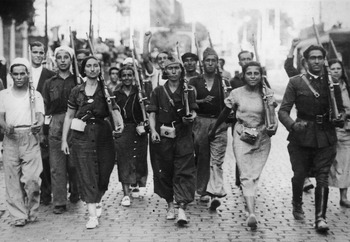
- July 1936: The military uprising is met with popular resistance, leading to the formation of armed militias.
- August–November 1936: Nationalist forces advance on Madrid; the Siege of Madrid begins in November.
- 1937–1938: The war spreads to the north, with the fall of Asturias and the Basque Country; foreign intervention (German and Italian aid to the Nationalists, Soviet and International Brigades to the Republicans) intensifies.
- January–February 1939: The fall of Catalonia and the collapse of Republican resistance.
- April 1939: The Nationalists capture Madrid and the Republic surrenders.
Oral histories, such as those in Blood of Spain by Ronald Fraser and Spanish Fighters by Neil MacMaster, provide personal testimonies of these events. In MacMaster’s book, a participant named David recounts the war in Asturias, the fall of the region, and his eventual exodus across the Pyrenees. Consuelo, another interviewee, describes her escape from Asturias and her time in French concentration camps.
How It Was Seen at the Time
Contemporaries understood the war as a decisive struggle between two irreconcilable visions of society. For many Republicans, it was a defense of democracy against fascism; for anarchists and leftists, it was also a social revolution. Nationalists framed it as a crusade to save Spain from atheism and communism. The language of the era was charged with ideological fervor. In the oral history Blood of Spain, survivors recall the deep sense of commitment and the belief that the war would decide the future of Europe.
The prevailing mood among Republicans was one of determination mixed with anxiety. As the Nationalists advanced, rumors of atrocities circulated, and the fear of reprisals shaped behavior. Journalists like Geoffrey Cox reported from the front, sending dispatches that emphasized the heroism of the defenders and the brutality of the siege. At the time, the international community was divided: while some governments remained neutral, volunteers from around the world joined the International Brigades to fight against fascism.
Historical Snapshot
| Aspect | Detail |
|---|---|
| Date | 17 July 1936 – 1 April 1939 |
| Place | Spain, including the fronts in Madrid, Asturias, Catalonia, and the Basque Country |
| People | Nationalists (led by General Franco) vs. Republicans (supported by leftist and anarchist groups) |
| What Happened | A military coup triggered a civil war that became a proxy conflict between fascism and democracy |
| Why It Mattered | The war foreshadowed the broader European conflict of World War II and left lasting scars on Spanish society |
What People Knew at the Time
| What People Knew Then | What We Know Now |
|---|---|
| They knew of the foreign intervention, especially from Italy and Germany, but not the full scale of the secret military aid. | We know that Germany and Italy provided significant aircraft, tanks, and troops, while the Soviet Union supplied arms to the Republicans. |
| They knew of atrocities on both sides, but many were exaggerated or downplayed for propaganda. | Later research has documented the systematic repression of the Nationalists and the violence of the Republican militias, though the total death toll remains debated. |
| They believed the war would be short and decisive. | The war lasted nearly three years, with a brutal attrition and the eventual victory of the Nationalists. |
Daily Life
Daily life during the war was shaped by scarcity, fear, and the constant threat of bombing. In Madrid, as the siege tightened, residents faced severe food shortages, long queues for bread, and the ever-present sound of artillery. The oral histories in Spanish Fighters describe how people in Asturias adapted to the disruption of agriculture and the arrival of refugees. Consuelo, one of the interviewees, recalls the harsh conditions in French concentration camps after her escape, where food was scarce and the cold was biting. In the Republican zone, the revolution also brought changes to daily life: workers’ collectives, the abolition of church property, and a new spirit of social equality. Yet the war also meant that families were separated, and the threat of arrest or execution was constant.
Aftermath
The Nationalist victory in April 1939 led to the establishment of Franco’s dictatorship, which lasted until his death in 1975. For many Republicans, the aftermath was exile. Thousands fled across the Pyrenees into France, where they were interned in concentration camps. The oral history of Consuelo in Spanish Fighters details her experience in the Aspres camp, followed by the coming of the Liberation. For those who remained in Spain, the aftermath was a brutal period of repression, with executions, imprisonment, and forced labor. The war also left deep social and economic scars, and the country remained politically divided for decades.
How Historians See It Today
Modern historians have moved beyond the traditional military and political narratives to focus on social history and the lived experiences of ordinary people. The oral histories collected by Ronald Fraser in Blood of Spain and by Neil MacMaster in Spanish Fighters have been instrumental in this shift. They allow historians to understand the war from the perspective of the civilians, the fighters, and the refugees, revealing the complexity of motivations and the long-term effects of the war on individuals. The field of oral history has also highlighted the importance of memory and the ways in which participants later reconstructed their experiences. Today, historians see the Spanish Civil War not only as a prelude to World War II but also as a social revolution and a human tragedy, whose echoes continue to shape Spanish identity.
The eyewitness accounts and oral histories of the Spanish Civil War offer an irreplaceable record of what it meant to live through a war that was both a national and an international conflict. They remind us that behind the statistics and the military strategies were real people who endured fear, loss, and hope. The voices of Geoffrey Cox, David, Consuelo, and countless others preserved in these archives, teach us that history is not just a sequence of events but a tapestry of human experience.
FAQ
What are the most important eyewitness accounts of the Spanish Civil War?
Key accounts include Geoffrey Cox's 'Defence of Madrid' (an immediate eyewitness report), Ronald Fraser's 'Blood of Spain' (a collection of oral histories from both sides), and Neil MacMaster's 'Spanish Fighters' (oral histories of refugees).
How did the oral histories change our understanding of the war?
They shifted focus from military and political leaders to the experiences of ordinary people, revealing the daily struggles, the emotional impact, and the long-term memories of the conflict.










Leave a Reply