
Short Answer
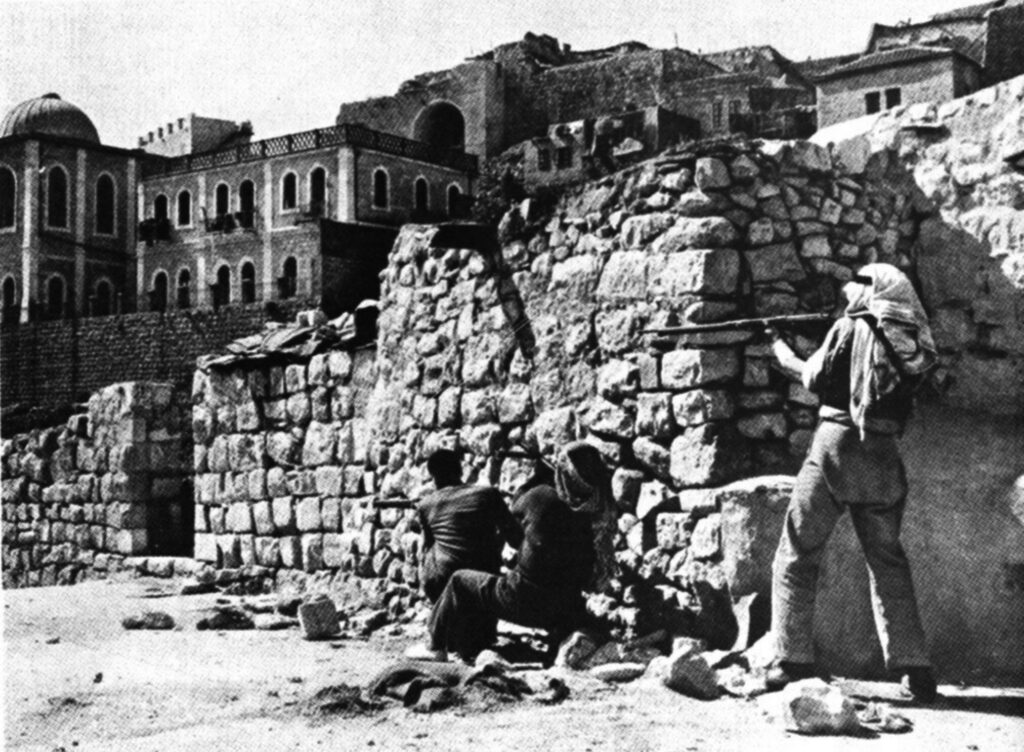
In May 1948, Jerusalem was a city under fire. On the morning of May 16, the Rev. Hugh Jones, rector of Christ Church, was celebrating an early service when a heavy explosion scattered glass and dust across the sanctuary. “It proved to be so noisy in Church,” he wrote in his diary, “that it was decided to hold the 10 a.m. Service and the evening Service in the School Hall.” The entire compound, excluding the Moslem families, turned up to both services. That evening, a mortar fell at the feet of two people but failed to explode. By 10 p.m., heavy explosions nearby forced the Hadawi family to abandon their upstairs rooms and sleep on the floor of the rector’s sitting room. A night of terror ended at 5:30 a.m. when a mortar exploded in the compound, peppering a car with shrapnel and breaking its windows. This was the daily reality of the siege that would shape the city for months.
What Happened?
The 1948 war in Palestine began after the United Nations voted on November 29, 1947, to partition the country into separate Jewish and Arab states. In Jerusalem, fighting erupted almost immediately between Jewish and Palestinian forces. As the British mandate ended on May 14, 1948, the State of Israel was declared, and neighboring Arab armies intervened. Jerusalem was split: the western districts were held by Jewish forces, while the eastern Old City and surrounding areas were contested. The Arab Liberation Army, commanded by Fauzi al-Qawuqji, entered Palestine in the first months of 1948 to aid the Arab side. In his memoirs, al-Qawuqji described how “the enemy started a series of violent attacks on all fronts” with the objective “to reach Jerusalem and rescue the 100,000 Jews there who were suffering from hunger, and then to occupy the whole city.”
For the Jewish population of Jerusalem, the siege meant isolation and bombardment. The city was cut off from the coastal plain, and convoys carrying food and supplies were frequently attacked. The Rev. Hugh Jones, rector of Christ Church from 1945 to 1964, kept a detailed diary of the period. On May 16th, he recorded that “a mortar fell in the Compound at the feet of two people but mercifully failed to explode.” His diary describes a night of “heavy explosions” and a mortar that hit at 5:30 a.m., damaging a car. The diary also notes that the church services were moved to the school hall due to the noise and danger. The Old City, where the Jewish Quarter was located, came under intense fire. A young Israeli soldier who fought there later dictated a harrowing account, published in Haaretz in 2019, describing how “our situation grew more desperate by the day. Every day we sent calls for help to the city. Apparently, from so many calls for help they stopped believing us.”
The fighting continued until a series of cease-fires in July 1948, with Jerusalem remaining divided. The Old City fell to the Jordanian Arab Legion on May 28, and the Jewish population of the Old City was expelled. The western part of Jerusalem was held by Israel and eventually became part of the state.
How It Was Seen at the Time
Contemporaries experienced the siege as a struggle for survival. Jewish residents of Jerusalem described the atmosphere in letters and diaries, as documented by the scholarly article “Jerusalem in 1948: A Contemporary Perspective” (Project MUSE). The article notes that these materials “describe how Jews in Jerusalem under siege felt, reacted, and perceived what they were going through,” including the “fragility of Jewish society and social tensions” and the responses of Holocaust survivors. The language was one of desperation and hope. The soldier’s account from the Old City is full of urgency: “Our calls for help became hysterical.” In contrast, the Arab commander al-Qawuqji saw the battle as a defensive struggle against an enemy that was “suffering from hunger” but nonetheless advancing. Rev. Jones, a neutral observer, recorded the chaos without taking sides, focusing on the impact on his congregation and the physical destruction. The prevailing mood was one of fear and uncertainty, with civilians on all sides uncertain about the future.
Historical Snapshot
| Aspect | Detail |
|---|---|
| Date | November 29, 1947 – July 18, 1948 (with ceasefires) |
| Place | Jerusalem, divided between Jewish and Arab areas |
| People | Jewish civilians and fighters, Arab Liberation Army, British forces (until May 1948), Rev. Hugh Jones |
| What Happened | Jerusalem was besieged and bombarded; the Jewish Quarter of the Old City fell in May 1948; the city was divided along the armistice lines. |
| Why It Mattered | The siege determined the status of Jerusalem, leading to its division between Israel and Jordan until 1967. |
Eyewitness Accounts
The Rev. Hugh Jones’s diary provides one of the most detailed day-by-day records of the siege. On May 16th, he wrote:
“One heavy explosion occurred during the early Celebration and scattered glass and dust in the Sanctuary and damaged one of the plain glass windows there. It proved to be so noisy in Church that it was decided to hold the 10 a.m. Service and the evening Service in the School Hall. The entire Compound (excluding the Moslem families) turned up to both these Services. During the morning a mortar fell in the Compound at the feet of two people but mercifully failed to explode.”
His diary also records the terror of the night: “At 10 p.m., some very heavy explosions occurred nearby and Mr. and Mrs. Hadawi and their two children who were sleeping upstairs in the Parsonage, came down and spent the night with me on the floor in my sitting room.”
From the Jewish side, a soldier who fought in the Old City dictated a long-lost account, later published by Haaretz. He described the hopelessness: “Our situation grew more desperate by the day. Every day we sent calls for help to the city. Apparently, from so many calls for help they stopped believing us.”
Arab commander Fauzi al-Qawuqji provided a different view: “While Arab resistance was gradually being wiped out in Jaffa, the enemy started a series of violent attacks on all fronts. The main object of these attacks was, in the long run, to reach Jerusalem and rescue the 100,000 Jews there who were suffering from hunger.”
Letters & Diaries
In addition to Rev. Jones’s diary, the letters and diaries of Jewish civilians provide insight into the daily experience of the siege. According to the Project MUSE article “Jerusalem in 1948: A Contemporary Perspective,” these materials describe “the atmosphere in the street, reactions to the growing number of casualties, varied attitudes to the Palestinian enemy, the fragility of Jewish society and social tensions, different gender perceptions of women and their roles in the war, and the responses of Holocaust survivors to the war.” These letters often expressed fear of starvation and a desire for a truce. For example, a letter from a Jewish mother might mention the difficulty of finding bread, while a fighter’s diary might record the shortage of ammunition. The soldier’s dictated testimony (published in Haaretz) is a personal account that he lost an eye in the battle for the Old City, illustrating the physical cost of the siege.
Different Perspectives
Jewish Civilians and Fighters
Jewish residents saw the siege as a battle for survival. They faced constant bombardment, food shortages, and the threat of a military defeat. The letters and diaries cited in the Project MUSE article reveal a mix of fear and determination. The soldier’s account from the Old City shows the despair of a trapped force, with calls for help going unanswered. Civilians, meanwhile, often focused on daily survival—the search for food, the need to shelter from mortars, and the hope for a ceasefire.
Arab Forces and Civilians
Arab forces, led by commanders like Fauzi al-Qawuqji, viewed the battle as an attempt to prevent the establishment of a Jewish state. Al-Qawuqji’s memoirs describe the Jewish enemy as “suffering from hunger” and portray the Arab attacks as a response to Jewish aggression. Arab civilians in Jerusalem also suffered from the fighting, though the sources we have focus mainly on the Jewish side. Rev. Jones’s diary mentions that the Moslem families in his compound did not attend the services, but they were also affected by the explosions, as the entire compound was exposed.
Neutral Observers
Rev. Hugh Jones, as an Anglican clergyman, offers a neutral perspective. His diary records the chaos and the impact on the church community, without taking sides. He notes that the entire compound, except the Moslem families, attended the services, indicating that the siege affected both communities. His account is valuable for its impartiality and its attention to the material conditions of life during the siege.
Daily Life
Daily life in besieged Jerusalem was a constant struggle. Rev. Jones’s diary describes how the church services were moved to the school hall because of the noise and danger. The mortar that fell at the feet of two people and the one that damaged the car illustrate the constant threat of death. Civilians spent nights in basements and on floors, as the Hadawi family did. Food and water were scarce, and the Jewish population was reportedly “suffering from hunger” according to al-Qawuqji. The soldier’s account describes the desperate situation in the Old City, where the defenders were running out of supplies and ammunition. The Project MUSE article notes that women took on new roles, and Holocaust survivors added to the social fabric. The daily routine was disrupted by bombings, with people moving between shelters and homes, trying to maintain some semblance of normalcy.
The siege of Jerusalem in 1948 was not just a military conflict; it was a human tragedy that shaped the city’s future. The primary sources—diaries, letters, and memoirs—offer a visceral record of fear, courage, and uncertainty. They remind us that history is not just a series of dates and battles, but the lived experience of ordinary people caught in extraordinary circumstances.
FAQ
What was the 1948 siege of Jerusalem?
The siege was a military blockade of Jerusalem during the 1948 Arab-Israeli war. Jewish-held areas were cut off from the rest of Israel, leading to shortages of food and supplies, while the Old City was captured by Jordanian forces. The siege ended with a ceasefire in July 1948.
Who were the main eyewitnesses?
Rev. Hugh Jones, an Anglican clergyman, kept a detailed diary. Jewish civilians wrote letters and diaries that are now studied by historians. Arab commander Fauzi al-Qawuqji also wrote memoirs, and a young Israeli soldier dictated an account of the fall of the Old City.



Leave a Reply