
Short Answer
Quick Snapshot
This article uses the most common encyclopedic meaning of the subject: Montgomery, Alabama, in 1955, with particular attention to the Montgomery bus boycott as documented in local newspapers and testimony. It is not a general history of the civil rights movement, but a focused reconstruction of how one city and its bus system became a national symbol.
At the beginning of 1955, Montgomery was a segregated state capital whose daily life was shaped by state government, two military airfields, railroads, cotton trade, and a bus system used heavily by African American workers. The city had an active black middle class, strong churches, and institutions such as Alabama State College, but public space remained rigidly divided by race.
The year is remembered for the arrest of Rosa Parks on December 1 and the mass protest that followed. On December 5, African Americans stayed off Montgomery City Lines buses, a mass meeting at Holt Street Baptist Church formed the Montgomery Improvement Association, and the Rev. Martin Luther King Jr. emerged as a spokesman. Local newspapers reported the protest, while testimony from participants preserved the arguments, fears, and hopes behind it.
Montgomery in 1955
Montgomery lies on the Alabama River in the state’s central Black Belt, a region long tied to cotton and plantation agriculture. In 1955 the city was both a governmental center and a market town for surrounding farms. Its climate was hot and humid in summer, with mild winters and seasonal thunderstorms.
The atmosphere was shaped by legal segregation. Streetcars had disappeared by the 1950s, and buses had become the main form of public transport for people without cars. White Montgomery and black Montgomery lived near one another but used separate schools, waiting rooms, churches, and seating arrangements. The state capitol, county courthouse, churches, and commercial streets made the city a stage for political ritual and protest.
Population & Economy
The 1950 census counted 106,525 people in Montgomery, and by mid-decade the city was probably home to roughly 110,000 residents. A substantial African American minority, roughly two-fifths of the population, lived mostly in segregated neighborhoods. The city was growing, but opportunity was uneven: black workers were concentrated in domestic service, manual labor, and segregated professional roles, while white residents dominated government, business, and the professions.
The economy rested on state government, Maxwell Air Force Base, Gunter Air Force Base, railroads, cotton and livestock trade, retail, and small manufacturing. Montgomery City Lines operated the buses that became central to the year’s events. Contemporary prices were modest by later standards: a loaf of bread cost about 18 cents, a newspaper about 5 cents, and a city bus fare about 10 cents. For working families, however, even a dime mattered, and the bus was essential.
Government & Politics
Montgomery was governed by a city commission, with William A. Gayle as mayor. At the state level, James E. “Big Jim” Folsom was governor. Local politics were dominated by segregationist assumptions, and the White Citizens Council and similar groups defended racial separation. The bus franchise, police power, and city code placed enormous discretion in the hands of public officials and bus drivers.
The political climate of 1955 was one of hardening resistance to racial change across the South. National developments, including the Supreme Court’s 1954 school desegregation decision and the murder of Emmett Till in Mississippi in August 1955, sharpened anxieties. In Montgomery, the bus boycott forced city officials to confront questions they had preferred to leave to custom and local ordinance.
Industry
Montgomery’s largest employers included state offices, the military installations at Maxwell and Gunter, railway shops, wholesale houses, cotton warehouses, and retail stores. The city was also a regional market for livestock and agricultural goods. Montgomery City Lines, though not a major industry, was a vital public utility whose segregated seating rules made it a flashpoint.
Employment was segregated by race and often by gender. African American women worked in domestic service and laundry; men worked in labor, trades, and service jobs. Black teachers, ministers, doctors, and lawyers served their own community. These professional and church networks would help organize the boycott and sustain it through car pools, meetings, and financial support.
Education
Public education was segregated by law. White students attended schools such as Sidney Lanier High School, while black students attended Booker T. Washington High School and other segregated institutions. Alabama State College for Negroes, later Alabama State University, was a center of black higher education; Huntingdon College served white students. Literacy was widespread, but educational resources were unequal.
Schools and colleges were not isolated from politics. Teachers and students discussed the bus situation, and black institutions provided meeting spaces and skilled leaders. The boycott would draw on the organizational discipline learned in churches, schools, and civic groups.
Transportation
By 1955, Montgomery’s streetcars were gone and buses dominated public transit. Montgomery City Lines required black passengers to sit from the rear and white passengers from the front, with drivers empowered to move the dividing line. Buses were crowded, and African Americans made up the majority of riders. The MIA later argued that about 75 percent of bus riders were black.
The city was also connected by railroads and highways, and the airport linked it to wider networks. But for many residents, the bus was the practical link between home, work, church, and downtown. A boycott therefore struck at the heart of daily routine, not merely at a symbol.
Everyday Life
Daily life in Montgomery was organized around family, church, work, and neighborhood. Housing was segregated, and black neighborhoods often had poorer services and overcrowded schools. Foodways combined Southern cooking with church suppers and garden produce. Clothing followed the fashions of the mid-1950s: hats, suits, dresses, and modest formal wear for public occasions.
Entertainment included radio, church socials, school events, movies, and, by 1955, local television through WSFA-TV. Churches were central social institutions. Segregation shaped ordinary encounters: where one sat, which door one used, how one addressed a police officer or bus driver. The boycott transformed these routines into political choices, as thousands of people walked, shared rides, and attended mass meetings.
Major Events
Earlier in 1955, Claudette Colvin was arrested in March for refusing to give up her bus seat, and Mary Louise Smith was arrested in October. These cases prepared the ground but did not produce a sustained campaign. On December 1, Rosa Parks was arrested after refusing to move from her seat. Within days, the Women’s Political Council and other activists called for a one-day boycott.
On December 5, the boycott held, and a mass meeting at Holt Street Baptist Church formed the Montgomery Improvement Association. The MIA elected King as president and issued demands for courteous treatment, first-come-first-served seating, and employment of black bus operators on predominantly black routes. Negotiations with city officials and the bus company deadlocked on December 8. On December 10, the MIA issued a public statement defending its position under Alabama law and the Montgomery City Code.
What Newspapers Were Reporting
Local newspapers, especially the Montgomery Advertiser and the Montgomery Alabama Journal, covered the arrest, the boycott, and the mass meetings. The Advertiser’s December 7 report by Joe Azbell carried the headline “At Holt Street Baptist Church: Deeply Stirred Throng of Colored Citizens Protests Bus Segregation.” The phrase captured the scale and emotion of the meeting, even as the paper’s framing reflected white editorial assumptions.
“At Holt Street Baptist Church: Deeply Stirred Throng of Colored Citizens Protests Bus Segregation” — Joe Azbell, Montgomery Advertiser, December 7, 1955.
The Advertiser also quoted portions of the MIA’s December 10 statement. The MIA insisted that segregation was not required by the cited state law in the way the bus company claimed, and it appealed for negotiation.
“We feel that there is no issue between the Negro citizens and the Montgomery City Lines that cannot be solved by negotiations between people of good will.” — Montgomery Improvement Association statement, December 10, 1955.
Newspaper coverage thus provides a chronology and official language, but it must be read critically. White-owned papers often treated the boycott as a disruption rather than as a claim to justice, while the MIA’s statements preserved the protesters’ legal reasoning and demands.
What People Were Talking About
Testimony and later accounts show that people talked about three practical demands: courteous treatment by drivers, seating on a first-come-first-served basis, and the hiring of black bus operators. They also debated the law. The MIA argued that the Alabama Act of July 18, 1947, authorized separate accommodations but did not require them, and that the Montgomery City Code did not force a passenger to surrender a seat unless another seat was vacant in the assigned section.
Beyond legal argument, conversation turned to economic pressure, car pools, and fear. Domestic workers worried about losing jobs; families shared rides and shoes wore out. Ministers urged nonviolence, while white segregationists denounced outside agitators. Rosa Parks’s own accounts, King’s Stride Toward Freedom, and Jo Ann Robinson’s memoir all testify to the mixture of weariness, courage, and organization that sustained the protest.
Historical Photographs
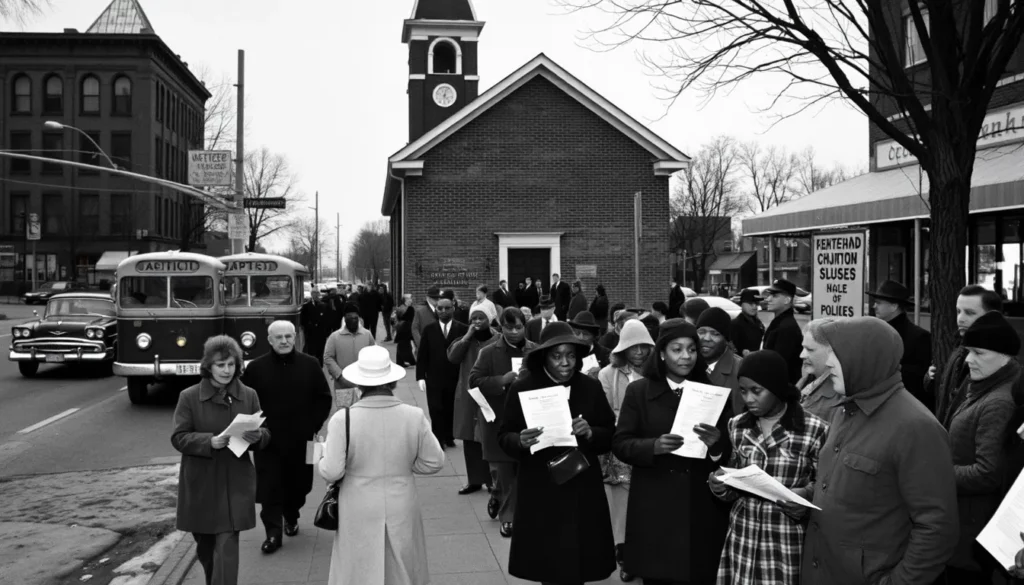
The visual record of Montgomery in 1955 includes press photographs of Rosa Parks being fingerprinted after her arrest, empty or partially empty city buses, boycotters walking along sidewalks, and mass meetings in churches. These images became iconic, but not all were taken on the same day or in the same circumstances. Local newspaper negatives, wire-service photographs, and personal collections held by archives preserve the visual evidence.
Photographs show the material world of the boycott: winter coats, hats, church interiors, bus stops, and the ordinary streets where politics happened. Because cameras were not everywhere, testimony remains essential for reconstructing the mass meetings, car-pool arrangements, and private conversations that photographs cannot capture.
Documents & Primary Sources
- Montgomery Advertiser and Montgomery Alabama Journal issues from December 1955, including Joe Azbell’s December 7 report.
- The Montgomery Improvement Association’s “Statement of Negro Citizens on Bus Situation,” December 10, 1955.
- Montgomery City Code provisions on bus seating and the Alabama Act of July 18, 1947.
- Rosa Parks’s arrest records, court documents, and later testimony.
- Martin Luther King Jr.’s papers, E.D. Nixon’s papers, and Jo Ann Robinson’s memoir.
1955 Timeline
| Date | Event |
|---|---|
| March 2, 1955 | Claudette Colvin is arrested for refusing to give up a bus seat. |
| October 21, 1955 | Mary Louise Smith is arrested in a separate bus incident. |
| December 1, 1955 | Rosa Parks is arrested after refusing to move from her seat. |
| December 5, 1955 | Montgomery bus boycott begins; MIA is formed at Holt Street Baptist Church. |
| December 7, 1955 | Montgomery Advertiser publishes Joe Azbell’s report on the Holt Street meeting. |
| December 8, 1955 | Negotiations between MIA representatives and city/bus officials deadlock. |
| December 10, 1955 | MIA issues its public statement on the bus situation. |
What Changed Next
The boycott continued into 1956. In Browder v. Gayle, federal courts struck down bus segregation; the Supreme Court affirmed the decision in November 1956, and the boycott ended on December 20, 1956. Montgomery had changed the national struggle. King became a national figure, the MIA became a model for nonviolent protest, and the bus boycott demonstrated that ordinary people, organized through churches and neighborhoods, could challenge segregation.
The year 1955 was not the end of segregation in Montgomery, but it was a turning point. The local newspapers and testimony from participants preserve how a city’s daily routine became a political argument, and how a bus seat became a question of citizenship.
Sources
- Joe Azbell, “At Holt Street Baptist Church: Deeply Stirred Throng of Colored Citizens Protests Bus Segregation,” Montgomery Advertiser, December 7, 1955, via Online King Records Access, https://okra.stanford.edu/link/document551207-000.
- “Statement of Negro Citizens on Bus Situation,” December 10, 1955, Martin Luther King, Jr. Papers Project, http://okra.stanford.edu/transcription/document_images/Vol03Scans/81_10-Dec-1955_Statement%20of%20Negro%20Citizens.pdf.
- Martin Luther King Jr., Stride Toward Freedom: The Montgomery Story (New York: Harper and Brothers, 1958).
- Jo Ann Gibson Robinson, The Montgomery Bus Boycott and the Women Who Started It, edited by David J. Garrow (Knoxville: University of Tennessee Press, 1987).
- Alabama Department of Archives and History, Montgomery city directories, maps, and local government records, Montgomery, Alabama.
FAQ
What was the population of Montgomery in 1955?
The 1950 census recorded 106,525 residents; mid-decade estimates place the city at roughly 110,000 people.
What major events happened in Montgomery in 1955?
Claudette Colvin and Mary Louise Smith were arrested earlier in the year; Rosa Parks was arrested on December 1; the bus boycott began December 5; and the Montgomery Improvement Association was formed that day.
What primary sources are available for studying Montgomery in 1955?
Key sources include Montgomery Advertiser issues, MIA statements, city code and state law records, Rosa Parks's arrest records, Martin Luther King Jr.'s papers, and memoirs by Jo Ann Robinson and others.
How did daily life in Montgomery in 1955 differ from today?
Public life was legally segregated; buses were central to daily travel; and African Americans faced restricted access to schools, jobs, and public accommodations. The boycott turned ordinary transit into a political struggle.







Leave a Reply