
Short Answer
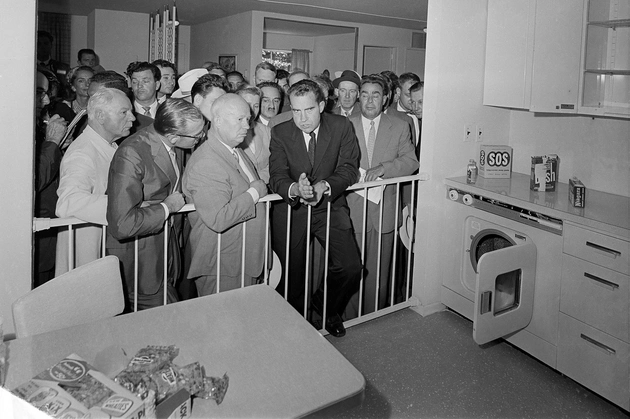
On the afternoon of July 24, 1959, inside a model kitchen at the American National Exhibition in Moscow’s Sokolniki Park, Vice President Richard Nixon and Soviet Premier Nikita Khrushchev stood face-to-face, trading barbs over washing machines, steel workers, and the fundamental merits of their respective systems. The exhibition’s centerpiece—a model American suburban home nicknamed “Splitnik” by the press, a play on Sputnik—had become the most famous room in the Cold War. Within minutes, a guided tour of a kitchen turned into a live, televised debate between the American way of life and Soviet communism. The “Kitchen Debate” would dominate front pages from Washington to Moscow for weeks.
What Happened?
Nixon arrived in Moscow on July 23, 1959, to open the American National Exhibition, a showcase of American consumer goods designed to counter Soviet claims of American decline. The exhibition was held in Sokolniki Park, and its centerpiece was a model home—a typical American suburban house complete with a modern kitchen. On July 24, Nixon and Khrushchev met in the exhibition’s kitchen, and the conversation quickly turned from appliances to ideology.
Nixon pointed to the dishwasher and said, “I want to show you this kitchen. It is like those of our houses in California.” Khrushchev replied, “We have such things.” Nixon responded, “This is our newest model. This is the kind which is built in thousands of units for direct installation in the houses. In America, we like to make life easier for women.”
Khrushchev: “Your capitalistic attitude toward women does not occur under Communism.”
Nixon: “I think that this attitude towards women is universal. What we want to do, is make life more easy for our housewives.”
The exchange escalated as Nixon made the case for American affordability. “This house can be bought for $14,000, and most American [veterans from World War II] can buy a home in the bracket of $10,000 to $15,000,” he said. “Let me give you an example that you can appreciate. Our steel workers as you know, are now on strike. But any steel worker could buy this house. They earn $3 an hour. This house costs about $100 a month to buy on a contract running 25 to 30 years.”
The transcript, recorded by the U.S. Embassy, cuts off as Khrushchev began his reply: “We have steel workers and peasants who can afford to spend…” The exchange continued, but the preserved record of that conversation remains a key primary source for understanding the debate.
How It Was Seen at the Time
For Americans, the debate was a moment of national pride. The press framed the exchange as a triumph of the American way of life, a demonstration that capitalism could provide the consumer goods that Soviet communism could not match. The model home, “Splitnik,” became a symbol of the American Dream, and the debate was seen as proof of American superiority.
The American press, however, was also struggling with the logistics of covering Nixon’s tour. TIME magazine’s August 10, 1959 report described the ordeal of the 73 U.S. newsmen accompanying the Vice President. “Let’s just try to finish the race on our feet, men,” mumbled the New York Daily News’s Frank Holeman, weary after a long night in the Grand Urals Hotel in Sverdlovsk. The Washington Star’s European Correspondent Crosby Noyes wrote:
“For the other tourists encountered along the way are regarded by now rather enviously as a happy, carefree lot. For them there are, presumably, no pre-dawn departures, no missed meals, no ghostly excursions into the night in search of elusive telegraph offices. Traveling with the Vice President is a progressive redefinition of roughing it.”
The reporters also faced “interminable, often unexplained Red-tape delays” that caused many dispatches to miss their U.S. deadlines. The only sure way to get copy back home was by telephone—the Associated Press held one circuit open for seven hours.
Historical Snapshot
| Aspect | Detail |
|---|---|
| Date | July 24, 1959 |
| Place | American National Exhibition, Sokolniki Park, Moscow, Soviet Union |
| People | Vice President Richard Nixon, Soviet Premier Nikita Khrushchev |
| What Happened | The two leaders exchanged a heated debate over the merits of capitalism versus communism, using a model American kitchen as the stage |
| Why It Mattered | The debate became a defining moment of the Cold War, symbolizing the ideological and cultural competition between the superpowers |
Contemporary Newspaper Coverage
American newspapers covered the Kitchen Debate extensively, framing it as a victory for Nixon and the American consumer culture. TIME’s August 10, 1959 article emphasized the challenges of the press corps: “The tour indeed had its trials. Despite a handsome time advantage in filing—seven hours in Moscow, eleven in Novosibirsk—many dispatches missed their U.S. deadlines because of interminable, often unexplained Red-tape delays.”
The American press also focused on the emotional impact of the debate. According to the study published in Istoriya, the televised coverage of the encounter, the preceding media campaign, and the subsequent wave of letters from Americans made it possible to trace how the emotional defense of familiar values merged with a growing curiosity toward the Soviet leader’s personality.
The Soviet press covered the debate differently. Khrushchev’s remarks were portrayed as a defense of the Soviet system against American claims. The Soviet perspective emphasized that the Soviet Union was not behind the West in material terms and that the American way of life was not a model to be emulated.
Letters & Diaries
One of the most revealing primary sources for the debate are the letters sent by American citizens to Khrushchev in the aftermath of the exchange. The Istoriya study draws on these letters, showing how the public discussion surrounding the model home “Splitnik” and questions about the accessibility of the “American way of life” shaped the emotional background for the reception of the debate.
The letters show that Khrushchev’s expressiveness, unexpected for the American audience, helped break the image of an enemy and inspired a desire for dialogue. Many Americans wrote to the Soviet leader, inviting him to visit their homes and cities. These letters are a testament to the power of the debate to humanize Khrushchev in the eyes of ordinary Americans, transforming him from a faceless adversary into a figure of curiosity.
Different Perspectives
The American Press
The American press saw the debate as a victory for the American way of life. Nixon’s focus on consumer goods—the dishwasher, the washing machine, the $14,000 house—was framed as proof that capitalism could deliver a better life for ordinary citizens. The model home was a symbol of the American Dream, and the debate was a demonstration of American superiority.
The Soviet Press
The Soviet press framed the debate as a defense of the Soviet system. Khrushchev’s remarks about the “capitalistic attitude toward women” and his insistence that “we have such things” were portrayed as a defense of Soviet values against American claims. The Soviet perspective emphasized that the Soviet Union was not behind in material terms and that the American way of life was not a model to be emulated.
What People Feared
The Kitchen Debate took place amid a backdrop of anxiety about Soviet technological and military power. The launch of Sputnik in 1957 had shaken American confidence, and Nixon’s emphasis on the American household was, in part, a response to that fear. The debate was a way of reassuring the American public that the United States was still the world’s most prosperous nation.
For the press corps, the fear was more immediate. The TIME article reported on the “interminable, often unexplained Red-tape delays” that threatened their deadlines. The fear of missing the story, of being caught in the Soviet bureaucratic machinery, was a constant concern for the 73 newsmen accompanying Nixon.
How Historians See It Today
Modern historians view the Kitchen Debate as a pivotal moment in the Cold War. It was a moment when the ideological and cultural competition between the two powers was played out not on a battlefield but in a kitchen, and it marked a shift in the focus of the Cold War from military might to economic and cultural influence. The debate is also seen as a moment of personal triumph for Nixon, who was able to present himself as a strong, confident defender of the American way of life.
Historians also note that the debate was a moment of humanization for Khrushchev. His expressiveness, captured on television, made him seem more human to the American public, and the letters that followed the debate show that the event had a genuine emotional impact on the American people.
While the primary sources at the time framed the debate as a triumph for the American way of life, historians today are more cautious, noting that the debate was as much about propaganda as it was about substance.
The Kitchen Debate of July 24, 1959, was a moment when the two superpowers met in a kitchen and fought a battle of ideas. The primary sources—the CIA transcript, the letters, the newspaper reports—tell us what it was like to be alive at that moment. The pride, the anxiety, and the uncertainty of the Cold War are all captured in that single exchange. The debate’s enduring legacy reminds us that the Cold War was fought not only with weapons but with ideas and the everyday objects of daily life.
FAQ
What was the Kitchen Debate?
The Kitchen Debate was a heated, informal exchange between Vice President Richard Nixon and Soviet Premier Nikita Khrushchev on July 24, 1959, at the American National Exhibition in Moscow. The two leaders argued over the merits of American capitalism versus Soviet communism, using a model American kitchen as the backdrop.
Why was the model home called 'Splitnik'?
The model home was nicknamed 'Splitnik' by the American press as a play on the Soviet satellite 'Sputnik,' which had been launched in 1957. The name highlighted the American claim that the model home was a cultural and technological achievement that rivaled Sputnik.








Leave a Reply