
Short Answer
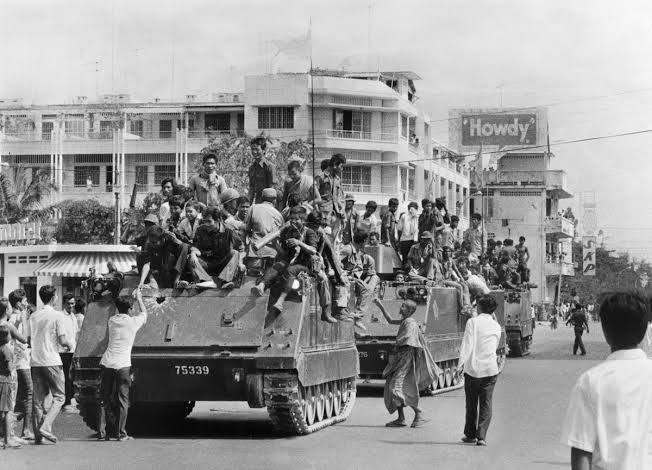
Dawn on April 17, 1975, broke over a Phnom Penh that had not known silence in five years. The artillery barrages of the Cambodian Civil War had suddenly ceased. The city, one of the last remaining strongholds of the Khmer Republic, was completely surrounded by the Communist-led Khmer Rouge and dependent on aerial resupply through Pochentong Airport. As the morning light rose over the capital, thousands of residents, exhausted by years of bloodletting, poured into the streets to welcome the approaching soldiers in black, hoping that peace had finally returned. But within hours, the conquerors revealed their true intent, ordering the city’s two million inhabitants into the countryside at gunpoint. The Fall of Phnom Penh was not a liberation—it was the beginning of a radical experiment that would consume a quarter of the Cambodian people.
What Happened?
The fall of Phnom Penh was the culmination of a brutal civil war that had ravaged Cambodia since 1970. By April 1975, the capital was one of the last remaining strongholds of the Khmer Republic, surrounded by Khmer Rouge forces and entirely dependent on aerial resupply through the airport. With the victory imminent, the United States government evacuated its nationals and allied Cambodians on April 12, a stark signal that the end was near.
On the morning of April 17, the Cambodian government surrendered. Colonel Phin Oum, the military attaché at the Cambodian embassy in Bangkok, reported that the surrender occurred at 7 a.m. local time (8 p.m. EDT, Wednesday). “There has been no official declaration of surrender but it occurred at 7 a.m. this morning,” Oum told United Press International. “There seems to be no fighting in the town at the moment.”
The Khmer Republic government had already evacuated the city, intending to establish a new government center near the Thai border to continue resistance. But later that day, the last defenses around Phnom Penh were overrun, and the Khmer Rouge occupied the capital. Captured Khmer Republic forces were taken to the Olympic Stadium, where they were executed. Senior government and military leaders were forced to write confessions prior to their executions.
By the afternoon of that first day, soldiers using bullhorns began ordering the city’s two million residents into the countryside. Houses and schools were emptied at gunpoint, with shots fired if people did not move fast enough. Not even hospitals were spared—patients were forced into the streets. Families split apart as children lost sight of parents in the confusion of the exodus.
How It Was Seen at the Time
Many city residents turned out to welcome the Khmer Rouge soldiers, believing that peace would now return after five years of bloodletting. The mood was one of cautious hope—the war was over, and perhaps the killing would stop. But the conquerors began to reveal their true intent almost immediately. Within hours, they started implementing their radical plan to transform Cambodia into a rural society where all individuals would be harnessed in service of the state.
“By the afternoon of that very first day, soldiers using bullhorns began ordering the city’s two million residents into the countryside. Houses and schools were emptied at gunpoint, with shots fired if people did not move fast enough.” — United States Holocaust Memorial Museum
In Washington, the State Department was cautious and noncommittal. A spokesman said: “I an reports but we won’t have of the any comment.” The fate of Cambodian officials—including Prime Minister Long Boret, who had been marked for death by the insurgents—was unknown. UPI reporters in Phnom Penh said there was no sign of rebel forces near their bureau, and they could not confirm reports of the surrender. The city hung in a strange limbo, suspended between the old world and a terrifying new one.
Historical Snapshot
| Aspect | Detail |
|---|---|
| Date | April 17, 1975 |
| Place | Phnom Penh, capital of the Khmer Republic (present-day Cambodia) |
| People | Khmer Rouge insurgents; Khmer Republic government; approximately 2 million city residents |
| What Happened | The Khmer Rouge captured Phnom Penh, ending the Cambodian Civil War; the city was evacuated and its residents forced into the countryside |
| Why It Mattered | The fall led to the establishment of the Khmer Rouge regime, which killed an estimated 1.5 to 2 million Cambodians over the next four years |
Contemporary Newspaper Coverage
Newspapers around the world reported the fall of Phnom Penh with a mixture of relief that the war had ended and deep uncertainty about what would come next. The New York Times ran an article by Sydney H. Schanberg on April 17, 1975, under the headline “Truce Was Sought,” reporting that all troops had been told to stop shooting. The headline reflected the Khmer Republic’s last-minute attempt to negotiate a ceasefire—an attempt that had come too late.
The Observer, the student newspaper of the University of Notre Dame, reported the surrender on the same day, relying on United Press International wire coverage. Its headline was “Cambodia falls to communists,” and the article captured the uncertainty of the moment:
“There were no indications what might have happened to Cambodian officials, including Long Boret, the prime minister, or to the journalists who remained in the city. Boret had been marked for death by the insurgents.” — The Observer, April 17, 1975
The tone of the coverage was cautious and uncertain. The State Department declined to comment. The press reported what it knew, but the full scale of the Khmer Rouge’s radical plan was not yet apparent. The world would not learn the true horror of what happened in the streets of Phnom Penh until much later.
Eyewitness Accounts
The most vivid eyewitness records of the day come from photographers and journalists who were present when the Khmer Rouge entered the city. French photographer Roland Neveu captured some of the most iconic images of the day, documenting both the arrival of the soldiers and the beginning of the forced evacuation. His photographs, preserved by the United States Holocaust Memorial Museum, show residents being directed out of the city, carrying their belongings, as Khmer Rouge soldiers in black uniforms watched.
The USHMM’s account of the day describes the scene in stark detail:
“By the afternoon of that very first day, soldiers using bullhorns began ordering the city’s two million residents into the countryside. Houses and schools were emptied at gunpoint, with shots fired if people did not move fast enough. Not even hospitals were spared, with patients forced into the streets. Families split apart as children lost sight of parents in the confusion of the exodus.”
UPI reporters on the ground reported no sign of rebel forces in the vicinity of their bureau, and said they had no confirmation of the surrender. The city was eerily quiet—a calm before the storm of the evacuation.
What People Feared
The immediate fears of April 17, 1975, were concrete and personal. Prime Minister Long Boret had been marked for death by the insurgents, and his fate—along with that of other senior officials—was unknown. The Khmer Rouge had a reputation for executing those who had served the Khmer Republic, and there was a widespread fear of reprisals.
The evacuation of the city raised fears of chaos and displacement. Two million people were ordered to leave their homes with no notice, and families were separated in the confusion. The sick, the elderly, and the wounded were forced to join the exodus. But at the time, few could have imagined the scale of the catastrophe that was to come. The evacuation was presented by the Khmer Rouge as a temporary measure, perhaps a military necessity—not the beginning of a radical transformation of Cambodian society.
Aftermath
The immediate aftermath of the fall of Phnom Penh was swift and brutal. Captured Khmer Republic forces were taken to the Olympic Stadium, where they were executed. Senior government and military leaders were forced to write confessions prior to their executions. Prime Minister Long Boret, marked for death, was among those killed.
The city was emptied of its residents, leaving only expatriates who had taken refuge in the French embassy. They remained there until April 30, when they were transported to Thailand. The Khmer Rouge began the radical transformation of Cambodia into a rural society, emptying cities, abolishing money, and forcing the entire population into agricultural labor. Over the next four years, an estimated 1.5 to 2 million Cambodians died through executions, forced labor, starvation, and disease.
How Historians See It Today
At the time, the fall of Phnom Penh was seen by many as the end of a brutal civil war—a moment of peace, however fragile. The Khmer Rouge’s victory was initially met with a degree of optimism, especially by residents who hoped that the war was finally over. Contemporary reporting reflected this uncertainty: the press reported the surrender and the evacuation, but the full scope of the Khmer Rouge’s plans was not yet known.
Today, historians see April 17, 1975, as the beginning of one of the most devastating genocides of the twentieth century. The Khmer Rouge, under the leadership of Pol Pot, established a regime that killed an estimated one-quarter of Cambodia’s population through executions, forced labor, starvation, and disease. The primary sources from April 17—the photographs of Roland Neveu, the wire reports of UPI, the articles in the New York Times and the Observer—are essential for understanding how the horror began. They show a moment of transition, when hope turned to fear, and when a city of two million people was emptied in a single afternoon.
The Fall of Phnom Penh is a reminder of how quickly the promise of peace can turn into the machinery of terror. The primary sources of April 17, 1975, capture a moment when the residents of a city welcomed their conquerors with hope, only to be driven into the countryside within hours. The photographs, the wire reports, and the newspaper accounts of that day are more than just records of a historical event—they are a testament to the resilience of those who lived through it, and a warning of the consequences of radical ideology unchecked. The world that watched Phnom Penh fall in 1975 did not yet know what the city’s residents would soon endure, but the sources from that day remain a vital record of how it all began.
FAQ
What happened on April 17, 1975, in Phnom Penh?
The Khmer Rouge captured the city, ending the Cambodian Civil War. The government surrendered at 7 a.m., and by the afternoon the Khmer Rouge began forcing the city's two million residents into the countryside at gunpoint. Captured soldiers were executed at the Olympic Stadium, and senior officials were forced to write confessions before being killed.
Why did the Khmer Rouge empty Phnom Penh?
The Khmer Rouge's plan was to transform Cambodia into a rural society where all individuals would be harnessed in service of the state. They saw cities as corrupt and decadent, and they forced the entire urban population into the countryside to work in forced labor camps, which resulted in the deaths of an estimated 1.5 to 2 million Cambodians over the next four years.
What was the role of the United States in the fall of Phnom Penh?
The United States evacuated its nationals and allied Cambodians on April 12, 1975, just five days before the city fell. The U.S. government had supported the Khmer Republic during the civil war, but by April 1975 the victory of the Khmer Rouge was imminent and the U.S. withdrew.






Leave a Reply