
Short Answer
In the summer of 1945, the United States stood at the edge of a new and terrible era. After years of bloody island-hopping in the Pacific, the nation faced the prospect of an invasion of the Japanese mainland—a campaign that would demand an enormous toll in American and Allied lives. Yet a secret project, the Manhattan Project, had produced a weapon of unprecedented destructive power. As President Harry S. Truman and his advisors weighed the decision to use that weapon, they recorded their deliberations in secret memoranda, committee reports, and official correspondence. These primary sources, now preserved in the Truman Library and the National Security Archive, capture the moment as it was understood at the time: the fears, the expectations, and the language of a nation that had grown weary of war. This essay examines those contemporary reports and government documents to show what officials knew, believed, and decided in the weeks that led to the bombings of Hiroshima and Nagasaki.
What Happened?
The decision to use the atomic bomb unfolded over several months, with key documents marking each step. In May 1945, the Interim Committee, established to advise President Truman on the atomic bomb, issued its report. The report, preserved in the Columbia University archive, recommended that the bomb be used against Japan without warning. On July 16, 1945, the first atomic bomb was tested at the Trinity Site in New Mexico. On August 6, 1945, a uranium gun-type bomb, “Little Boy,” was dropped on Hiroshima. Three days later, on August 9, a plutonium implosion bomb, “Fat Man,” was dropped on Nagasaki. Japan announced its surrender on August 15, 1945. The Truman Library’s online collection includes memoranda from October and November 1945 that document the aftermath and the decision-making process.
- May 1945: The Interim Committee issues its report on the military use of the atomic bomb.
- July 16, 1945: The first atomic bomb is tested at Trinity Site.
- August 6, 1945: “Little Boy” is dropped on Hiroshima.
- August 9, 1945: “Fat Man” is dropped on Nagasaki.
- August 15, 1945: Japan announces its surrender.
How It Was Seen at the Time
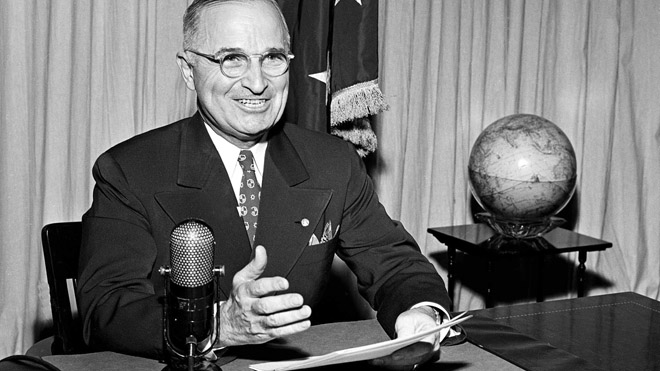
At the time, the decision to use the atomic bomb was widely framed as a necessary measure to end the war and save American lives. The Truman Library’s museum exhibit states that “For President Truman, the decision was a clear-cut one. In 1945, America was weary of war. Japan was a hated enemy. The nation feared the cost of invading the Japanese mainland.” This perspective was echoed in official circles. The Interim Committee report, as summarized in the Columbia University source, argued that the bomb could bring the war to a rapid conclusion. The prevailing mood was one of relief and triumph, but also a sober recognition of the weapon’s immense power.
“For President Truman, the decision was a clear-cut one. In 1945, America was weary of war. Japan was a hated enemy. The nation feared the cost of invading the Japanese mainland.” — Truman Library Museum
Historical Snapshot
| Aspect | Detail |
|---|---|
| Date | August 6 and August 9, 1945 |
| Place | Hiroshima and Nagasaki, Japan |
| People | President Harry S. Truman, the Interim Committee, Manhattan Project scientists, Japanese military leaders |
| What Happened | The United States dropped atomic bombs on Hiroshima and Nagasaki, leading to Japan’s surrender |
| Why It Mattered | It ended World War II and opened the nuclear age |
Official Reports
The official reports and memoranda preserved in the Truman Library and the National Security Archive provide a detailed record of the decision-making process. The Interim Committee Report of May 1945 is a key document; it recommended the use of the bomb without warning and considered the military and political implications. The Truman Library’s online collection includes memoranda from R. Gordon Arneson, George L. Harrison, and others, dated October and November 1945, which discuss the aftermath of the bombings and the administration’s rationale. These documents reveal the official justifications: the desire to avoid a costly invasion, the belief that the bomb would force a quick surrender, and the acknowledgment of the weapon’s destructive power.
Timeline
- May 1945 – The Interim Committee issues its report on the military use of the atomic bomb.
- July 16, 1945 – The first atomic bomb is tested at Trinity Site in New Mexico.
- August 6, 1945 – “Little Boy” is dropped on Hiroshima.
- August 9, 1945 – “Fat Man” is dropped on Nagasaki.
- August 15, 1945 – Japan announces its surrender, ending World War II.
Aftermath
The immediate aftermath of the bombings was Japan’s surrender and the end of World War II. The Truman Library’s collection includes documents covering the years 1945 through 1964, indicating the long-term impact of the decision. The atomic bombings also initiated a global nuclear arms race and a rethinking of warfare. The primary sources from the period show that the decision was not simply a military one but also a political and moral one, with consequences that would be debated for decades.
How Historians See It Today
Modern historians have actively debated the necessity of the atomic bombings, their effect on ending the war, and the alternatives available to the United States. The Columbia University source notes: “The dropping of the atomic bombs on Hiroshima (August 6, 1945) and Nagasaki (August 9, 1945) remains among the most controversial events in modern history. Historians have actively debated whether the bombings were necessary, what effect they had on bringing the war in the Pacific to an expeditious end, and what other options were available to the United States.” This debate reflects a shift from the contemporary view of a clear-cut necessity to a more nuanced analysis of the decision’s motivations and consequences. Primary sources remain the foundation of this scholarship, allowing historians to trace the reasoning and the uncertainties of the era.
Key Documents
- Report of the Interim Committee on the Military Use of the Atomic Bomb (May 1945) – The official recommendation to use the bomb without warning.
- Memoranda from October and November 1945 (Truman Library) – Official correspondence and notes documenting the decision and its aftermath.
- The Atomic Bomb and the End of World War II: A Collection of Primary Sources (National Security Archive) – A comprehensive collection of documents, photographs, and reports.
These primary sources—the reports, memoranda, and official records—offer a direct window into the minds of the men who made the decision. They show a world in which the atomic bomb was seen as a decisive tool to end a brutal war, and they record the initial reactions of relief and awe. The documents also remind us that history is not a single narrative but a complex of voices, and that the decision to drop the atomic bomb remains one of the most consequential and debated in modern history.
FAQ
Why did President Truman decide to use the atomic bomb?
According to the Truman Library, the decision was seen as clear-cut: America was weary of war, Japan was a hated enemy, and the nation feared the cost of an invasion. The Interim Committee report recommended the bomb be used to end the war quickly and save American lives.
What did the Interim Committee recommend?
The Interim Committee, in its May 1945 report, recommended that the atomic bomb be used against Japan without warning, as a way to end the war expeditiously. The report is preserved in the Columbia University archive.



Leave a Reply