Short Answer
In the late 1940s, the world emerged from the devastation of World War II into a new and unsettling peace. The Grand Alliance of the United States, Britain, and the Soviet Union had fractured, and a shadow fell across Europe. In March 1946, Winston Churchill, speaking in Fulton, Missouri, declared that “an iron curtain has descended across the Continent.” That phrase, captured in contemporary newsreels and printed in newspapers worldwide, gave a name to the growing division between East and West. For ordinary citizens, the Cold War was not an abstract geopolitical contest but a lived reality: schoolchildren practiced “Duck and Cover” drills, families stocked bomb shelters, and newspapers carried headlines of Soviet expansion and Western containment. The primary sources of the era—government documents, personal letters, oral histories, photographs, and propaganda—reveal the hopes, fears, and expectations of people who did not know how the standoff would end.
What Happened?
The Cold War emerged from the ashes of World War II, as wartime cooperation gave way to mutual suspicion. The National Archives’ Cold War on File collection documents the key turning points. At the Tehran meeting (1943) and the Yalta Conference (February 1945), the “Big Three”—Roosevelt, Churchill, and Stalin—agreed on postwar spheres of influence, but tensions soon surfaced. The Potsdam Conference (July–August 1945) revealed deep disagreements over Germany and Eastern Europe. In 1946, Churchill’s “Iron Curtain” speech in Fulton, Missouri, publicly articulated the division. The United States responded with the Truman Doctrine (1947), pledging to contain communism, and the Marshall Plan (1947), offering economic aid to rebuild Europe. The Soviet Union reacted with suspicion, tightening its grip on Eastern Europe. The Berlin Blockade (1948–49) brought the first major crisis, leading to the Western airlift. The formation of NATO in 1949 and the Warsaw Pact in 1955 institutionalized the divide. The Korean War (1950–53) turned the Cold War hot in Asia. The Cuban Missile Crisis (1962) brought the world to the brink of nuclear war. Détente in the 1970s eased tensions, but the Soviet invasion of Afghanistan (1979) reignited conflict. The fall of the Berlin Wall in 1989 and the dissolution of the Soviet Union in 1991 ended the standoff.
How It Was Seen at the Time
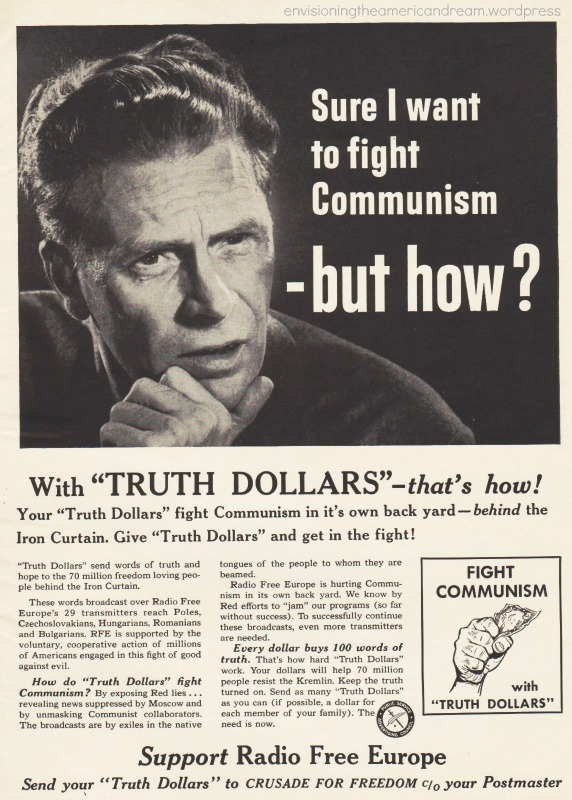
Contemporaries understood the Cold War as a life-or-death struggle between two incompatible systems. Western leaders framed it as a defense of freedom against totalitarian communism. Churchill’s speech, preserved in the National Archives, warned that “from Stettin in the Baltic to Trieste in the Adriatic, an iron curtain has descended across the Continent.” Soviet officials, meanwhile, portrayed the West as aggressive and imperialist. The National Archives holds documents such as “Soviet ‘striving for security’” and “Threat to Western Civilisation,” showing how each side justified its actions. The Library of Congress’s primary source set includes a placard titled “Soviet Imperialism” and a poster “Real Peace/Atomic War,” reflecting the stark binary choices presented to the public. The prevailing mood was one of anxiety and vigilance, punctuated by moments of hope, such as the 800 women strikers for peace who demonstrated near the UN Building in New York.
Contemporary Newspaper Coverage
Newspapers were the primary source of information for most people. The National Archives’ Cold War on File includes “Press on Potsdam,” a file of press reactions to the 1945 conference, showing how Allied decisions were reported and debated. “Moscow radio broadcasts” were monitored by Western intelligence, revealing Soviet propaganda themes. The Library of Congress holds bound volumes of the Congressional Record from the 82nd and 86th Congresses (1952 and 1959), which contain speeches and debates on Cold War policy. Headlines of the era—such as “Germany’s Iron Curtain Is There For All to See”—captured the public’s sense of a divided world. Newspapers also covered civil defense preparations, with articles advising citizens on how to survive an atomic attack. The tone was often alarmist, but it also reflected genuine uncertainty about the future.
Eyewitness Accounts
Oral histories provide a unique window into the personal experiences of Cold War participants. The William & Mary Libraries’ collection Cold War: Voices of Confrontation and Conciliation includes transcripts of recollections from diplomats, military officers, and civilians, covering the 1950s through the 1990s. These accounts reveal the motivations behind policy decisions and the human cost of the standoff. The Library of Congress also holds “Cold War Dispatches, Melvin Edward Ratz,” a personal account that likely includes letters or diary entries from the era. Such sources show how individuals navigated the fear of nuclear war, the pressure of espionage, and the hope for peace. One oral history participant, a former diplomat, recalled the tension of the Cuban Missile Crisis, describing the “twenty minutes” that felt like “an eternity” as ships approached the quarantine line.
Official Reports
Government documents are the backbone of Cold War history. The National Archives’ collection includes “Operation Unthinkable,” a British plan from 1945 for a possible war with the Soviet Union, revealing the depth of Western distrust. “Truman on Potsdam” records the president’s private reflections on the conference. “British policy on USSR 1947” outlines London’s strategy of containment. The Soviet side is represented by documents such as “Soviet ‘striving for security’” and “Reaction in USSR,” which show Moscow’s defensive posture. These official reports often contradict public statements, exposing the gap between rhetoric and policy. For example, while Western leaders publicly called for peace, “Operation Unthinkable” contemplated a military strike. Similarly, Soviet documents emphasized security needs while Western analysts saw expansionism.
Different Perspectives
American Perspective
American officials framed the Cold War as a moral crusade. The Truman Doctrine, announced in 1947, pledged to “support free peoples who are resisting attempted subjugation by armed minorities or by outside pressures.” The Library of Congress’s “Real Peace/Atomic War” poster encapsulates the binary choice presented to the public. American newspapers and films, such as “Duck and Cover,” urged vigilance and preparedness.
British Perspective
Britain, though weakened by war, played a key role in shaping Western policy. The National Archives’ “British policy on USSR 1947” shows London’s concern about Soviet expansion and its advocacy for a strong American response. Churchill’s “Iron Curtain” speech, delivered in the United States, reflected British anxieties about the division of Europe.
Soviet Perspective
Soviet leaders saw themselves as encircled by hostile capitalist powers. The National Archives’ “Soviet press on Tehran meeting” and “Soviet ‘striving for security’” reveal Moscow’s emphasis on securing its borders after two devastating invasions. Soviet propaganda portrayed the West as aggressive and imperialist, as seen in the “Soviet Imperialism” placard from the Library of Congress, which was actually a Western exhibit, but it shows how each side used imagery to demonize the other.
What People Feared
The most pervasive fear was nuclear war. The Library of Congress’s “Duck and Cover” film, produced in 1951, taught schoolchildren to hide under desks in the event of an atomic blast. The poster “Real Peace/Atomic War” presented a stark choice, implying that peace was only possible through strength. The “Iron Curtain Threat” and “Soviet Imperialism” materials fueled fears of communist expansion. Many Americans worried about communist infiltration, leading to McCarthyism and loyalty oaths. In Europe, the fear of Soviet invasion was palpable, especially during the Berlin Blockade. The 800 women strikers for peace, photographed near the UN Building, represented a countervailing hope for disarmament. These fears were not unfounded—the Cuban Missile Crisis in 1962 brought the world within a hair’s breadth of nuclear catastrophe—but they were also amplified by propaganda on both sides.
How Historians See It Today
Modern historians use these primary sources to move beyond the simplistic narratives of the era. While contemporaries often saw the Cold War as a clear-cut struggle between good and evil, scholars now emphasize the role of misperception, domestic politics, and third-world agency. The oral histories at William & Mary, for example, reveal the complexity of decision-making, showing that leaders were often driven by fear and uncertainty rather than a master plan. The National Archives’ documents, such as “Operation Unthinkable,” demonstrate that the West was not always defensive, and Soviet documents show that Moscow’s actions were often reactive. Historians like Edward H. Judge, in The Cold War through Documents, and Priscilla Roberts, in The Cold War: Interpreting Conflict through Primary Documents, argue that a global perspective is essential, incorporating voices from Asia, Africa, and Latin America. The primary sources remain the foundation for these reinterpretations, offering a rich, if partial, record of how the Cold War was experienced and understood.
The Cold War was not a single event but a prolonged state of tension that shaped every aspect of life. The contemporary sources—newspapers, official reports, oral histories, and propaganda—reveal a world of fear, hope, and uncertainty. They show that people at the time did not know how the conflict would end, and their predictions ranged from nuclear apocalypse to peaceful coexistence. By studying these sources, we gain not only a factual account of what happened but also a profound understanding of how it felt to live through an era defined by the threat of annihilation. The legacy of the Cold War persists, and the primary sources remind us that history is not a dry recitation of dates but a human story of choices, fears, and resilience.
FAQ
What types of primary sources are available for studying the Cold War?
Primary sources include government documents (e.g., the National Archives' 'Cold War on File'), personal letters and diaries (e.g., 'Cold War Dispatches' at the Library of Congress), oral histories (e.g., William & Mary's 'Voices of Confrontation and Conciliation'), newspapers, propaganda films like 'Duck and Cover', and photographs. These sources reveal both official policy and personal experience.
How did contemporaries view the Cold War differently from historians today?
Contemporaries often saw the Cold War as a clear moral struggle between freedom and communism, with each side demonizing the other. Modern historians, using a broader range of sources, emphasize misperceptions, domestic politics, and the agency of non-Western actors, leading to a more nuanced and global interpretation.




Leave a Reply