
Short Answer
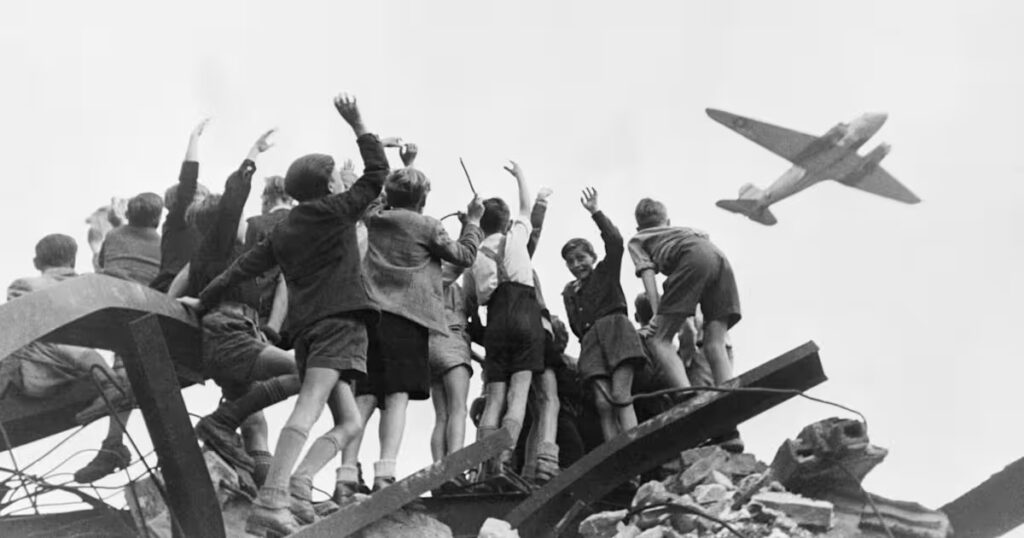
In the summer of 1948, Berliners in the western sectors of the divided German capital looked to the sky with a mixture of hope and dread. Since June 24, Soviet forces had severed all land and water routes into the city, cutting off more than two million people from food, coal, and medicine. The only lifeline was a thin ribbon of airspace, through which American and British aircraft flew round-the-clock missions to keep the city alive. Contemporary reports captured the drama of those days—the roar of engines over Tempelhof and Gatow, the sacks of dehydrated potatoes and coal dust, the tense exchanges between Allied and Soviet officials at the Berlin Air Safety Centre. For the men who flew the missions and the people who watched them, the airlift was not yet a legend; it was a desperate, uncertain gamble.
What Happened?
The Berlin blockade began on June 24, 1948, when Soviet forces cut off all road, rail, and water access to the western sectors of Berlin, which lay deep inside the Soviet occupation zone of Germany. The Western Allies—the United States, Britain, and France—responded with an unprecedented airlift of supplies.
- June 24, 1948: Soviet forces impose the blockade on western Berlin, severing all land and water routes.
- July 8, 1948: Soviet authorities disclaim all responsibility for the safety of American aircraft supplying Berlin, as revealed in an exchange of letters at the Berlin Air Safety Centre.
- July 10, 1948: The first cargo of foodstuffs from the United Kingdom leaves Abingdon, carrying 7,695 lb of dehydrated potatoes aboard York MW 173 of No. 59 Squadron, 47 Group, Transport Command.
- September 25, 1948: The airlift enters its 100th day, with the Süddeutsche Zeitung noting the numerous difficulties involved in providing aid to the western sectors.
The operation grew from a stopgap measure into the largest air supply operation of its kind since the war. American C-47 Skytrains landed at Tempelhof airport, while British aircraft delivered coal and food at Gatow and on the Havel. The airlift was a logistical feat that contemporaries struggled to comprehend, even as they witnessed it firsthand.
How It Was Seen at the Time
Contemporary observers understood the airlift in stark moral terms. The blockade and subsequent airlift “proved to be a public relations bonanza for the United States in the Cold War against the Soviet Union,” as the American military provided humanitarian relief to Germans—whom they had recently fought on the battlefield—while the Soviets used starvation as a means to control a population.
“The American military provided humanitarian relief to Germans—whom they had recently fought on the battlefield—while the Soviets used starvation as a means to control a population.” — PBS, American Experience
The Daily Telegraph‘s military correspondent, Lieutenant-General Hugh Gray Martin, wrote on August 4, 1948, that he had been “privileged to watch every stage of the Berlin air lift from the planning of it at headquarters to the delivery of the coal and food at Gatow and on the Havel.” He acknowledged that “much has already been written about the air lift” but offered his unusually complete view of the operation. The prevailing mood was one of cautious admiration—the airlift was seen as a remarkable technical achievement, but also as a fragile lifeline that could snap at any moment.
Historical Snapshot
| Aspect | Detail |
|---|---|
| Date | June 24, 1948 – May 12, 1949 (blockade); airlift continued to September 30, 1949 |
| Place | Berlin, Germany (western sectors) |
| People | American, British, and French air forces; Soviet occupation authorities; Berlin civilians |
| What Happened | Soviet forces blockaded land and water routes to West Berlin; Allies supplied the city by air |
| Why It Mattered | The airlift became a defining moment of the Cold War, demonstrating Western resolve and cementing the division of Germany |
Contemporary Newspaper Coverage
The Palestine Post (later the Jerusalem Post) reported on July 8, 1948, under the headline “Russia Disclaims Responsibility for Air Safety,” that Soviet authorities had disclaimed all responsibility for the safety of American aircraft supplying Berlin. The report noted that the Russian notification came after the American controller had informed the other three Allies of a modification in the procedure for handling American flight information.
“The Russia authorities have disclaimed all responsibility for the safety of American aircraft supplying Berlin, it was officially revealed here today with the publication of an exchange of letters between the American and Russian control elements at the Berlin Air Safety Centre.” — The Palestine Post, July 8, 1948
The Daily Telegraph published Lieutenant-General Hugh Gray Martin’s account on August 4, 1948, describing the airlift from planning to delivery. The Aeroplane magazine sent John E. Fricker to fly to Berlin with a load of food, and his first-hand report described the flight from Abingdon, over the Zuider Zee, to Berlin. The Süddeutsche Zeitung, on September 25, 1948, marked the 100th day of the airlift, considering “the numerous difficulties involved in providing financial aid to the Western sectors of the City of Berlin.” Across the world, newspapers framed the airlift as a test of Western resolve and a humanitarian mission.
Eyewitness Accounts
John E. Fricker of The Aeroplane flew to Berlin with a cargo of food. He described the first cargo of foodstuffs to be flown from the United Kingdom to Berlin, leaving Abingdon at 11:30 on Saturday, July 10, 1948. The aircraft, York MW 173, carried 7,695 lb of dehydrated potatoes.
“Flying mainly above cloud, we left the East Coast over Ipswich heading almost due East to Holland, where weather conditions gradually improved. We passed over the Zuider Zee in bright sunshine.” — John E. Fricker, The Aeroplane
Lieutenant-General Hugh Gray Martin wrote in The Daily Telegraph:
“Last week, thanks to the kindness of the British Army and British Air Force of Occupation, I was privileged to watch every stage of the Berlin air lift from the planning of it at headquarters to the delivery of the coal and food at Gatow and on the Havel.” — Lieutenant-General Hugh Gray Martin, The Daily Telegraph, August 4, 1948
These accounts convey the sense of witnessing something unprecedented—an operation that had no precedent in the history of warfare or humanitarian relief.
What People Feared
The most immediate fear was air safety. The Soviet disclaimer of responsibility for the safety of American aircraft, reported on July 8, 1948, raised the specter of Soviet fighters or anti-aircraft fire targeting Allied planes. The exchange of letters at the Berlin Air Safety Centre made clear that the Soviets were unwilling to guarantee the safety of the very aircraft that were keeping the city alive. There was also the fear that the airlift would simply fail—that the tonnage required to sustain two million people could not be delivered by air. The Süddeutsche Zeitung, at the 100-day mark, reflected on the numerous difficulties involved in sustaining the operation, and contemporaries worried that winter weather, mechanical failures, or Soviet interference could bring the whole enterprise crashing down.
What People Expected Would Happen Next
At the 100-day mark, the Süddeutsche Zeitung reflected on the difficulties of sustaining the airlift. Many contemporaries expected the blockade to be a test of endurance—would the Allies tire first, or would the Soviets back down? The airlift was widely seen as a temporary measure, not the eleven-month operation it became. The Soviet disclaimer of responsibility for air safety suggested that the confrontation could escalate at any moment. Some observers predicted that the airlift would force a diplomatic resolution within weeks; others feared it would lead to open conflict. Few, if any, anticipated that the airlift would continue into the spring of 1949 and become a permanent symbol of Western commitment to Berlin.
How Historians See It Today
Historians today view the Berlin Airlift as a pivotal moment in the early Cold War. Contemporary reporting framed it as a humanitarian mission and a moral victory for the West. Modern scholarship emphasizes the logistical achievement—the sheer scale of the operation—and its role in solidifying the division of Germany and Europe. The airlift demonstrated that the Western Allies would not abandon West Berlin, and it set the stage for the creation of NATO and the permanent division of Germany. While contemporaries saw the airlift as a desperate gamble, historians recognize it as a calculated and ultimately successful demonstration of Western resolve that shaped the trajectory of the Cold War for decades to come.
The contemporary reports of the Berlin Airlift capture a moment of profound uncertainty. For the men who flew the missions, the journalists who accompanied them, and the Berliners who watched from below, the outcome was far from certain. The airlift was not yet a symbol of Cold War resolve; it was a daily struggle against weather, distance, and Soviet pressure. The primary sources—newspaper accounts, eyewitness reports, and official exchanges—preserve that uncertainty, reminding us that history is lived forward, not backward.
FAQ
How long did the Berlin Airlift last?
The Soviet blockade began on June 24, 1948, and was lifted on May 12, 1949. The airlift itself continued until September 30, 1949, to build up reserves in West Berlin. Contemporary reports, such as the Süddeutsche Zeitung's September 25, 1948 article, marked the 100th day of the operation, reflecting the uncertainty about how long it would need to continue.
What was the first British cargo flown to Berlin?
The first cargo of foodstuffs from the United Kingdom left Abingdon on July 10, 1948, carrying 7,695 lb of dehydrated potatoes aboard York MW 173 of No. 59 Squadron, 47 Group, Transport Command. The flight was described firsthand by John E. Fricker of The Aeroplane magazine.
What did the Soviets say about air safety during the airlift?
On July 8, 1948, Soviet authorities disclaimed all responsibility for the safety of American aircraft supplying Berlin. This was revealed in an exchange of letters between American and Russian control elements at the Berlin Air Safety Centre, as reported by The Palestine Post. The disclaimer raised fears that Soviet forces might interfere with Allied aircraft.











Leave a Reply