
Short Answer
On the morning of December 5, 1941, Lieutenant Ted S. Faulkner was briefed at Pearl Harbor for a flight that would carry his B-24 Liberator thousands of miles south-west, over Japanese-mandated islands, to photograph whatever he found — under orders to avoid starting a war and to avoid being shot down. That same week in Washington, department stores on F Street were crowded with Christmas shoppers, clerks at the Japanese Embassy on Massachusetts Avenue were feeding confidential papers into a furnace a handful at a time, and a few dozen officers in the Navy and War Departments were reading Japan’s most secret diplomatic messages nearly as fast as Tokyo composed them. The capital knew that something enormous was coming. It did not know where, or when, and almost no one in it seriously imagined Hawaii. On the evening of December 6, a Navy pouch reached the White House with the first thirteen parts of a long Japanese note. President Franklin Roosevelt read it, passed it to Harry Hopkins, and said, according to Hopkins’s memorandum of the conversation, “This means war.”
What Happened?
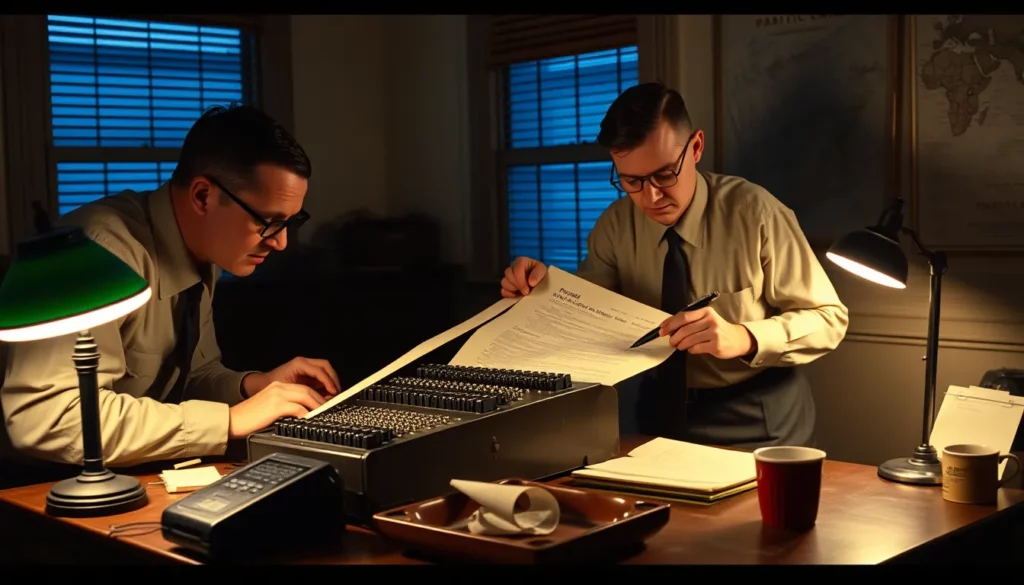
By late 1941 the United States had achieved something remarkable and largely invisible to the public: the Army Signal Intelligence Service, under William F. Friedman, had reconstructed the Japanese Foreign Ministry’s cipher machine — code-named PURPLE by the Americans — and was reading Tokyo’s diplomatic traffic. The product, called MAGIC, went to a short distribution list: the President, the secretaries of state, war and navy, the Army and Navy chiefs of staff, and a handful of senior intelligence officers. The commanders in Hawaii, Admiral Husband E. Kimmel and Lieutenant General Walter C. Short, were not on it.
What MAGIC showed, week by week, was not an attack plan but the closing of a diplomatic vise. The key intercepts, in the order Washington read them:

- 24 September 1941. Tokyo instructs Consul General Nagao Kita in Honolulu to divide Pearl Harbor into five sub-areas and report the berthing of warships twice a week. American cryptanalysts decoded it on 9 October and called it the “bomb plot” message. It was circulated in Washington; it was not sent to Hawaii.
- 5 November 1941. An Imperial Conference sets a deadline: war unless diplomacy succeeds by 1 December. Japanese naval traffic grows heavier, but the operational code (JN-25) remains unreadable in real time.
- 27 November 1941. Admiral Harold Stark, Chief of Naval Operations, cables Kimmel: “This dispatch is to be considered a war warning.” The same day General George Marshall warns Short that “hostile action by Japan is possible at any moment.” Stark predicts an aggressive move against the Philippines, Thailand, the Kra Peninsula or Borneo — not Hawaii. Short replies that he has alerted against sabotage.
- 1–2 December 1941. A final Imperial Conference decides on war; the fleet receives the signal “Niitaka Yama Nobore 1208” — climb Mount Niitaka. The carrier force, having sailed from Hitokappu Bay on 26 November, keeps absolute radio silence.
- 3–4 December 1941. Fragments of the “winds” code — the prearranged signal for breaking relations — are logged by some American stations. Their meaning remains disputed to this day.
- 6–7 December 1941. The fourteen-part Japanese reply arrives in Washington. On Sunday morning the fourteenth part and the instruction to deliver it at 1 p.m. are decoded. Marshall, at home on horseback, is reached by telephone and sends a warning by commercial cable at about noon; atmospheric delays and an Army communications chain that assumed a Sunday sent it to Honolulu where it reached General Short’s headquarters hours after the bombs fell.
The last hours were crowded with chances. At 6:37 a.m. the destroyer USS Ward sank a midget submarine at the harbor mouth and reported it; the report climbed slowly. At 7:02 the Opana radar station picked up the incoming aircraft; the officer on duty, Lieutenant Kermit Tyler, told the operators, “Don’t worry about it.” At 7:55 the first bombs fell, and at 7:58 the Pacific Fleet’s headquarters flashed: “AIR RAID ON PEARL HARBOR X THIS IS NOT DRILL.”
How It Was Seen at the Time
Contemporaries did not describe December 7 as a failure to anticipate war; they described it as a failure to anticipate where. War with Japan had been treated in Washington as a matter of weeks since the autumn. What shocked officials was the presumption that Japan would strike south, against British and Dutch colonies and the Philippines, while a carrier force sailed undetected across the empty North Pacific.
“The question was how we should maneuver them into the position of firing the first shot without allowing too much danger to ourselves.”
Secretary of War Henry L. Stimson, diary entry, 25 November 1941
For the men in Hawaii, the war warning of 27 November had meant sabotage, not invasion — an assumption Short defended in testimony and which the first newspaper editions of 7 December seemed briefly to confirm. The Honolulu papers that afternoon carried extras announcing the attack alongside unconfirmed reports of parachutists and landing craft, rumors that spread through the city faster than the facts.
“Yesterday, December 7, 1941 — a date which will live in infamy — the United States of America was suddenly and deliberately attacked by naval and air forces of the Empire of Japan.”
President Franklin D. Roosevelt, address to Congress, 8 December 1941
Historical Snapshot
| Aspect | Detail |
|---|---|
| Date | 7 December 1941, 7:55 a.m. Hawaii time (12:55 p.m. Washington) |
| Place | Pearl Harbor and Oahu, Territory of Hawaii; decisions taken in Washington, D.C. |
| People | Franklin D. Roosevelt, Henry Stimson, Cordell Hull, General George Marshall, Admiral Harold Stark; Admiral Husband Kimmel, General Walter Short; Japanese commander Vice Admiral Chuichi Nagumo |
| What Happened | Two waves of Japanese carrier aircraft attacked the U.S. Pacific Fleet and Oahu airfields, killing 2,403 Americans and sinking or damaging eight battleships |
| Why It Mattered | The United States entered the Second World War; the question of what Washington knew and what it passed on became a political controversy that lasted decades |
What People Knew at the Time
| What People Knew Then | What We Know Now |
|---|---|
| Tokyo’s diplomatic messages indicated war was imminent, possibly within days | Washington possessed the “bomb plot” message of 24 September showing Pearl Harbor under systematic surveillance, but never forwarded it to Hawaii |
| The 27 November “war warning” told Kimmel and Short to expect aggression somewhere in the Pacific | Both commanders received it; both read it as a warning against sabotage rather than assault, and Washington’s follow-up messages reinforced that reading |
| The Japanese fleet had vanished from its anchorages; radio traffic gave no clue where | The carriers maintained radio silence from 26 November, so no intercept could have located them |
| Radar operators reported a large formation approaching Oahu at 7:02 a.m. | New radar technology, an untrained reporting chain and an expected flight of B-17s combined to dismiss the contact |
Official Reports
The first inquiry, the Roberts Commission, was appointed by executive order on 18 December 1941 and reported on 23 January 1942. Chaired by Supreme Court Justice Owen J. Roberts, it concluded that Kimmel and Short had been guilty of “dereliction of duty” and “errors of judgment,” and it did so without access to the full MAGIC material, which remained secret. That finding shaped public opinion for years.
Later bodies reached further up the chain. The Army Pearl Harbor Board, convened in 1944 and reporting in October of that year, criticized Marshall, Stark and the War Plans Division in Washington; portions were withheld from publication at the time. The Navy’s courts of inquiry and the Clarke and Clausen investigations of 1944–45 examined the delays in the 7 December warning message. Finally the Joint Congressional Committee, opening in November 1945, heard 151 witnesses over six months and printed its hearings in thirty-nine volumes. Its majority report divided responsibility between Washington and Hawaii, a verdict closer to the documentary record than the 1942 finding, and the full text of the intercepts entered the public domain for the first time.
Different Perspectives
In Washington
Stimson, Hull and Stark saw the intercepts as proof that diplomacy had run out and that Japan would move somewhere in Southeast Asia. Marshall’s warning of 7 December — “Japanese are presenting at one p.m. Eastern Standard Time today what amounts to an ultimatum … Be on the alert accordingly” — shows that Washington grasped the significance of the timing but did not connect it to Hawaii. Marshall testified that he assumed the Navy had its own channel to Kimmel.
In Honolulu
Kimmel and Short commanded a fleet and an army garrison that had been told, repeatedly, that sabotage was the danger. Short’s own reply to Marshall’s 27 November warning — that he had alerted to “prevent sabotage” and was liaising with the Navy — became the central exhibit of the inquiries. Kimmel’s staff repeatedly asked Washington for the MAGIC material and were refused. Both men believed, with reason, that they had been denied the intelligence on which the verdict against them rested.
At Bletchley Park
British signals intelligence was reading Japanese diplomatic traffic too, and days before the attack a Bletchley Park assessment warned of impending Japanese moves in Southeast Asia — assuming an invasion of Thailand. It was shared with American intelligence. It said nothing of Hawaii.
In Tokyo
The Japanese government intended its rupture note to be delivered in Washington at 1 p.m. on 7 December, half an hour before the attack. The embassy’s decoding was slow, and Ambassador Kichisaburo Nomura delivered it at 2:20 p.m. Washington’s inference that the hour itself was a warning came from a message the Japanese had not intended to be a deadline at all.
What the Sources Got Wrong
- “No warning at all.” The phrase, common in early press coverage and in the Roberts Commission’s framing, obscured a real distinction: Kimmel and Short were warned of war but not of location. Their own replies to the 27 November cables are in the record.
- The Roberts Commission’s verdict. Its finding of dereliction rested on testimony taken without the full intercept file and without cross-examination of Washington’s distribution failures. The 1944 Army Board and the 1946 Joint Committee both redistributed the blame.
- The “winds execute.” Navy witnesses in 1944–45 insisted no execute message was ever received; later declassified logs show a “winds” signal picked up around 4 December whose authenticity and meaning remain contested. The record is ambiguous, not settled.
- The Roosevelt–Churchill conspiracy myth. Claims that either leader knew of the attack and concealed it to bring America into the war appear in no contemporary document; the British government’s own historians note that the carriers attacked in radio silence, leaving nothing to intercept.
- The 7 December Honolulu extras. Newspaper reports of parachutists, landing barges and Japanese troops on the North Shore were rumor, later repeated in official testimony. No evidence of a landing on Oahu that day has ever been found.
Timeline
- 24 September 1941: Tokyo orders grid reports on Pearl Harbor shipping; decoded 9 October as the “bomb plot.”
- 5 November 1941: Imperial Conference sets a 1 December diplomatic deadline.
- 26 November 1941: The carrier strike force sails from Hitokappu Bay in radio silence.
- 27 November 1941: Stark and Marshall send their “war warning” cables to Hawaii.
- 2 December 1941: “Climb Mount Niitaka 1208” transmitted to Nagumo.
- 6 December 1941: First thirteen parts of the Japanese note reach Roosevelt; “This means war.”
- 7 December 1941, 11:52 a.m. EST: Marshall’s last-minute warning is filed; it arrives in Honolulu after the attack.
- 7 December 1941, 7:55 a.m. Hawaii: The attack begins; 2,403 Americans killed.
- 8 December 1941: Congress declares war, 388 to 1.
The documents leave a picture that is neither innocence nor conspiracy but something harder to accept: a government that knew war was coming, possessed extraordinary intelligence about Japanese intentions, and still could not convert that knowledge into action at the one point in the Pacific where it mattered most. MAGIC revealed that Japan was preparing to fight; it never revealed where. The “bomb plot” telegram showed that Pearl Harbor was being watched, and no one in Washington read that as an operational warning. The delay of General Marshall’s message on the morning of 7 December — a few hours, a commercial cable, a Sunday — encapsulates the failure better than any indictment: the intelligence system worked, and the machinery for acting on it did not. What the primary sources teach is how narrow the gap between knowing and preventing can be.
FAQ
Did Washington have advance knowledge of the attack on Pearl Harbor?
American officials knew from MAGIC intercepts that war with Japan was imminent and had specific evidence that Pearl Harbor was under systematic observation, including the 'bomb plot' message of 24 September 1941. What they did not have was any evidence of the target: the carrier striking force sailed in radio silence from 26 November, and Washington's own war warning of 27 November predicted a move against the Philippines, Thailand, the Kra Peninsula or Borneo. Knowledge of the war's likelihood was real; knowledge of the attack's location was not.
Why did Admiral Kimmel and General Short not receive the MAGIC intercepts?
MAGIC was distributed to a deliberately narrow list in Washington — the President, the secretaries of state, war and navy, the service chiefs and senior intelligence officers — to protect the secret of PURPLE. The commanders in Hawaii requested the material and were refused. The 1945–46 Joint Congressional Committee treated this distribution policy as one of the central failures of the episode, and its hearings led to the public release of the intercepts.
Was there a 'winds execute' message warning of the attack?
This remains one of the genuinely unresolved questions in the documentary record. Some Navy logs show a 'winds' signal — the phrase 'east wind rain' — picked up around 4 December 1941, and officers later testified to having seen it. Other witnesses and investigators concluded that no authentic execute message was received or recognized. The Joint Committee examined the matter at length without reaching a firm conclusion, and historians still disagree.
Why did General Marshall's warning arrive too late?
Marshall's message was composed on the morning of Sunday, 7 December, after the fourteenth part of the Japanese note and its 1 p.m. delivery instruction had been decoded. Because the Army's radio link to Honolulu was considered insecure, the message went by commercial cable, where atmospheric conditions delayed transmission. It was received at RCA Honolulu at 7:33 a.m. Hawaii time — twenty-two minutes before the attack — but was not decoded and delivered to General Short's headquarters until late that morning, after the bombing had ended.
Did Roosevelt or Churchill deliberately allow the attack to bring America into the war?
No contemporary document supports this claim. The British government's signals intelligence historians have examined the allegation directly and found no evidence for it; the strategic situation in the Far East made war more likely, and Bletchley Park had warned of Japanese moves in Southeast Asia — assuming an invasion of Thailand — a few days before the attack. The Japanese carriers maintained radio silence, so there was nothing to intercept that would have revealed the target.


Leave a Reply