
Short Answer
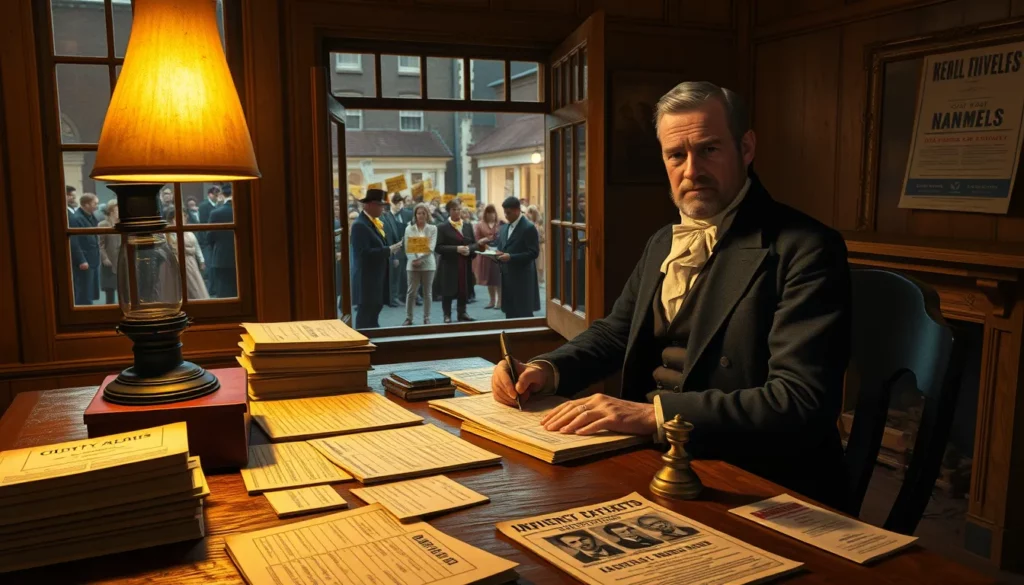
On a November evening in the 1840s, a county clerk in a courthouse lit by whale oil and tallow copies tallies from township poll books into a return for the governor’s race. Around him are not neutral papers. There are party tickets printed by local committees, a handbill accusing the opposing candidate of corruption, a newspaper extra with partial returns from the next county, and letters from friends asking whether the canvass is safe. This article is a guide to reading such materials as primary sources. It treats historical election returns as official or semi-official records of votes cast—county canvass reports, poll books, certificates of election, and later compilations such as ICPSR’s United States Historical Election Returns, 1824–1968—and campaign materials as the printed and handwritten apparatus of persuasion: tickets, broadsides, pamphlets, campaign biographies, newspaper advertisements, and correspondence. The focus is chiefly the United States from the early republic to the early twentieth century. The aim is not to treat returns as perfect data or campaign literature as mere decoration, but to reconstruct how contemporaries produced, disputed, and used political paper.
What Happened?
There was no single moment when American election returns became standardized. Instead, a patchwork of local practices slowly produced the records historians now read. In the colonial and early republican periods, voting was often oral or conducted with manuscript ballots, and local officials kept poll books or tally sheets. State laws required sheriffs, clerks, or canvassing boards to transmit returns to a governor or legislature, but the forms varied by state and county. By the 1820s, mass parties were printing tickets and newspapers were reprinting county returns as political news. ICPSR’s United States Historical Election Returns begins in 1824 and extends to 1968, listing county-level returns for over 90 percent of all elections to the offices of president, governor, U.S. senator, and U.S. representative. The project includes returns for all parties and candidates, write-in and scattering votes where available, and special as well as regularly scheduled elections.
- Colonial and early republican voting. Local officials recorded votes in poll books or tally sheets; returns moved from townships to county seats and then to state authorities. A New Nation Votes provides searchable early American election returns from this era.
- The party press and the ticket. By the 1820s and 1830s, parties printed tickets, broadsides, and campaign biographies, while partisan newspapers published early and sometimes incomplete returns.
- The county canvass. County boards examined returns, resolved discrepancies, and certified results. These canvass records are often the closest surviving link to the actual count.
- Ballot reform and standardization. Late nineteenth- and early twentieth-century ballot laws, registration systems, and state canvassing procedures changed how votes were recorded and reported, but local variation persisted.
- Scholarly compilation. In the twentieth century, projects such as ICPSR standardized county-level returns, matched county names over time, and assigned congressional district numbers so that data could be aggregated.
How It Was Seen at the Time
Contemporaries did not read returns as neutral statistics. They read them as evidence of public opinion, as grounds for victory or complaint, and as tests of local honor. Campaign materials were understood to be persuasive instruments, not impartial records. Partisan editors knew that the first returns printed might shape the story, and party committees knew that a ticket or broadside could define a candidate before voters ever heard him speak. The language of the era mixed confidence with suspicion: returns were “official” yet could be “contested”; a canvass was “regular” or “fraudulent” depending on who described it.

“Talents for low intrigue, and the little arts of popularity, may alone suffice to elevate a man to the first honors in a single State…” — Alexander Hamilton, The Federalist No. 68, 1788
Hamilton’s warning captured a persistent fear: that campaign arts might substitute for merit. Yet the same political culture that distrusted “popularity” also produced tickets, parades, and handbills without embarrassment. Electioneering was not considered undemocratic; it was considered dangerous only when it corrupted judgment.
“Every difference of opinion is not a difference of principle.” — Thomas Jefferson, First Inaugural Address, 1801
Jefferson’s line, spoken after a bitterly contested election, helps explain how contemporaries could treat campaign materials as both inflammatory and disposable. Partisan papers might call opponents enemies of the republic, but the inaugural ritual insisted that disagreement could be contained. Reading campaign materials therefore requires attention to genre: a broadside is an appeal, a ticket is a slate, a newspaper extra is a report, and a private letter is a confidence.
Historical Snapshot
| Aspect | Detail |
|---|---|
| Date | Chiefly the 1780s to the early 1900s; the ICPSR compilation covers 1824–1968. |
| Place | United States, especially county courthouses, state capitals, party headquarters, and newspaper offices. |
| People | County clerks, canvassing boards, party committees, newspaper editors, poll workers, and voters. |
| What Happened | Votes were recorded, canvassed, certified, printed, disputed, and preserved in official and partisan records. |
| Why It Mattered | The paper record determined who was declared elected and shaped how later generations understood political conflict. |
What People Knew at the Time
| What People Knew Then | What We Know Now |
|---|---|
| Local returns were often incomplete when first published, and newspaper reports could be partisan or premature. | Historians compare multiple newspapers, manuscript returns, and canvass records to identify corrections and errors. |
| Party tickets and broadsides were designed to persuade; they were not expected to be neutral. | Campaign materials are now read as evidence of political strategy, rhetoric, and constituency appeals, not as factual records. |
| Election laws and ballot forms varied by state and county, and local officials exercised wide discretion. | Modern compilations standardize county names and district numbers, but split districts and boundary changes still complicate aggregation. |
| Many people were excluded from voting by law or practice, including women, enslaved people, and some free men of color. | Returns alone undercount political life; historians supplement them with census records, petitions, private letters, and community studies. |
Contemporary Terminology
The vocabulary of the sources is not identical to modern election language. Reading it correctly prevents anachronism.
- Return: the official report of votes cast in a district, county, or state, transmitted to a canvassing authority.
- Canvass: the examination and counting of votes, often by a county or state board; also used for the whole body of returns.
- Ticket: a printed slate of candidates distributed by a party.
- Broadside: a large single-sheet printed announcement or campaign appeal, often posted or handed out.
- Poll book: a record of who voted and, in some places, for whom.
- Scattering vote: votes for persons not on the regular party ticket; ICPSR files include them where available.
- Party organ: a newspaper aligned with and often subsidized by a political party.
Numbers at the Time
| Figure or Record | Detail and Source |
|---|---|
| ICPSR time span | 1824–1968; county-level returns for president, governor, U.S. senator, and U.S. representative (ICPSR 1). |
| ICPSR coverage | Over 90 percent of all elections to those offices, with returns for all parties and candidates where available (ICPSR 1). |
| Party names | More than 1,000 individual party names plus many unaffiliated candidates in the ICPSR collection. |
| Smallest unit | County-level records; congressional district numbers are included for U.S. House elections, with special handling for split-district counties. |
| Special votes | Write-in and scattering votes are included where individual states reported them. |
What the Sources Got Wrong
Modern compilations are not immune to error. The ICPSR codebook for datasets 126–129, covering Georgia, warns that Jackson County is coded 1510 in the data but should be 1570. Dataset 32 for Delaware is titled “Election Returns for Delaware, 1823–1876” and includes 1832 data, while the study title begins in 1824. These are compilation errors, not contemporary ones, but they show why researchers must read codebooks alongside the returns. Contemporary sources made different mistakes. Newspapers often printed early, incomplete returns as if they were decisive, and party organs sometimes framed narrow losses as fraud. A first telegraphic dispatch from a county could be superseded by a later correction, but the correction might appear on an inside page or not at all. The lesson is not that every return is false, but that every return has a producing institution, a transmission path, and an audience. Reading against the grain means asking who counted, who reported, who printed, and who benefited from the version that survived.
Key Documents
- County canvass return — varies by state, 1780s–1900s. The official tally submitted by a county board is often the most direct surviving record of votes cast.
- Poll book — varies by locality, 1600s–1900s. Poll books record who appeared to vote and sometimes how they voted, making them essential for local and social history.
- Party ticket — 1790s–1880s. A printed slate of candidates shows how parties presented their choices to voters and which coalitions they sought.
- Campaign broadside — 1820s–1890s. Broadsides reveal campaign rhetoric, accusations, and the visual culture of partisan appeal.
- Newspaper election extra — 1800s–1900s. Extras show how returns were publicized, often before final canvasses were complete.
- Certificate of election — varies by state. Certificates formalized a winner’s claim and are useful for tracing contests and disputes.
Reading historical election returns and campaign materials is finally an exercise in historical imagination disciplined by evidence. The return tells us who was counted; the ticket and broadside tell us what voters were asked to believe; the newspaper tells us how results were narrated; the letter tells us what partisans feared or hoped. Together they show that elections were not merely moments of arithmetic but extended contests over paper, publicity, and local authority. The sources also teach caution: totals can be incomplete, categories can be anachronistic, and the loudest campaign voice was not always the most representative. Used together, these records let us see American political life as contemporaries saw it—contested, local, partisan, and intensely documented.
FAQ
What is the difference between an election return and a campaign broadside?
An election return is a record of votes cast, usually produced by local or state officials and transmitted to a canvassing authority. A campaign broadside is a printed appeal designed to persuade voters. Returns are evidence of counting; broadsides are evidence of political argument and strategy.
How can I tell if a historical election return is reliable?
Compare the return with other versions: manuscript canvass records, newspaper reports from different parties, certificates of election, and private letters. Check the codebook or archival description for known errors and boundary changes. Reliability is not all-or-nothing; a return may be accurate for some precincts and incomplete for others.










Leave a Reply