
Short Answer
Quick Snapshot
Warsaw in 1944 was a city under German occupation, scarred by five years of terror, deportation, and deprivation. Its pre-war vitality had been shattered, yet a dense network of clandestine institutions, schools, newspapers, and Home Army units still operated in the shadows. On 1 August 1944 the Polish underground launched the Warsaw Uprising, hoping to liberate the capital before Soviet forces arrived and to assert Polish sovereignty against Nazi Germany and Soviet-backed communism alike.
For sixty-three days, insurgents and civilians fought in streets, courtyards, cellars, and sewers. Civilian diaries from the period record hunger, fear, sudden death, religious faith, black humour, and the daily labour of survival. Underground reports from the Home Army and the Polish Underground State describe military positions, German atrocities, supply shortages, and the political calculations behind the rising.
By the time the uprising ended on 3 October 1944, much of Warsaw had been destroyed and its surviving population expelled. The diaries and reports are therefore not merely chronicles of battle; they are records of how ordinary people experienced the disintegration of a capital city.
Warsaw in 1944
Scope: This article treats Warsaw in 1944 as the capital of German-occupied Poland and focuses on the Warsaw Uprising of 1 August to 3 October 1944 as seen through civilian diaries and underground reports. It is not concerned with the 1943 Warsaw Ghetto Uprising, a distinct event in the city’s wartime history.
Warsaw straddles the Vistula River. The historic left bank contained the Old Town, Śródmieście, Wola, Mokotów, Żoliborz, and the ruined Jewish quarter. Across the river lay Praga, a district that remained outside the main insurgent fighting and was occupied by Soviet forces in September 1944. The river, bridges, and sewers became strategic features of the uprising.
The atmosphere was one of exhausted expectancy. German forces had begun to fortify the city and conscript labour; the Red Army was advancing from the east; and the Polish Underground State debated whether to rise. Civilians stockpiled food, dug shelter trenches, and exchanged rumours. When the fighting began, smoke, artillery fire, and the crash of collapsing buildings became the everyday soundscape of the capital.
Population & Economy
Pre-war Warsaw had about 1.3 million inhabitants, including a large Jewish community. By 1944 the Holocaust, deportations, German terror, and flight had transformed the city. Estimates for the civilian population in summer 1944 vary, but a plausible figure is roughly 900,000–1,000,000 in the whole city, with the left bank heavily overcrowded. The uprising cost an estimated 150,000–200,000 civilian lives; after the capitulation some 500,000–550,000 people were expelled, and many were sent to labour or concentration camps.
The wartime economy was distorted by occupation, requisition, and scarcity. German authorities controlled factories, transport, and food distribution; Polish workers were conscripted or pressed into service. Wages lost value quickly, and urban households relied on black-market trade, barter, smuggling, and informal networks. Bread, fuel, medicine, and clothing were unreliable. The underground economy sustained not only civilians but also the resistance, which needed paper, ink, chemicals, weapons, and safe houses.
Government & Politics
Warsaw was administered by the German occupation authorities. Ludwig Fischer served as governor of the Warsaw District, while German police and military commands exercised emergency powers. Beneath this official structure, the Polish Underground State maintained a clandestine administration linked to the Polish government-in-exile in London. The Home Army commander Tadeusz Bór-Komorowski ordered the uprising; Antoni Chruściel, known as Monter, commanded insurgent forces in Warsaw. Civilian structures connected to the Government Delegation for Poland attempted to operate during the fighting.
The politics of the uprising were inseparable from international rivalry. The Polish government-in-exile hoped that a liberated Warsaw would strengthen its claim to legitimacy before Soviet-backed authorities could take control. The Soviet Union, however, halted its offensive on the Vistula and did not provide timely large-scale aid. The uprising thus became a military struggle against Germany and a political struggle over Poland’s post-war future.
Industry
Warsaw was not primarily an industrial city on the scale of Upper Silesia or Łódź, but wartime workshops and factories mattered greatly. German-controlled plants repaired vehicles, produced food, processed materials, and maintained municipal utilities. Underground workshops manufactured grenades, small arms, ammunition, and printing equipment. Publishing was itself an industry: clandestine presses produced newspapers, leaflets, posters, and orders.
During the uprising, improvised production took over. Insurgents captured German supplies, converted workshops into armaments plants, and used cellars for field hospitals and communications. The city’s infrastructure became a weapon and a target: electricity, water, gas, and tram networks were repeatedly disrupted.
Education
Formal Polish education above elementary level had been banned under German occupation, but clandestine teaching continued. Children and teenagers attended secret classes in private flats; university-level courses were organised underground, risking arrest and execution. Pre-war Warsaw had a high literacy rate and a strong academic tradition, and teachers, scouts, and professors carried that tradition into the resistance.
During the uprising, education gave way to emergency training and youth service. Boy Scouts and Girl Guides served as couriers, nurses, and firefighters. Field hospitals became improvised classrooms for medical apprentices, while underground newspapers tried to sustain public information and morale.
Transportation
Movement through Warsaw was controlled, dangerous, and increasingly improvised. Trams operated sporadically under German restrictions; horse-drawn carts, bicycles, and railways moved goods and people. The Vistula bridges were strategic targets and were destroyed during the fighting. In the insurgent-held areas, barricades blocked streets and forced movement through courtyards, basements, and sewers.
The sewer system became a lifeline. Couriers, wounded fighters, and civilians used it to move between districts under German fire. Underground reports and diaries describe the sewers as dark, flooded, and disorienting, but sometimes the only route between isolated pockets of resistance.
Everyday Life
Daily life in 1944 Warsaw was organised around scarcity and danger. Civilians queued for water and food, hid in cellars during bombardment, and patched clothing repeatedly. Housing was overcrowded, and many families lived in ruins or makeshift shelters. The uprising forced people into bunkers, hospitals, and temporary refuges; families were separated, and children often became couriers or carers.
Despite this, cultural and social life persisted. Underground concerts, religious services, scouting, and newspapers helped maintain morale. Diaries record small acts of normality: sharing soup, celebrating a birthday, praying, or telling jokes about the occupiers. These routines were fragile and often ended abruptly with a shelling or a German round-up.
Major Events
On 1 August 1944, at 5 p.m., the Home Army launched the uprising. Fighting spread across the left-bank districts. German forces responded with mass reprisals; in Wola, tens of thousands of civilians were killed in early August. On 15 August the cathedral of St. John in the Old Town collapsed during fighting. In late August and September, insurgents used the sewers to move ammunition, messages, and people between districts.
On 2 October 1944 Bór-Komorowski signed the act of capitulation; the ceasefire took effect on 3 October. German forces then expelled much of the remaining population and systematically destroyed the city. Soviet forces had taken Praga in September but did not cross the Vistula in force to relieve the insurgents.
What Newspapers Were Reporting
Warsaw’s public press was controlled by the German occupation, but the underground press was extensive. The Home Army’s Biuletyn Informacyjny and publications linked to the Government Delegation reported on military developments, German atrocities, Allied news, and civil defence. German-controlled titles such as Nowy Kurier Warszawski carried propaganda, compulsory announcements, and warnings to civilians.
Underground reports described barricades, fires, shortages, and the movement of German units. They also tried to counter rumour and sustain morale. The diary record is equally direct: entries preserved in the Polish Academic Information Center exhibit include headings such as "As the ‘W’ hour approached . . .", "Women couriers brave German fire", and "Evacuation through the sewers." These brief titles convey the combination of anticipation, danger, and improvisation that shaped civilian experience.
What People Were Talking About
Conversations in Warsaw circled around survival and expectation. Would Soviet forces cross the river? Would German reprisals intensify? Where could families find food and shelter? Diaries record debates over whether to hide, flee, or join the fighting. Rumours about Allied aid and German retreats spread quickly, as did fear of betrayal and exhaustion.
Zofia Charytańska’s diary from the period, held in manuscript and typescript in Poland’s national collections, is a rare civilian account from Praga. It describes a person watching the burning city across the Vistula while navigating the ordinary, unheroic routines of occupied life. Such accounts complicate the heroic narrative of the uprising by showing civilians as observers, victims, and reluctant participants.
"Women delivering ammunition through the sewers." — diary heading for 21 August 1944, attributed to Teresa Wilska in the Warsaw Uprising diaries exhibit.
Historical Photographs
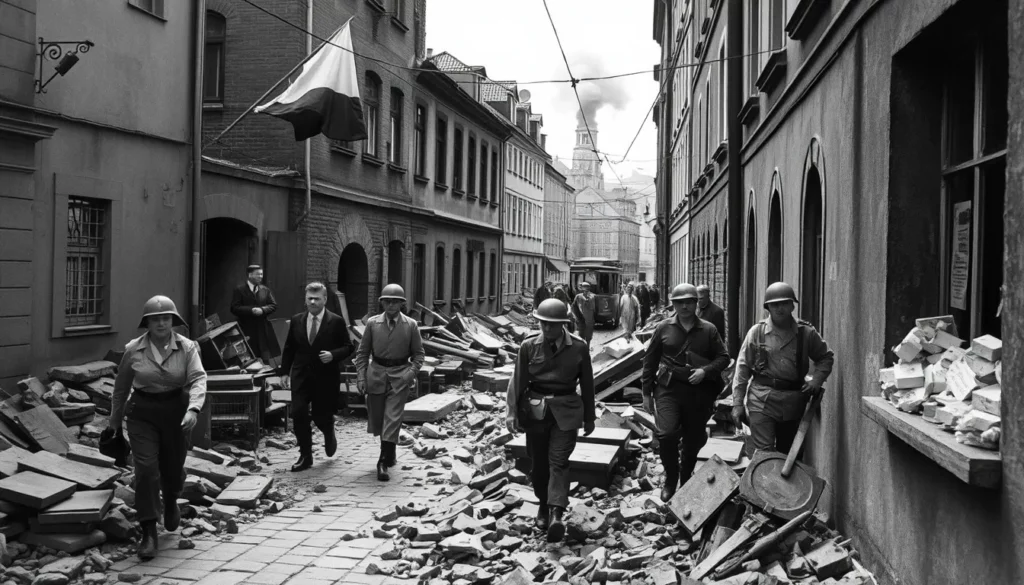
The visual record of Warsaw in 1944 is extensive but uneven. Photographs taken by Polish insurgents, German propaganda units, and later Soviet photographers show barricades, ruined streets, civilians in cellars, insurgent portraits, field hospitals, and the expulsion of the population. Some images were staged for propaganda; others are raw records of destruction.
Collections held by the Warsaw Rising Museum, the Polish National Digital Archives, and the German Bundesarchiv preserve photographs of the Old Town, Śródmieście, and the Vistula bridges. These images are essential evidence for the scale of destruction and for the material culture of the uprising: uniforms, armbands, weapons, posters, and makeshift shelters.
Documents & Primary Sources
Historians of Warsaw in 1944 rely on a wide range of primary sources. Civilian diaries, such as those of Maria Bańkowska, Teresa Wilska, Leopold Buczkowski, Teresa Łatyńska, and Zofia Charytańska, describe daily life, fear, and loss. Underground reports from the Home Army and the Government Delegation provide military and political context. Other sources include German administrative records, maps, posters, orders, ration cards, photographs, and post-war testimonies.
Key collections include the Warsaw Rising Museum, the Institute of National Remembrance, the Archiwum Akt Nowych, the National Library of Poland, and the Polish Underground Movement Study Trust in London. These archives preserve both the paper trail of the underground state and the intimate record of civilians caught in the fighting.
1944 Timeline
| Date | Event |
|---|---|
| July 1944 | Soviet forces advance toward the Vistula; German authorities intensify defences in Warsaw. |
| 1 August 1944 | The Warsaw Uprising begins at 5 p.m., the so-called W hour. |
| 5 August 1944 | German forces carry out mass killings of civilians in Wola. |
| 15 August 1944 | St. John’s Cathedral in the Old Town collapses during fighting. |
| 21 August 1944 | Women couriers move ammunition through the sewers between insurgent positions. |
| 1 September 1944 | Evacuation through the sewers from threatened districts continues. |
| September 1944 | Soviet forces take Praga but do not cross the Vistula in force to relieve the uprising. |
| 2 October 1944 | Bór-Komorowski signs the act of capitulation. |
| 3 October 1944 | Ceasefire takes effect; German forces begin expelling the civilian population. |
| October 1944 onward | Warsaw is systematically destroyed; survivors are dispersed. |
What Changed Next
After October 1944 Warsaw was a ruined and emptied city. German forces destroyed buildings, archives, and infrastructure; civilians were sent to transit camps, labour camps, and other parts of occupied Poland. In January 1945 Soviet and Polish communist-led forces entered the city. The post-war reconstruction of Warsaw became a symbol of national survival, but the political memory of the uprising was contested under communist rule.
The diaries and underground reports survived in archives, private hands, and later published collections. They remain essential for understanding the uprising not only as a military episode but as a human catastrophe and a moment of civic resistance.
Sources
- Polish Academic Information Center, Warsaw Uprising: Diaries, http://info-poland.icm.edu.pl/exhib/warsaw/diaries.html.
- Marta Taperek, "Obserwując płonące miasto. O ludności cywilnej i (nie)uczestniczeniu w powstaniu warszawskim w Notatkach z okresu Powstania Warszawskiego Zofii Charytańskiej", Białostockie Studia Literaturoznawcze (2017), https://doi.org/10.15290/bsl.2017.10.03.
- Norman Davies, Rising ’44: The Battle for Warsaw (London: Macmillan, 2003).
- Włodzimierz Borodziej, The Warsaw Uprising of 1944, trans. Barbara Harshav (Madison: University of Wisconsin Press, 2006).
- Jan M. Ciechanowski, The Warsaw Rising of 1944 (Cambridge: Cambridge University Press, 1974).
FAQ
What was the population of Warsaw in 1944?
Estimates vary because of occupation, deportation, and flight. Pre-war Warsaw had about 1.3 million people, but by mid-1944 perhaps 900,000–1,000,000 remained in the city, with the left bank heavily overcrowded.
What major events happened in Warsaw in 1944?
The central event was the Warsaw Uprising, from 1 August to 3 October 1944. It included the Wola massacres, the collapse of St. John's Cathedral, sewer evacuations, the Soviet capture of Praga, and the final capitulation and expulsion of civilians.
What primary sources are available for studying Warsaw in 1944?
Researchers use civilian diaries, Home Army and Government Delegation reports, German administrative records, underground newspapers, maps, photographs, posters, and post-war testimonies held in Polish and international archives.
How did daily life in Warsaw in 1944 differ from today?
Daily life was dominated by occupation, scarcity, bombardment, and displacement. People relied on black markets, secret schools, and clandestine media, while movement was restricted by barricades, patrols, and the destruction of infrastructure.

Leave a Reply