
Short Answer
Quick Snapshot
This article treats the phrase “Tulsa in 1921: Greenwood Before and After the Massacre” as the history of Tulsa’s Greenwood District in the months around May 31–June 1, 1921. That scope is the most common encyclopedic meaning of the subject: not a general survey of all Tulsa history, but a focused account of a thriving African American neighborhood, its destruction by a white mob, and the immediate aftermath.
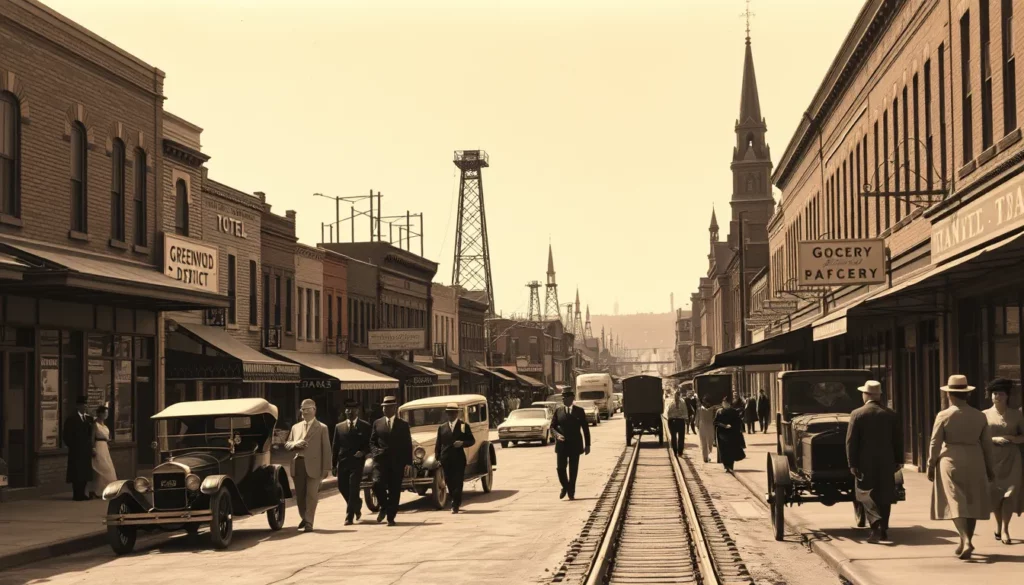
In 1921 Tulsa was an oil-boom city of about 72,000 people, and Greenwood was its Black commercial and residential heart. Dubbed “Negro Wall Street” by contemporaries, the district contained churches, schools, theaters, hotels, groceries, barbershops, doctors’ offices, and professional men and women who served a segregated community. Then, on May 31 and June 1, a white mob attacked Greenwood, burning homes and businesses and killing an unknown number of Black residents. The state’s official count was 36 dead, but historians have long estimated the toll at 100 to 300.
After the massacre, thousands of Black Tulsans were interned, and much of Greenwood lay in ashes. Yet survivors rebuilt. Within a few years the district rose again, though the massacre was largely silenced in public memory for decades. Greenwood’s story in 1921 is therefore both a record of extraordinary community life and a warning about how quickly that life could be taken.
Tulsa in 1921
Tulsa sits in northeastern Oklahoma on the Arkansas River, a region of rolling prairie and oil fields. By 1921 the city was still young in infrastructure but old enough in ambition to boast skyscrapers, rail yards, refineries, and new subdivisions. The discovery of oil at Glenn Pool in 1905 and later fields had transformed Tulsa into a boomtown. Strangers arrived weekly looking for work, and the city’s streets mixed Oklahoma accents with those of Kansas, Texas, Arkansas, and the Deep South.
The climate was warm and sometimes humid in late spring. Memorial Day 1921 fell on a Monday, and Tulsa’s parks and streetcars were busy with holiday crowds. But the city was also rigidly segregated. Oklahoma law and local custom separated Black and white Tulsans in schools, theaters, hospitals, and public accommodations. Greenwood, north of the downtown railroad tracks, was the place where Black Tulsans built a parallel world of institutions and businesses. Its churches, fraternal lodges, and storefronts gave the district a density and confidence that visitors noticed.
Population & Economy
The 1920 federal census counted 72,075 people in Tulsa. Estimates of Greenwood’s population in 1921 vary, but roughly 10,000 African Americans lived in the district and nearby blocks. Many had come from the rural South or from older Black towns in Oklahoma. Greenwood’s economy rested on segregation: because white-owned businesses excluded or mistreated Black customers, Black entrepreneurs supplied groceries, clothing, insurance, funeral services, medical care, and entertainment within the neighborhood.
Oil and rail work dominated the wider Tulsa economy, but Greenwood had its own commercial hierarchy. The Stradford Hotel, founded by J. B. Stradford, was a symbol of Black wealth. O. W. Gurley, an early Greenwood entrepreneur, owned land and businesses. The Williams Dreamland Theatre drew audiences for films and live acts. Grocers, tailors, barbers, cooks, domestic workers, and laborers all formed part of the district’s working life. Prices were those of the early 1920s: a newspaper cost a few cents, a loaf of bread about a dime, and rents varied widely by block and building. For many Black Tulsans, Greenwood was not merely a neighborhood but a market, a social club, and a refuge.
Government & Politics
Tulsa had a commission form of government in 1921. Mayor T. D. Evans and city commissioners presided over a city whose police force was small and whose political culture was shaped by boosterism and white supremacy. The county sheriff was Willard M. McCullough, and the police chief was John Gustafson. Oklahoma’s governor, James B. A. Robertson, would ultimately declare martial law. Adjutant General Charles F. Barrett commanded the Oklahoma National Guard units that entered Tulsa.
Black Tulsans lived under Jim Crow, but Greenwood had its own civic leaders, ministers, newspaper editors, and lawyers. A. J. Smitherman edited the Tulsa Star, a Black newspaper that reported on lynching, civil rights, and community progress. During the crisis, Greenwood residents appealed to local authorities for protection and, when that failed, armed themselves to prevent a lynching. The political failure of May 31 was not abstract: it was the decision of local officials and white citizens to tolerate, and often join, a mob.
Industry
Oil was the engine of Tulsa’s prosperity. Derricks, pipelines, refineries, tank farms, and railroad shops employed thousands. The city’s skyline rose on petroleum money, and its newspapers were filled with lease sales and drilling reports. Greenwood’s industry was smaller in scale but varied: retail shops, restaurants, cleaning establishments, shoe repair, tailoring, hauling, construction, and professional services. Black teachers, nurses, dentists, and lawyers depended on the district’s customers because downtown offices were largely closed to them.
The Tulsa Star and other Black publications linked Greenwood to a wider network of African American business and politics. The district’s hotels and rooming houses served traveling musicians, salesmen, and laborers. Churches functioned as mutual-aid agencies as well as places of worship. Greenwood’s economic success was real, but it was fragile: it depended on segregation, limited capital, and the goodwill or indifference of white landlords, banks, and city inspectors.
Education
Tulsa’s schools were segregated. Black children attended separate schools, and Greenwood parents pressed for better facilities and trained teachers. Booker T. Washington High School was the community’s best-known secondary institution, a source of pride and a center of neighborhood identity. Elementary schools and church-sponsored classes supplemented public instruction. No reliable district-wide literacy rate for Greenwood in 1921 is available, but the presence of physicians, attorneys, teachers, and newspaper editors indicates that many adults were highly literate.
Education was also political. Black Tulsans knew that schooling could preserve dignity and economic independence. Teachers and ministers encouraged young people to respect the district’s institutions, and graduates often moved into trades, teaching, or further study. The destruction of schools in the massacre therefore struck at Greenwood’s future as well as its present.
Transportation
Tulsa in 1921 was a railroad city. The Frisco, Santa Fe, and Midland Valley lines carried freight and passengers, and the tracks north of downtown marked a physical as well as social boundary. Streetcars connected Greenwood to downtown and to white residential districts, though seating and treatment were segregated. Automobiles were increasingly common, but working-class families still relied on walking, wagons, jitneys, and streetcars.
For Greenwood residents, transportation meant both mobility and vulnerability. The streetcar could carry a worker to a downtown job, but it could also carry a mob toward the district. When violence began, the railroads and roads became escape routes for families fleeing with whatever they could carry.
Everyday Life
Daily life in Greenwood mixed hard work with strong institutions. Families rented or owned small frame houses; some brick commercial buildings lined the main streets. Women cooked, cleaned, sewed, and worked in homes and businesses; men labored in oil fields, rail yards, shops, and trades. Children attended school, ran errands, and played in streets and vacant lots. On Sundays, churches such as Vernon AME and Mount Zion Baptist drew large congregations.
Entertainment included the Dreamland Theatre, lodge meetings, baseball, music, and church socials. Clothing followed the fashions of the early 1920s: suits and hats for professional men, modest dresses and coats for women, and practical work clothes for laborers. Food was simple and regional—cornbread, beans, greens, chicken, and pies—but restaurants and groceries offered variety. Greenwood was not a utopia; poverty and inequality existed. Yet it was a community with its own newspapers, leaders, and social calendar, and that ordinary life is what the mob destroyed.
Major Events
On May 30, 1921, a Black shoe shiner named Dick Rowland encountered Sarah Page, a white elevator operator, in the Drexel Building downtown. What happened in the elevator remains disputed; Page later declined to press charges. On May 31, Rowland was arrested and held at the county courthouse. The Tulsa Tribune published a story under the headline “Nab Negro for Attacking Girl in Elevator,” and a white crowd gathered at the courthouse.
Armed Black men, including veterans of World War I, went to the courthouse to prevent a lynching. Shots were fired, and the violence spread. White mobs, some deputized by local officials, attacked Greenwood. Homes and businesses were looted and burned. Eyewitnesses reported airplanes in the sky, though the extent of their role remains debated by historians. On June 1, Governor Robertson declared martial law, and National Guard troops interned thousands of Black residents. The Red Cross later estimated that 1,256 houses had been burned. The official death count was 36, but modern scholarship places the toll much higher.
What Newspapers Were Reporting
Tulsa had two major daily newspapers, the morning Tulsa Daily World and the afternoon Tulsa Tribune. Their coverage reflected the white business class and often inflamed rather than calmed the crisis. The Tribune’s May 31 headline was widely read and repeated:
“Nab Negro for Attacking Girl in Elevator” — Tulsa Tribune, May 31, 1921, headline as later cited.
The Tulsa Daily World reported the courthouse confrontation and the spread of violence, using language that treated white mob action as a “race riot” rather than a massacre. After the destruction, newspapers carried relief appeals, lists of the dead and injured, and debates over blame. Black newspapers such as the Tulsa Star had reported on lynching and civil rights before the massacre; its editor, A. J. Smitherman, was among those displaced by the violence. The newspaper record is essential but must be read critically, because it preserves the assumptions of the perpetrators as well as the facts of the event.
What People Were Talking About
In the days after the massacre, Black survivors talked about escape, loss, and betrayal. Families searched for missing relatives, tried to recover bodies, and wondered whether insurance would pay for burned homes. White Tulsans debated whether the city should rebuild Greenwood, who was to blame, and how to prevent future disorder. Rumors about armed Black resistance and alleged plots circulated widely.
Survivor accounts provide a different conversation. B. C. Franklin, a Greenwood attorney, later wrote of hiding with his family and watching the district burn. Mary E. Jones Parrish, a teacher and journalist, collected survivor testimony in Events of the Tulsa Disaster (1922), preserving voices that official reports often ignored. Greenwood leaders insisted that the community had been loyal and law-abiding and that the city owed it protection and relief. Those arguments would shape the rebuilding effort and the long campaign for acknowledgment.
Historical Photographs
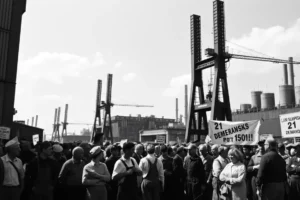
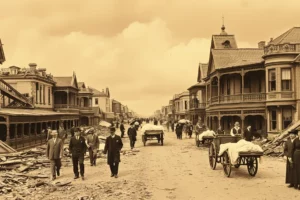
Photographs of the Tulsa Race Massacre survive, but they are fragmentary and uneven. They show burned blocks, ruined storefronts, crowds of refugees, National Guard troops, and interned Black residents. The National Museum of African American History and Culture holds images such as a photographic print of men and women in front of Vernon AME Church and a photograph of people standing in line on a Tulsa street. Such images document both community life and sudden displacement.
No single comprehensive photographic survey of Greenwood before the massacre is known. Historians therefore combine photographs with maps, city directories, and newspaper images. The visual record is powerful but incomplete: it captures the destruction more fully than the ordinary prosperity that preceded it. For that reason, reconstructing Greenwood requires written sources as well as pictures.
Documents & Primary Sources
- Federal census records, especially the 1920 census, which document Tulsa’s population and household structure.
- Tulsa city directories, which list Greenwood businesses, addresses, and occupations.
- Mary E. Jones Parrish, Events of the Tulsa Disaster (1922), a compilation of survivor testimony and contemporary observation.
- American Red Cross relief reports, which record the number of burned houses and the scale of relief work.
- B. C. Franklin’s survivor account, held in archival collections, which describes the violence and its aftermath.
- Oklahoma Commission to Study the Tulsa Race Riot of 1921, Tulsa Race Riot: A Report (2001), which synthesizes archival evidence and historical estimates.
1921 Timeline
| Date | Event |
|---|---|
| May 30 | Dick Rowland and Sarah Page encounter each other in the Drexel Building elevator. |
| May 31 | Rowland is arrested; the Tulsa Tribune publishes an inflammatory headline; a white crowd gathers at the courthouse; shots are fired and violence spreads. |
| June 1 | Greenwood is attacked and burned; Governor Robertson declares martial law; National Guard troops intern thousands of Black residents. |
| Early June | Fires smolder; relief efforts begin; survivors search for missing family members and property. |
| June 1921 | A grand jury begins investigating the massacre; Red Cross and local relief agencies assist the displaced. |
| Late 1921 | Rebuilding begins amid new fire ordinances, insurance disputes, and continuing racial tension. |
What Changed Next
Greenwood did not disappear. Survivors rebuilt homes and businesses during the 1920s, and by the 1940s the district had again become a thriving center of Black Tulsa life. But the massacre left deep scars. Insurance companies often denied claims, and city regulations made rebuilding harder. No meaningful reparations were paid, and for decades the event was omitted from public memory and school curricula.
Later urban renewal and highway construction, especially Interstate 244, cut through Greenwood and displaced many residents. In 2001 the Oklahoma Commission to Study the Tulsa Race Riot of 1921 published a report that documented the scale of the destruction and recommended reparations. The centennial in 2021 brought renewed attention, but the struggle over memory, justice, and repair continues.
Sources
- Parrish, Mary E. Jones. Events of the Tulsa Disaster. Tulsa, 1922.
- Oklahoma Commission to Study the Tulsa Race Riot of 1921. Tulsa Race Riot: A Report. 2001.
- Hirsch, James S. Riot and Remembrance: The Tulsa Race War and Its Legacy. Houghton Mifflin, 2002.
- Parshina-Kottas, Yuliya, and Anjali Singhvi. “How We Reconstructed the Neighborhood Destroyed by the Tulsa Race Massacre.” NYT Open, July 2, 2021. https://open.nytimes.com/how-we-reconstructed-the-neighborhood-destroyed-by-the-tulsa-race-massacre-33fcf32dd086.
- National Museum of African American History and Culture. “Remembering Tulsa Before the Massacre.” https://nmaahc.si.edu/explore/stories/remembering-tulsa-before-massacre.
FAQ
What was the population of Tulsa in 1921?
The 1920 federal census counted 72,075 people in Tulsa. Greenwood's African American population in 1921 is usually estimated at about 10,000.
What major events happened in Tulsa in 1921?
The central event was the Tulsa Race Massacre of May 31–June 1, 1921, when a white mob destroyed most of Greenwood, killed an unknown number of Black residents, and led to the internment of thousands of survivors.
What primary sources are available for studying Tulsa in 1921?
Key sources include the 1920 census, Tulsa city directories, Mary E. Jones Parrish's Events of the Tulsa Disaster, Red Cross relief reports, B. C. Franklin's survivor account, newspaper issues, photographs, and the 2001 Oklahoma Commission report.
How did daily life in Tulsa in 1921 differ from today?
Daily life was segregated by law and custom, relied on streetcars and railroads rather than interstate highways, and lacked modern communications and medical technology. Greenwood, however, had its own thriving business and institutional life that was destroyed in the massacre.










Leave a Reply