
Short Answer
Quick Snapshot
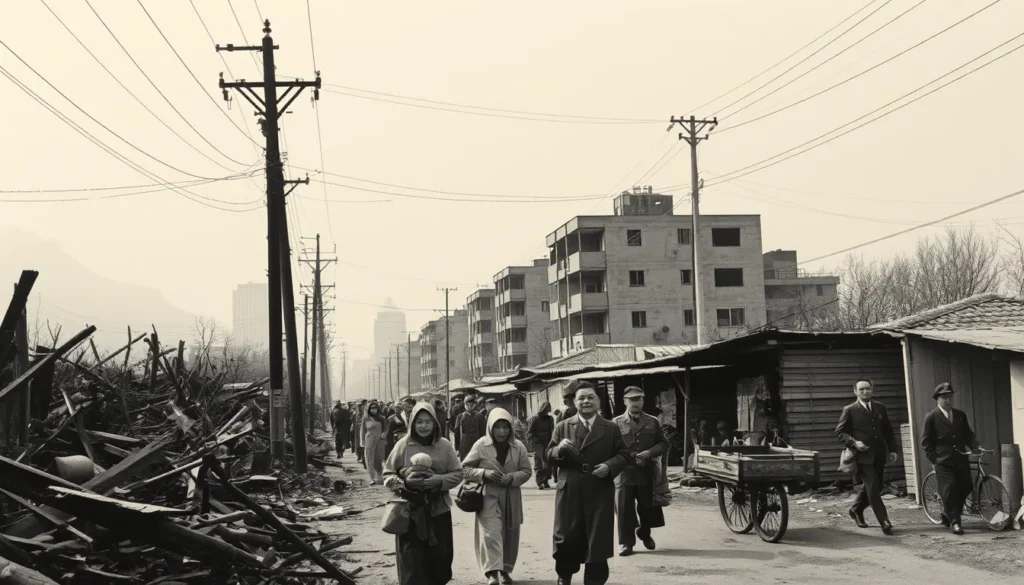
Tokyo in 1945 was the capital of an empire at war and a city on the edge of annihilation. The metropolis that had grown into one of the world’s largest urban centers was by spring a landscape of blackout curtains, ration lines, air-raid alarms and, in the eastern lowlands, acres of charred rubble. The American B-29 campaign against Japan reached its terrible climax over Tokyo on the night of 9–10 March 1945. In Operation Meetinghouse, incendiary bombs created a firestorm that burned roughly sixteen square miles, killed at least 83,793 people according to the wartime Tokyo police count, injured more than 40,000, and left over one million homeless.
The year also contained the end of the war. Further incendiary raids, the atomic bombings of Hiroshima and Nagasaki, the Soviet declaration of war, and the emperor’s broadcast of 15 August led to Japan’s acceptance of the Potsdam Declaration and the formal surrender on 2 September 1945. For Tokyo, 1945 was therefore both a year of catastrophe and a year of political collapse and transition. This article treats the subject as wartime Tokyo in the metropolitan area, with emphasis on the urban core and the events that made the year decisive in Japanese and world history.
Tokyo in 1945
Tokyo lay on the Kanto Plain facing Tokyo Bay, a low, river-crossed city of wooden houses, narrow lanes, canals, railways and factories. The Sumida and Arakawa rivers, the bay shore, and the dense shitamachi districts east of the imperial palace were especially vulnerable to fire. The climate also mattered: late-winter cold and strong seasonal winds helped turn the March incendiaries into a firestorm, while summer heat and humidity added to the misery of the homeless. The city’s skyline was still punctuated by government ministries, department stores, universities and the imperial palace, but by mid-1945 the atmosphere was dominated by scarcity, fear and exhaustion.
Tokyo was not simply a ruin. It remained the administrative heart of the empire, the seat of the emperor, the cabinet, the Home Ministry, the military command and the national press. Civil servants, railway workers, doctors, police and neighborhood officials continued to function amid raids. Yet the war had transformed the city into a front line. Blackouts, sandbagged windows, firebreaks, evacuee trains and ubiquitous uniforms marked daily life. The contrast between the surviving monumental center and the burned eastern districts became one of the defining images of the year.
Population & Economy
At the 1940 census, Tokyo City had about 6.7 million residents, making it one of the largest cities in the world. Wartime evacuation, military conscription, factory dispersal and the firebombing reduced and displaced the 1945 population, though exact wartime figures are difficult to establish. The March raid alone made over a million people homeless; many fled to relatives in the countryside, while others crowded into schools, temples, makeshift shelters and surviving homes. The city’s population was therefore not only smaller but also more transient, with refugees, fire victims and mobilized workers moving through damaged neighborhoods.
The wartime economy was a command economy. Production was prioritized for munitions, aircraft parts, machinery and chemicals, often in small workshops scattered among residential streets. Rationing controlled rice, sugar, cloth and other essentials, but the official ration was inadequate. Households relied on sweet potatoes, soybeans, wild greens, ration substitutes and the black market. Inflation and scarcity made prices unstable; a controlled ration of rice was little comfort when people queued for hours and paid far more on the informal market. By 1945, the Tokyo economy was less a normal urban economy than a survival system organized around war production, rationing and mutual aid.
Government & Politics
Tokyo was governed nationally by a wartime cabinet under Emperor Hirohito. In April 1945, Prime Minister Kuniaki Koiso was replaced by Kantarō Suzuki, an elderly admiral who presided over the final months of the war. The metropolis itself was administered as Tokyo-to by a Home Ministry-appointed governor, reflecting the centralized wartime system in which local government was subordinate to national and military priorities. Political life was tightly controlled: censorship, surveillance, patriotic associations and the threat of repression limited public debate.
Within the leadership, the approach of defeat sharpened divisions. Hardliners insisted on continuing the war, while peace-oriented figures sought a way to end it, preferably while preserving the imperial institution. The atomic bombings, the Soviet entry into the war and the emperor’s intervention broke the deadlock. On 15 August, Hirohito’s recorded broadcast announced acceptance of the Potsdam Declaration; the formal surrender followed on 2 September. Tokyo thus became the stage on which the collapse of imperial war policy and the beginning of Allied occupation were enacted.
Industry
Tokyo’s industrial base was broad but increasingly militarized. Aircraft components, electronics, machinery, chemicals, textiles, printing and food processing all contributed to the war effort. Much production took place in small and medium workshops in the shitamachi districts, where residential and industrial space were intermingled. This pattern made the city especially vulnerable to area bombing: a raid aimed at factories inevitably burned the wooden homes of the workers who staffed them. Historians such as Thomas R. Searle have argued that the shift to incendiary area raids was not a departure from attacking industry but a continuation of it by other means, targeting the dense neighborhoods where skilled labor lived.
The March firebombing destroyed thousands of workshops and small factories along with homes. Larger enterprises dispersed machinery, moved records and tried to continue production in suburban or rural sites. The result was a fragmented war economy that could still produce weapons and repair equipment but could no longer rely on the integrated urban industrial base that had existed before 1945. For workers, the factory and the home front had collapsed into the same vulnerable space.
Education
Tokyo was a major educational center, home to Tokyo Imperial University, Keio, Waseda and numerous schools and technical institutes. By 1945, however, education had been subordinated to the war. Classes were disrupted by air-raid drills, labor service and the evacuation of schoolchildren from vulnerable urban districts. Many children were sent to the countryside under group evacuation schemes, separating families and interrupting schooling. Older students worked in factories, offices and civil defense units.
Literacy remained high, and teachers, professors and students continued to study where possible, but the war dominated the curriculum. Textbooks and newspapers emphasized loyalty, sacrifice and the defense of the homeland. The destruction of schools and the displacement of pupils left a lasting mark on the city’s educational life. In the final months, some institutions became shelters, hospitals or administrative centers for relief.
Transportation
Tokyo’s transport network was among the most modern in Asia, but by 1945 it was strained and damaged. The Yamanote, Chuo and other railway lines, the dense tram network, buses, bicycles and horse-drawn carts moved people and goods through the city. Tokyo Station and other rail terminals remained critical for military traffic and evacuation, though services were overcrowded and frequently interrupted. Fuel shortages reduced motor traffic and made bicycles and walking essential.
Air raids damaged tracks, bridges, depots and rolling stock. The firebombing destroyed streets and tram lines in the eastern districts, complicating relief and rescue. Railway workers and tram operators often kept services running under hazardous conditions. The harbor and canal system, once important for freight, also suffered from bombing and disruption. Transport in 1945 was therefore a story of emergency adaptation: temporary routes, packed evacuation trains and the daily struggle to move through a ruined city.
Everyday Life
Daily life in Tokyo in 1945 was organized around survival. Families darkened windows, prepared bucket relays and sandbags, and ran to shelters when sirens sounded. The tonarigumi, or neighborhood associations, distributed ration notices, organized fire drills and enforced civil defense rules. Housing was precarious: many people lived in wooden houses, crowded lodgings or barracks, and after March in makeshift shelters made from salvaged boards and corrugated metal.
Food was the central preoccupation. Rice was rationed but insufficient; people supplemented it with sweet potatoes, pumpkins, soybeans, seaweed, wild vegetables and whatever could be found or bought on the black market. Clothing was patched and practical; women often wore monpe trousers and air-raid hoods, while children carried identity tags and evacuation bundles. Entertainment was restricted and often somber: radio broadcasts, newsreels, films and theatrical performances were censored and directed toward wartime morale. Family life was marked by separation, bereavement and the constant uncertainty of missing relatives.
Major Events
The defining event of the year was the Operation Meetinghouse firebombing of 9–10 March 1945. B-29s dropped incendiary bombs on densely populated eastern Tokyo, creating a firestorm that overwhelmed civil defense. The raid destroyed roughly sixteen square miles, killed at least 83,793 according to the Tokyo police, and left over a million homeless. It marked a turn from precision raids against factories to large-scale area raids across Japanese cities.
Further raids struck Tokyo in April and May. The raid of 24–25 May was one of the last major incendiary attacks on the capital and damaged central and western districts. Nationally, the Potsdam Declaration of July, the atomic bombings of Hiroshima and Nagasaki in August, and the Soviet declaration of war on 8 August created the final crisis. On 15 August, Hirohito’s broadcast announced the surrender; on 2 September, Japanese officials signed the instrument of surrender aboard USS Missouri in Tokyo Bay. For Tokyo, the year ended under Allied occupation, with the city’s ruins as the backdrop to Japan’s postwar transformation.
What Newspapers Were Reporting
Tokyo newspapers such as the Asahi Shimbun and Yomiuri Hochi operated under strict wartime censorship. Reports of air raids were controlled, casualty figures were delayed or minimized, and editorial language emphasized endurance and loyalty. After the March raid, the press described the destruction in formulaic terms while officialdom struggled to manage relief. The surrender itself was announced through the imperial rescript, printed and broadcast in restrained, archaic language. One widely cited passage urged the people to accept the decision by
enduring the unendurable and suffering what is insufferable.
For historians, the newspapers are valuable not only for what they reported but for what they omitted, revealing the limits of wartime information control.
What People Were Talking About
In private, Tokyo residents talked about food, shelter, missing relatives, air raids and the likelihood of defeat. Diaries and memoirs from 1945 record rumors about the atomic bomb, the Soviet entry into the war, and the possibility that the emperor might intervene. The diarist Kiyosawa Kiyoshi and the French journalist Robert Guillain both described a city under extreme strain, where public silence coexisted with intense private anxiety. People debated whether to evacuate, whether to send children away, and how to obtain rice or medicine.
After 15 August, conversations shifted to survival and uncertainty: Would the occupation be violent? Would the emperor be punished? What would happen to food supplies and jobs? Public debate remained constrained, but the end of the war opened space for reflection on responsibility, sacrifice and loss. These private accounts are essential because they preserve the emotions and ordinary calculations that official documents often flatten.
Historical Photographs
Photographs of Tokyo in 1945 are dominated by aerial reconnaissance and strike images taken by the U.S. military, which documented the firebombing and its results. Ground-level photographs by Japanese and Allied photographers show charred districts, homeless families, makeshift shelters, damaged railways and the surreal contrast of surviving buildings amid acres of ash. The United States Strategic Bombing Survey and occupation authorities also commissioned photographs for damage assessment.
Wartime Japanese press photographs were censored and rarely showed the full scale of destruction. Postwar images therefore carry much of the visual record: burned-out neighborhoods, relief distribution, children in evacuation groups, and the formal surrender ceremonies. These photographs are not neutral illustrations; they were shaped by military, bureaucratic and journalistic purposes. Read critically, they provide indispensable evidence of the physical and human cost of the bombing.
Documents & Primary Sources
Historians of Tokyo in 1945 rely on a wide range of primary sources. The United States Strategic Bombing Survey produced detailed reports, maps and interviews on the effects of the raids. Japanese police and civil defense records, including casualty counts, relief reports and damage assessments, provide local data. Newspapers, radio scripts, imperial rescripts and government notices document official language and censorship. Diaries, letters and memoirs by residents, soldiers, students and journalists reveal private experience.
- U.S. Strategic Bombing Survey reports and aerial photographs.
- Tokyo police and civil defense records from 1945.
- Japanese newspapers, radio broadcasts and the Imperial Rescript on Surrender.
- Diaries and memoirs, including Kiyosawa Kiyoshi’s wartime diary and Robert Guillain’s eyewitness account.
- Occupation records, maps and postwar relief documents held in Japanese and American archives.
1945 Timeline
| Date | Event |
|---|---|
| 9–10 March | Operation Meetinghouse firebombing devastates eastern Tokyo; over 83,000 killed and over one million homeless according to wartime counts. |
| 7 April | Kantarō Suzuki becomes prime minister as Japan’s war position deteriorates. |
| 13 April | Further B-29 incendiary raid strikes Tokyo. |
| 24–25 May | Major firebombing raid damages central and western Tokyo. |
| 26 July | Potsdam Declaration demands Japan’s unconditional surrender. |
| 6 and 9 August | Atomic bombings of Hiroshima and Nagasaki; Soviet Union declares war on Japan on 8 August. |
| 15 August | Emperor Hirohito’s broadcast announces Japan’s acceptance of the Potsdam Declaration. |
| 2 September | Formal surrender signed aboard USS Missouri in Tokyo Bay. |
What Changed Next
The years after 1945 brought Allied occupation, demilitarization and reconstruction. Tokyo became the center of the occupation administration under General Douglas MacArthur, and the International Military Tribunal for the Far East convened in the city in 1946. The wartime ruins were cleared and rebuilt, and the city gradually resumed its role as Japan’s political, economic and cultural capital. The memory of the firebombing remained powerful but was often overshadowed in national memory by the atomic bombings and by the broader narrative of postwar recovery.
Historians continue to debate the strategic logic and morality of the area bombing campaign. For Tokyo residents, the legacy was personal as well as urban: lost families, destroyed neighborhoods, disrupted schools and workplaces, and a rebuilt city that often erased the physical traces of 1945. Memorials, archives and survivor testimony preserve the experience, while the documents and photographs of the year remain essential for understanding how the capital endured firebombing, surrender and the end of war.
Sources
- Thomas R. Searle, “‘It Made a Lot of Sense to Kill Skilled Workers’: The Firebombing of Tokyo in March 1945,” Journal of Military History 66, no. 1 (2002): 103–133. https://www.japanairraids.org/wp-content/uploads/2023/03/Searle-The-firebombing-of-Tokyo-in-March-1945.pdf
- Richard Overy, Rain of Ruin: Tokyo, Hiroshima, and the Surrender of Japan. W. W. Norton. https://wwnorton.com/books/9781324105305
- Robert Guillain, I Saw Tokyo Burning: An Eyewitness Narrative from Pearl Harbor to Hiroshima. Doubleday, 1981.
- Kiyosawa Kiyoshi, A Diary of Darkness: The Wartime Diary of Kiyosawa Kiyoshi, edited by Eugene Soviak. Princeton University Press, 1999.
- United States Strategic Bombing Survey, The Effects of Strategic Bombing on Japanese Morale. Washington, D.C., 1946.
FAQ
What was the population of Tokyo in 1945?
Exact wartime figures are uncertain. Tokyo City had about 6.7 million people in the 1940 census, but evacuation, military mobilization and firebombing sharply reduced and displaced the population by 1945.
What major events happened in Tokyo in 1945?
The Operation Meetinghouse firebombing of 9–10 March was the deadliest event, followed by further incendiary raids in April and May. In August, Japan accepted the Potsdam Declaration, and the formal surrender was signed in Tokyo Bay on 2 September.
What primary sources are available for studying Tokyo in 1945?
Key sources include U.S. Strategic Bombing Survey reports, Tokyo police and civil defense records, Japanese newspapers and radio scripts, the Imperial Rescript on Surrender, aerial photographs, diaries and memoirs by residents and journalists.
How did daily life in Tokyo in 1945 differ from today?
Daily life was dominated by air raids, blackouts, rationing, food scarcity, mass evacuation and makeshift housing. Modern conveniences, open public debate and a normal consumer economy were absent under wartime controls.










Leave a Reply