
Short Answer
Quick Snapshot
Richmond, Virginia, entered 1865 as the capital of the Confederacy and the symbolic heart of a failing war effort. Its streets were crowded with government clerks, refugees, wounded soldiers, and enslaved people, while food shortages and runaway inflation made daily life precarious. The city was both a fortress and a pressure cooker, ringed by defenses and watched anxiously as Ulysses S. Grant’s armies tightened their grip on Petersburg and Richmond.
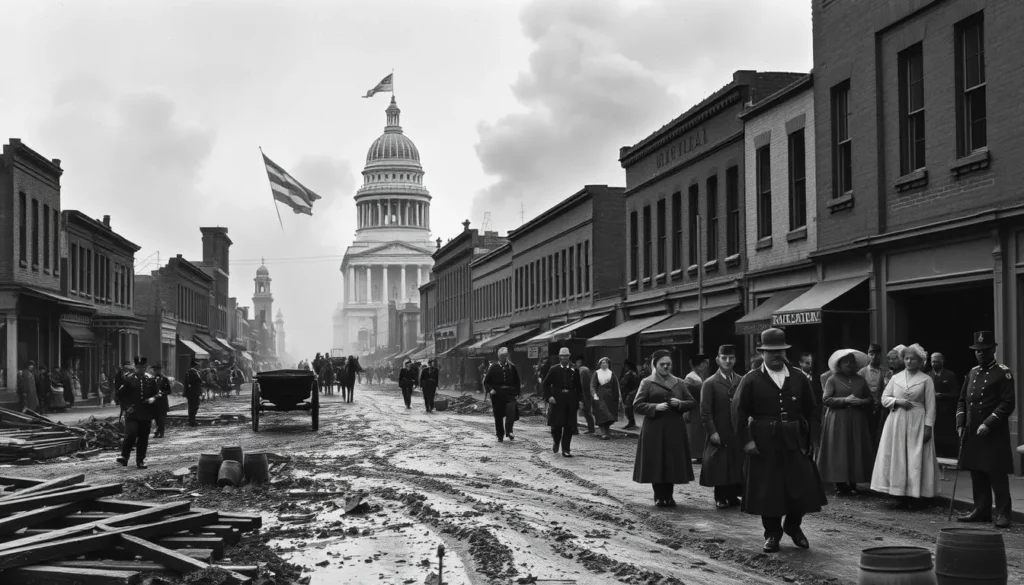
The decisive moment came on April 2–3, when Confederate forces evacuated the capital, fires consumed much of the commercial district, and Union troops under Maj. Gen. Godfrey Weitzel occupied the city. President Abraham Lincoln visited on April 4; Gen. Robert E. Lee surrendered on April 9; and within weeks the Confederate government was gone and slavery was being dismantled. For Richmonders, the fall was experienced as fear, smoke, hunger, relief, humiliation, and hope—sometimes all at once.
This article examines Richmond in 1865 through contemporary eyes: diaries, letters, newspapers, photographs, and official records. The scope is Richmond, Virginia, during the calendar year, with special attention to the fall of the Confederacy as contemporaries recorded it.
Richmond in 1865
Richmond sits at the fall line of the James River, its streets climbing steep hills above the water. In 1865 the city was a dense mix of brick warehouses, government offices, churches, hospitals, and crowded boardinghouses. The James River and Kanawha Canal, the railroads, and the river itself made Richmond a transportation hub, but war had turned that hub into a target. Earthworks and batteries surrounded the city, and the sounds of fighting around Petersburg could sometimes be heard in the distance.
The climate in early 1865 was wet and raw. Loomis L. Langdon, a Union artillery captain, noted rain and mud in late March, and Clara Shafer, a Richmond resident, described a night of fear and confusion during the evacuation. Spring brought no easy relief: the city was dirty, overcrowded, and exhausted. Hospitals such as Chimborazo treated thousands of sick and wounded men, while churches, schools, and private homes had been converted to wartime uses.
The atmosphere was one of foreboding and rumor. Confederate defeats had eroded confidence, and the presence of refugees and government workers made the city feel transient. Yet Richmond remained a place of intense social contrasts: wealthy families in townhouses, poor laborers in crowded tenements, enslaved people living under constant surveillance, and free Black residents navigating a hostile racial order. The fall of the city would expose all these tensions.
Population & Economy
In 1860 Richmond’s population was 37,910. By 1865 the wartime capital had swollen far beyond that figure, though no reliable census counted the crowds of soldiers, government clerks, refugees, and enslaved people who passed through. A common estimate places the wartime population near 100,000 at its height, but the exact number is uncertain. The city included white Virginians, Confederate officials from across the South, immigrant workers, free Black residents, and enslaved people hired out or forced into government service.
The economy was dominated by war. The Confederate government employed clerks, printers, armorers, and women who signed and numbered treasury notes. Tredegar Iron Works produced ordnance and rails; tobacco factories, flour mills, and iron foundries operated under military pressure; and hospitals created their own demand for food, bedding, and labor. But inflation crippled ordinary households. Judith McGuire recorded in 1863 that she paid 75 cents for a partridge and $1.50 per dozen for eggs, and she feared the currency was collapsing. By 1865 prices had grown even more ruinous, and staples such as coffee, sugar, flour, and meat were scarce.
The April fire destroyed banks, stores, warehouses, and government buildings, wiping out much of the commercial district. In the aftermath, Union authorities distributed food, regulated trade, and issued passes. The old Confederate economy vanished almost overnight, replaced by military occupation and the first uncertain steps toward free labor.
Government & Politics
Richmond’s municipal government was led by Mayor Joseph C. Mayo, while the Confederate national government under President Jefferson Davis and the Virginia state government under Gov. William Smith dominated the city’s political life. The Confederate Congress debated desperate measures, including the recruitment of enslaved men as soldiers, a proposal that exposed the contradictions of a slaveholding republic fighting for independence. Defeatism spread through the capital, and rumors of evacuation circulated in late March and early April.
On April 2, Davis and other officials left Richmond by train as Confederate forces prepared to abandon the city. The next day, Union troops occupied the capital, and military government under Gen. Godfrey Weitzel replaced Confederate authority. Lincoln’s visit on April 4 signaled that the United States intended to reclaim the city, but the legal and political status of Virginia remained unsettled. Later in 1865, the Freedmen’s Bureau began its work, and African Americans in Richmond took their first steps toward citizenship, education, and political organization.
Industry
Richmond’s industrial landscape was dominated by Tredegar Iron Works, one of the South’s largest iron manufactories, which produced cannon, shot, rails, and machinery for the Confederacy. The Richmond Arsenal and Confederate ordnance bureaus employed skilled workers and laborers. Tobacco factories rolled and pressed leaf for export and military use; Gallego Mills and other flour mills processed grain; and foundries, machine shops, and clothing bureaus supplied the army.
The evacuation fire devastated this industrial base. Clara Shafer recorded that Confederate forces set fire to tobacco warehouses, mills, magazines, and other buildings, and that flames destroyed sixteen squares on Main Street, including banks, the War Department, and the American Hotel. After the occupation, Union authorities seized or used surviving facilities, and Northern entrepreneurs began to survey the ruins. The war had turned Richmond into a workshop of rebellion; defeat turned it into a workshop of reconstruction.
Education
Before the war, Richmond had several private academies, church schools, and institutions of higher learning, including Richmond College and the Medical College of Virginia. Literacy among white residents was relatively high, but enslaved people were forbidden by law from learning to read and write, and free Black education was severely restricted. The war disrupted schools as buildings were converted to hospitals or barracks and teachers and students were drawn into military or government service.
After the occupation, education became a battleground of Reconstruction. Northern missionary societies and the Freedmen’s Bureau established schools for African American children and adults, often in churches or rented rooms. These schools faced hostility from some white residents but represented a profound change: formerly enslaved people eagerly sought literacy as a tool of freedom.
Transportation
Richmond was connected to the wider South by railroads, including the Richmond and Danville, the Virginia Central, the Richmond, Fredericksburg and Potomac, and the Richmond and Petersburg. The James River and Kanawha Canal carried goods along the river, and steamboats and bateaux moved people and produce on the James. Within the city, horse-drawn streetcars and omnibuses rattled over cobblestone and dirt streets, though war and fire disrupted service.
During the evacuation, bridges and railroad facilities were damaged or destroyed, and Union forces had to restore communications and supply lines. The arrival of Union troops brought new traffic: wagons, artillery, and soldiers filled the streets, while freedpeople moved toward Union lines and aid.
Everyday Life
Daily life in 1865 was shaped by scarcity and fear. Families queued for bread, stretched rations, and substituted chicory or parched corn for coffee. Women worked in government offices, hospitals, and sewing rooms; Sallie Brock Putnam recalled the Treasury Note bureau as a place where “hundreds of intelligent and deserving women” signed and numbered Confederate bills. Housing was crowded, and refugees doubled up with relatives or rented rooms. Clothing was patched and homespun, and public entertainment was subdued by war and mourning.
The evacuation brought chaos. Clara Shafer wrote of a night of confusion and terror: “I never spent such a night and hope never may again.” Langdon, entering with the Union army, recorded a different mood: “Every body as happy as they could be possibly.” Shafer also noted the presence of African American soldiers, writing with the racism of her class that “the Negro soldiers” were “stepping about as grandly as possible.” For enslaved and free Black Richmonders, the occupation meant the possibility of freedom, though racism and inequality persisted.
“Our forces were leaving the city all night. The last left about day-light—after setting fire to all the buildings in which tobacco was housed, several mills, magazines, et cetera.”
—Clara Shafer, diary, April 1865
Major Events
The year’s central events unfolded with astonishing speed. On April 2, Confederate lines at Petersburg broke, and Richmond was evacuated. Fires and looting followed. On April 3, Union troops entered the city; Langdon and Lt. Johnston L. de Peyster are credited with raising the first U.S. flag over the Virginia Capitol. On April 4, Lincoln visited Richmond and was surrounded by crowds. On April 9, news of Lee’s surrender reached the city, and salutes were fired. On April 14–15, Lincoln was assassinated, plunging the occupied capital into uncertainty. On May 10, Jefferson Davis was captured in Georgia, and by summer the Freedmen’s Bureau and military authorities were reshaping Richmond’s postwar life.
What Newspapers Were Reporting
Richmond’s wartime newspapers—chiefly the Richmond Dispatch and the Richmond Examiner—had spent the winter printing military bulletins, casualty lists, currency notices, and defiant editorials. In late March and early April 1865, they reported Grant’s movements, the approach of Union armies, and the government’s preparations for emergency. Once the city fell, the presses were silenced or placed under Union scrutiny. Occupation authorities used printed notices and friendly sheets to announce passes, food distribution, curfews, and the restoration of order. The newspapers of 1865 thus recorded both the last gasps of Confederate propaganda and the first official voices of Union rule.
What People Were Talking About
Richmonders talked about evacuation, arson, looting, and what Union occupation would mean. Rumors raced through churches, markets, and boardinghouses: Would the Yankees sack the city? Would Confederate troops burn it? Would enslaved people rise? Diarists recorded fear of fire and violence, but also exhaustion with war. Langdon noted Lincoln’s visit and the crowd that surrounded him; Shafer described the “white tents and covered wagons of the enemy” and worried about the behavior of servants and freedpeople. Underneath the rumors lay the largest question of all: what would freedom mean in a city built on slavery?
Historical Photographs
Richmond in 1865 is among the most photographed Southern cities of the war’s end. Mathew Brady, Alexander Gardner, Thomas C. Roche, and other Union photographers captured the burned district, the Virginia Capitol, Libby Prison, St. Paul’s Church, and the crowds that greeted Lincoln. These images show gutted storefronts, twisted rails, African American soldiers, and white civilians in period dress. They are both documentary evidence and instruments of memory: Northern photographers used ruins to demonstrate Confederate defeat, while later generations used them to craft narratives of loss and reunion.
Documents & Primary Sources
Historians rely on a rich body of primary sources for Richmond in 1865. The University of Virginia Library’s exhibit “Who shall tell the story?” preserves the diaries of Loomis L. Langdon and Clara Shafer, which offer contrasting Union and Confederate views of the evacuation and occupation. The National Park Service’s Richmond Speaks: Voices from the Home Front collects excerpts from Judith McGuire, J. B. Jones, Sallie Brock Putnam, and Phoebe Yates Pember. Other key sources include the 1860 census, Richmond city directories, maps of the burned district, Confederate government records, Freedmen’s Bureau records, local newspapers, and the photographs held by the Library of Congress and the National Archives.
1865 Timeline
| Date | Event |
|---|---|
| March 13 | Confederate Congress authorizes the recruitment of enslaved men as soldiers, a measure debated in Richmond. |
| April 2 | Confederate government evacuates Richmond; Jefferson Davis leaves by train; fires and looting begin. |
| April 3 | Union troops under Gen. Godfrey Weitzel occupy Richmond; U.S. flag raised over the Capitol. |
| April 4 | President Abraham Lincoln visits Richmond and is surrounded by crowds. |
| April 9 | Gen. Robert E. Lee surrenders at Appomattox; news reaches Richmond and salutes are fired. |
| April 14–15 | Lincoln is assassinated; Richmond remains under Union military authority. |
| May 10 | Jefferson Davis is captured in Georgia; the Confederate government definitively ends. |
| June | The Freedmen’s Bureau begins work in Virginia, including Richmond. |
| Fall | Reconstruction policies and military rule shape Richmond’s postwar order. |
What Changed Next
Richmond after 1865 was a city under occupation and reconstruction. Slavery was abolished, and African Americans began building churches, schools, and political organizations. The Freedmen’s Bureau and Northern aid societies provided food, education, and legal assistance, though white resistance and racial violence persisted. Virginia was readmitted to the Union in 1870, and Richmond slowly rebuilt its commercial district. The memory of 1865—the fire, the occupation, Lincoln’s visit, and the fall of the Confederacy—became central to both Southern Lost Cause mythology and African American narratives of emancipation.
Sources
- University of Virginia Library, “Who shall tell the story?”: Voices of Civil War Virginia, 1865. https://explore.lib.virginia.edu/exhibits/show/voicesofcivilwarvirginia/1865/thousandsnorthandsouth
- National Park Service, Richmond Speaks: Voices from the Home Front. https://www.npshistory.com/publications/rich/brochures/home-front-voices.pdf
- Lankford, Nelson D. Richmond Burning: The Last Days of the Confederate Capital. New York: Viking, 2002.
- Thomas, Emory M. The Confederate State of Richmond: A Biography of the Capital. Austin: University of Texas Press, 1971.
- Kimball, Gregg D. American City, Southern Place: A Cultural History of Antebellum Richmond. Athens: University of Georgia Press, 2000.
FAQ
What was the population of Richmond in 1865?
The 1860 census counted 37,910 people, but wartime Richmond swelled to perhaps 100,000 with soldiers, government workers, refugees, and enslaved people. No reliable 1865 census exists.
What major events happened in Richmond in 1865?
Confederate evacuation and fires on April 2–3, Union occupation on April 3, Lincoln’s visit on April 4, Lee’s surrender on April 9, Lincoln’s assassination on April 14–15, and Jefferson Davis’s capture on May 10.
What primary sources are available for studying Richmond in 1865?
Diaries such as those of Loomis Langdon and Clara Shafer, the NPS Richmond Speaks collection, local newspapers, census and city directories, maps, Freedmen’s Bureau records, and photographs by Brady, Gardner, and Roche.
How did daily life in Richmond in 1865 differ from today?
Residents faced inflation, food shortages, military occupation, and the end of slavery. Transportation was horse-drawn or rail-based, communication was by telegraph and newspaper, and racial and social hierarchies were enforced by law and custom.










Leave a Reply