
Short Answer
In the autumn of 1918, the weekly papers of the rural South began printing the same short items: schools closed, churches dismissed, and “influenza” entered the columns beside pneumonia and typhoid. On the farms, the news arrived by mail, by neighbor, or by the county doctor’s buggy. For sharecroppers—Black and white—the pandemic was not a distant city event. It entered cabins with no running water, no telephone, and no resident physician. Families nursed fevers with kerosene lamps, camphor, whiskey, and prayer; they buried neighbors when undertakers were overwhelmed. The virus arrived in a region already shaped by poverty, segregation, and a public health system that barely reached the countryside. This article reconstructs that experience from contemporary newspapers, state and local health reports, letters, diaries, and official notices, showing how rural Southerners understood and endured the 1918 influenza pandemic.
What Happened?
The pandemic came in waves. The first, in spring 1918, was mild and often mistaken for ordinary grippe. The deadly second wave reached the U.S. South in September and October 1918, moving along troop trains, railroads, ports, and county roads. It struck military camps first, then cities, then the countryside. In rural counties, the disease spread through stores, churches, schools, and family visits, but it was often recognized only when pneumonia followed.
- Spring 1918: A mild influenza wave circulated among troops and civilians; many Southerners remembered it as a bad cold or “three-day fever.”
- September–October 1918: The lethal second wave entered Southern camps, ports, and rail towns. Local boards of health closed schools, churches, saloons, and theaters; some cities required masks.
- October–November 1918: Rural counties reported influenza and pneumonia in farm families. Cotton picking and marketing continued, and sharecroppers bound by crop liens could rarely afford to stop work.
- Early 1919: A third wave appeared in some communities. Restrictions eased, but deaths and disrupted households remained. Many rural deaths were never fully registered.
The disease often killed through viral pneumonia or secondary bacterial pneumonia. In the rural South, care depended on household labor, neighborly help, midwives, and overworked country doctors. Official death records were patchy: many Southern states and counties had weak vital statistics systems in 1918, and poor and Black families were especially likely to be missed. Newspapers, church notices, and county reports remain the fullest contemporary record.
How It Was Seen at the Time
Contemporaries called the disease “Spanish influenza,” “Spanish grippe,” or simply “the flu.” The name did not mean it began in Spain; wartime censorship and neutral Spain’s open reporting led many people to associate early news with that country. Public health officials emphasized contagion by contact and droplets. Newspapers repeated advice to avoid crowds, cover coughs, and stay home when sick. Yet many rural families also interpreted illness through older ideas about bad air, cold, fatigue, and divine will.
“Cover up each cough and sneeze, / If you don’t you’ll spread disease.” — public health rhyme reprinted in newspapers, 1918.
The mood mixed fear with fatalism. War news dominated the front pages, and the flu was often described in military language as an enemy that had invaded homes and camps. Some whites claimed African Americans were less susceptible, a racial assumption contradicted by local suffering. Others blamed soldiers, travelers, or the poor. In sharecropper cabins, the pandemic was understood less as a national event than as a series of household emergencies: who could nurse the sick, who could pick the crop, who would dig the grave.
Historical Snapshot
| Aspect | Detail |
|---|---|
| Date | 1918–1919, with the deadly fall wave in September–November 1918 and a third wave in early 1919 |
| Place | Rural counties across the U.S. South: tenant farms, crossroads stores, county seats, and isolated cabins |
| People | Black and white sharecroppers, tenant farmers, midwives, country doctors, local health officers, planters, and storekeepers |
| What Happened | Influenza and pneumonia swept through communities; schools and churches closed; families nursed the sick at home; local relief and burial systems were overwhelmed |
| Why It Mattered | Exposed rural poverty, segregation, and weak public health; produced deaths that were unevenly counted and remembered |
What People Knew at the Time
| What People Knew Then | What We Know Now |
|---|---|
| Influenza was contagious and spread through contact and droplets; crowds and coughing were dangerous. | The pandemic was caused by an H1N1 influenza virus, spread mainly by respiratory droplets and contact. |
| Pneumonia was the feared complication and a common cause of death. | Many deaths resulted from secondary bacterial pneumonia after influenza, in an era before antibiotics. |
| Some officials and newspapers claimed race, climate, or rural isolation shaped susceptibility. | Poverty, malnutrition, crowding, segregation, and unequal medical care drove disparities; no racial immunity existed. |
| Home nursing, quarantine, fresh air, and folk remedies were central to care. | Rural deaths were undercounted; newspapers and county reports provide only a partial picture. |
Contemporary Newspaper Coverage
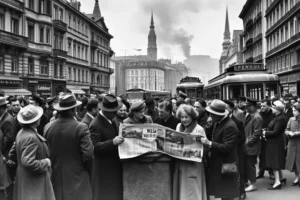
Local papers were the main source of news. In October 1918, papers such as the Atlanta Constitution, the News and Observer of Raleigh, the Montgomery Advertiser, and the Daily Arkansas Gazette carried daily notices of cases, closures, and deaths. Headlines were often plain—“Influenza” or “Epidemic”—and the tone was practical rather than sensational. Editors printed county health orders, listed the sick and dead, and urged readers to avoid crowds. The press also reflected local priorities: cotton markets, school schedules, and church notices shared space with epidemic news. Some papers minimized the danger to keep labor at work; others warned that the “grippe” was not ordinary influenza.
Rural weeklies often had less space and fewer reporters, so they relied on correspondents and official notices. Their columns show how the pandemic entered daily life: a teacher sick, a church service canceled, a merchant short of coffins, a family with several members ill at once. These small notices, rather than dramatic headlines, are the most revealing contemporary record of the rural Southern experience.
Different Perspectives
Planters and County Officials
Planters and local officials worried about labor, crops, and public order. Many supported closing schools and churches, but resisted costly measures that might disrupt cotton harvesting and marketing. Some blamed sharecroppers for spreading disease, even as poverty and debt made rest and isolation impossible for tenant families.
African American Sharecroppers
Black sharecroppers faced segregation, fewer doctors, exclusion from many hospitals, and mistrust of white officials. They relied on Black churches, midwives, neighbors, and extended kin. Some white officials claimed African Americans were immune or lightly affected, but local records and family accounts show heavy suffering. Racism shaped both care and record-keeping.
White Tenant Farmers
Poor white tenants were also isolated and debt-bound, though they were not subject to Jim Crow. Crop liens and store credit kept families working through illness. Relief, when it came, was often distributed through racial channels that favored white households.
Women and Midwives
Women carried most nursing: cooking, washing, dosing, and sitting with the feverish. Midwives attended births and sickness, and their knowledge rarely entered official reports. Their labor was central to survival in communities with few physicians.
Daily Life
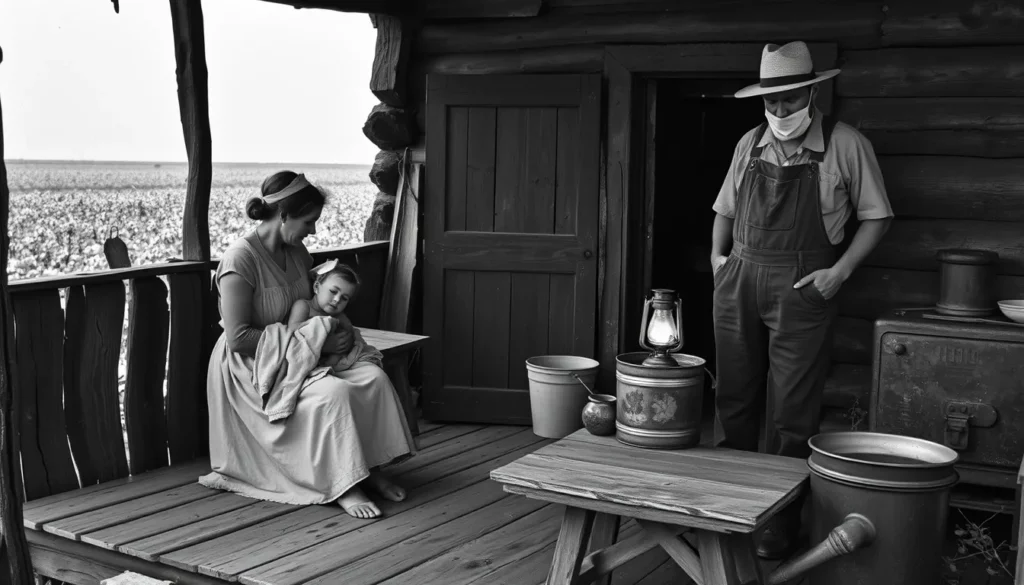
In a sharecropper cabin, daily life was already hard. Families drew water from a well or spring, cooked on a wood stove, used kerosene lamps, and relied on an outdoor privy. Diets of cornbread, molasses, pork, and beans were often inadequate. Cotton and corn set the rhythm of work. When influenza struck, quarantine was a luxury: someone had to fetch water, tend livestock, cook, and pick the crop before weather or debt ruined it.
Churches and schools were social centers as well as institutions. Their closing cut families off from news, comfort, and mutual aid. Neighbors left food at the door, hauled wood, or sat up with the sick. Folk remedies—camphor, turpentine, whiskey, onion poultices, and herbs—circulated alongside aspirin and quinine. In towns, masks and closing orders were visible; in the countryside, the pandemic was often a private struggle remembered in family stories and church notices.
How Historians See It Today
For decades, historians largely ignored the 1918 flu, focusing instead on World War I. Since the late twentieth century, social and medical historians have reconstructed the pandemic, and recent scholarship on the South has sharpened the picture. Andrew Kishuni’s studies of Southern cities and public health argue that the region’s poverty and underdeveloped health infrastructure produced a pandemic more like that of the Global South than the rest of the United States. He challenges the myth of a “democratic” flu that killed rich and poor alike, showing that African Americans often suffered higher mortality and case fatality in Southern localities. Historians now read newspapers, segregated health reports, letters, and diaries together, while acknowledging that rural and Black deaths were often undercounted.
The 1918 flu in the rural South is a history of ordinary people facing an extraordinary disease with few resources. Primary sources show that the pandemic did not level society; it followed the ruts of poverty, debt, and segregation. Sharecroppers nursed the sick in cabins, buried neighbors when institutions failed, and left fragments of their experience in newspapers, records, and family memory. Those fragments remind us that epidemics are never only biological events. They are also social histories, written in the unequal conditions of daily life.
FAQ
What was the “Spanish flu,” and why is the name misleading?
The “Spanish flu” was the 1918–1919 H1N1 influenza pandemic. Wartime censorship limited early reports in combatant countries, while neutral Spain reported the disease openly, so many people associated it with Spain. The virus did not originate there.
How did sharecroppers experience the pandemic?
Sharecroppers faced the flu in isolated cabins with little cash, no running water, and few doctors. Crop liens and debt made rest or quarantine difficult, so families nursed the sick while trying to keep work going. They relied on neighbors, midwives, churches, and folk remedies, and buried the dead when local services were overwhelmed.
Did African Americans suffer disproportionately in the rural South?
In many Southern localities, yes. Recent research using segregated health reports and local records shows higher mortality and case fatality among African Americans in many places, though data are incomplete. Racism, poverty, exclusion from hospitals, and unequal care shaped these disparities; claims of racial immunity were false.
Were rural Southern deaths accurately counted?
No. Many Southern states and counties had weak death registration in 1918, and poor, Black, and isolated families were especially likely to be missed. Newspapers, church notices, and county reports offer important evidence but do not provide a complete count.










Leave a Reply