
Short Answer
Quick Snapshot
This article treats Moscow in 1941 as the Soviet capital during Operation Barbarossa and the Battle of Moscow. It focuses on the direct threat to the city, the evacuation and panic of October, the declared state of siege, and the everyday experience of Muscovites. Moscow was never fully encircled as Leningrad was, but in the autumn and winter of 1941 it was a front-line capital under air attack, rationing, and military discipline.
At the start of 1941 Moscow was a vast industrial and administrative metropolis of more than four million people. By December, after evacuation, conscription, and flight, perhaps half that number remained. The city’s factories, metro stations, theaters, and universities were all reshaped by war.
The year ended with German armies stopped short of the capital and Soviet forces launching a counteroffensive on 5–6 December. The Battle of Moscow did not end the war, but it destroyed the myth of German invincibility and left the capital scarred, crowded, and still Soviet.
Moscow in 1941
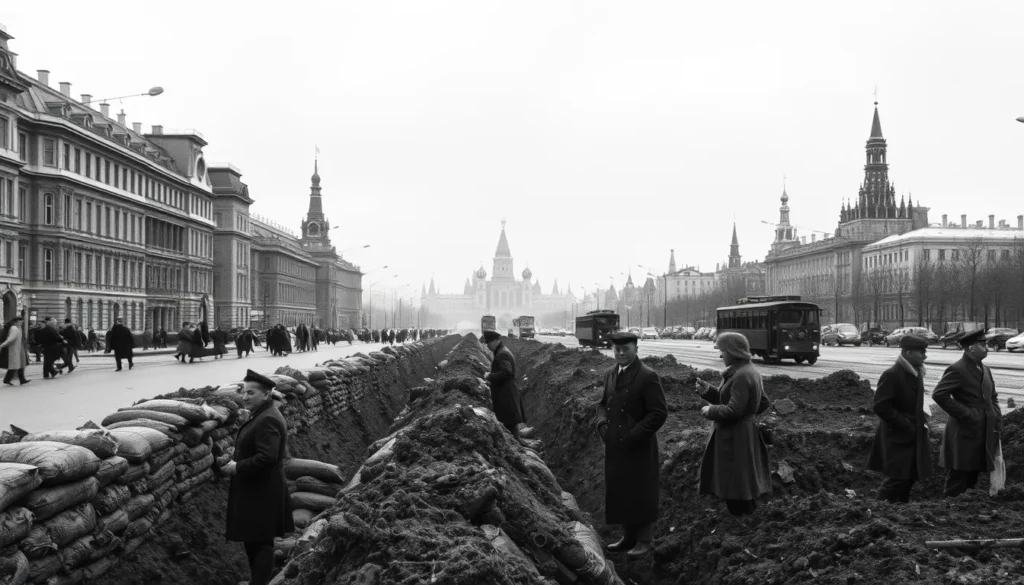
Moscow lies on the Moskva River, its plan a series of rings and radial avenues that made it a symbol of centralized power. In 1941 those boulevards and riverbanks became defensive lines. The climate was continental and severe: autumn rains turned roads to mud, and early winter frosts hardened the ground and punished troops and civilians alike. The city’s atmosphere in the second half of 1941 was one of blackout, sandbags, smoke, and rumor. Barrage balloons floated above squares, anti-aircraft guns stood on roofs, and militia patrols checked documents in the dark.
The capital was the heart of the Soviet state and a major rail and industrial hub. Its loss would have been both a military catastrophe and a political blow. German planners therefore made Moscow the objective of Operation Typhoon, launched at the end of September 1941. As Army Group Centre pressed east, the city’s residents dug trenches, fireproofed buildings, and prepared for street fighting that never came.
Population & Economy
The 1939 census counted about 4.1 million people in Moscow. War brought a sharp demographic shock. Conscription removed many men, while evacuation moved workers, officials, and whole institutions eastward. By late 1941 estimates suggest that perhaps 2.5 million people remained, though figures vary because movement was chaotic. Refugees from the western regions crowded into the city even as Muscovites left it.
The economy became a command economy of rationing and war production. Bread and basic goods were distributed through ration cards and factory canteens, while queues, shortages, and black-market exchange shaped daily life. Money mattered less than access, work status, and personal networks. Before the war Moscow had been a center of machine building, metalworking, electrical equipment, textiles, and food processing; in 1941 these sectors were converted, evacuated, or pressed into repair and munitions work.
Government & Politics
Moscow’s political life was dominated by the State Defense Committee, or GKO, headed by Joseph Stalin, and by the city’s Communist Party and Soviet organs. Alexander Shcherbakov served as first secretary of the Moscow City Committee, while Vasily Pronin chaired the Moscow City Executive Committee. In October, Georgy Zhukov was placed in charge of the Western Front’s defense of the approaches to Moscow.
On 19 October 1941 the GKO declared a state of siege in Moscow and the surrounding districts. The decree imposed curfews, military patrols, and severe penalties for disorder. The political climate combined discipline, censorship, and suspicion. Stalin remained in Moscow, a fact of enormous symbolic importance, and on 7 November 1941 he spoke on Red Square to troops departing for the front. The parade and speech were staged to show that the capital had not been abandoned.
Industry
Moscow’s industrial landscape included the Stalin Automobile Plant, the Dinamo electrical works, the Krasny Proletary machine-tool plant, ball-bearing factories, and textile enterprises such as Trekhgornaya Manufactory. In 1941 hundreds of factories and thousands of skilled workers were evacuated to the Volga, the Urals, Siberia, and Central Asia. Entire production lines were loaded onto trains while German forces advanced.
The plants that remained were retooled for war: repairing tanks and vehicles, making ammunition, uniforms, communications equipment, and metal components. Women and adolescents took on industrial jobs vacated by mobilized men. Working hours were long, discipline was strict, and factory committees organized defense work, fire watches, and air-raid drills. Industrial output was disrupted less by bombing than by evacuation, transport bottlenecks, and the winter crisis.
Education
Moscow was a major educational center, home to Moscow State University, the Bauman Moscow Higher Technical School, the Moscow Conservatory, and numerous institutes and technical schools. In 1941 many institutions were evacuated, merged, or reduced to skeleton staff. Students and teachers were mobilized, assigned to defense work, or transferred east with their faculties.
Schooling continued unevenly. Classes were held in shifts, sometimes in shelters or makeshift rooms, and air raids interrupted lessons. The curriculum emphasized patriotism, military training, first aid, and civil defense. Literacy remained high by the standards of the time, but the war years interrupted the normal progression of students and damaged the material base of schools and universities.
Transportation
Moscow was the hub of the Soviet railway network, and the movement of troops, evacuated factories, and supplies depended heavily on its stations and marshaling yards. Within the city, people moved by metro, tram, bus, and trolleybus. The metro, opened in 1935, became one of the most important civil-defense spaces: stations served as air-raid shelters, nurseries, and temporary dormitories during bombing raids.
Blackout regulations made night travel difficult, and winter snow and frost disrupted tram and road traffic. Private automobiles were rare; most residents walked, used public transport, or relied on official vehicles and military transport. The railway stations became scenes of separation and panic as families sought to evacuate or send children away from the threatened capital.
Everyday Life
Daily life in Moscow in 1941 was organized around scarcity, work, and danger. People queued for bread, potatoes, cabbage, and kerosene; they patched clothing and shared apartments with relatives or refugees. Air-raid warnings sent residents to shelters, basements, and metro stations. Fire watches, trench digging, and camouflage work became civic duties. Housing was crowded, heating uncertain, and water and electricity supplies sometimes failed.
Food was plain and rationed: black bread, kasha, soup, salted fish, and tea when available. Clothing reflected the cold and the emergency: padded jackets, valenki felt boots, caps, and whatever could be repaired. Entertainment survived in diminished form through radio broadcasts, films, concerts, libraries, and theater performances. Families were divided by evacuation and conscription, and letters became vital links to absent relatives. Social customs were marked by discipline, suspicion, and a grim determination to endure.
Major Events
- 22 June 1941: Germany invades the Soviet Union; Moscow mobilizes.
- 22 July 1941: First major German air raid on Moscow; air defense and shelters are tested.
- 30 September 1941: Operation Typhoon begins as German forces drive toward Moscow.
- 7 October 1941: German encirclement operations near Vyazma create a crisis on the approaches to the capital.
- 10 October 1941: Zhukov takes command of the Western Front’s defense of Moscow.
- 15–16 October 1941: GKO orders evacuation of much of the government to Kuibyshev and other rear cities; panic spreads in Moscow.
- 19 October 1941: State of siege declared in Moscow and surrounding districts.
- 7 November 1941: Stalin speaks on Red Square; troops parade before departing for the front.
- 15 November 1941: German forces begin the final November drive on Moscow.
- 5–6 December 1941: Soviet counteroffensive begins; the immediate threat to Moscow recedes.
What Newspapers Were Reporting
Newspapers such as Pravda, Izvestia, Krasnaya Zvezda, and Vechernyaya Moskva carried a mixture of frontline reports, official decrees, evacuation notices, and calls for discipline. They praised workers, soldiers, and air-defense crews, denounced panic and desertion, and presented the defense of Moscow as a test of national survival. Censorship meant that defeats were often reported obliquely or after delay.
The press published Stalin’s Red Square speech, which warned that “the enemy is at the gates of Moscow and Leningrad.” Such language was meant to mobilize rather than inform. Readers learned to read between the lines, looking for clues about the front, food supplies, and evacuation in the tone and placement of official announcements.
What People Were Talking About
Conversation in Moscow in October 1941 turned on a few urgent questions: Would the city fall? Was Stalin still in the Kremlin? Should one flee, hide papers, or report for defense work? The departure of officials and the sudden disruption of services on 15–16 October fed rumors and panic. People spoke of looted shops, abandoned posts, and trains crowded with evacuees. The panic subsided, but it left distrust and memory.
Foreign observers noticed the strain on Soviet leaders. Stafford Cripps, the British ambassador, recorded that Molotov had never looked “so tired and ill … he was deadly pale and his collar all awry.” In diaries and letters, Muscovites wrote about cold, hunger, bombing, and the hope that the capital would hold. Public talk was cautious, because careless words could be dangerous.
Historical Photographs
Photographs from Moscow in 1941 form a powerful visual record. They show anti-tank obstacles and barricades on the approaches to the city, Muscovites digging trenches, sandbagged monuments, barrage balloons over rooftops, and metro stations crowded with sleeping families. Images of the 7 November parade on Red Square capture soldiers in winter greatcoats marching past the Kremlin before departing for the front.
Soviet photojournalists and foreign correspondents, including Margaret Bourke-White, documented the city’s transformation. These photographs were often staged or carefully selected for propaganda, but they still reveal the material conditions of the defense: blackout curtains, ruined buildings, women in heavy coats, and children in shelters. They are essential evidence for the atmosphere of a capital under threat.
Documents & Primary Sources
- GKO resolutions and decrees on evacuation, the state of siege, and defense construction.
- Records of the Moscow City Committee and Moscow City Executive Committee.
- NKVD and militia reports on panic, desertion, crime, and public order in October 1941.
- Newspapers such as Pravda, Izvestia, Krasnaya Zvezda, and Vechernyaya Moskva.
- Diaries, letters, and memoirs of Muscovites, soldiers, and foreign correspondents.
- German army files, war diaries, and soldiers’ letters from Army Group Centre.
- Maps, photographs, posters, and film footage of the defense and evacuation.
1941 Timeline
| Date | Event |
|---|---|
| 22 June | Germany invades the Soviet Union; Moscow mobilizes. |
| 22 July | First major German air raid on Moscow. |
| 30 September | Operation Typhoon begins. |
| 7 October | German encirclement near Vyazma deepens the crisis. |
| 10 October | Zhukov takes charge of the Western Front’s defense of Moscow. |
| 15–16 October | Government evacuation order and the October panic. |
| 19 October | State of siege declared in Moscow. |
| 7 November | Stalin speaks on Red Square; parade held. |
| 15 November | German final November drive on Moscow begins. |
| 5–6 December | Soviet counteroffensive begins. |
What Changed Next
The Soviet counteroffensive of December 1941 pushed German forces back from the immediate approaches to Moscow and ended the most acute threat to the capital. The city remained a wartime capital, under restrictions and air-raid precautions, but it was no longer on the edge of capture. The state of siege remained in force into 1943, and reconstruction and evacuation continued to shape Moscow’s life.
The Battle of Moscow was a turning point in the wider war. It showed that the Wehrmacht could be stopped and that the Soviet state could survive a direct blow at its center. For Muscovites, the legacy was composed of grief, endurance, and memory: the dead, the evacuated, the factories moved east, and the winter of 1941 that became a founding story of the Soviet war effort.
Sources
- John Barber, “The Moscow Crisis of October 1941,” in Soviet History, 1917–53, eds. Julian Cooper, Maureen Perrie, and E. A. Rees (Palgrave Macmillan, 1995), https://doi.org/10.1007/978-1-349-23939-9_9.
- David Stahel, The Battle for Moscow (Cambridge University Press, 2015), https://www.cambridge.org/core/books/battle-for-moscow/B07EB032C092D29404401EEE8DDF880F.
- Alexander Werth, Russia at War, 1941–1945 (New York: Dutton, 1964) and Moscow War Diary (New York, 1942).
- V. A. Anfilov, Krushenie pokhoda Gitlera na Moskvu. 1941 (Moscow, 1989).
- Klaus Reinhardt, Moscow—the Turning Point: The Failure of Hitler’s Strategy in the Winter of 1941–42 (Oxford, 1992).
FAQ
What was the population of Moscow in 1941?
The 1939 census counted about 4.1 million people; by late 1941 wartime evacuation, conscription, and flight may have reduced the number remaining in the city to roughly 2.5 million, though estimates vary.
What major events happened in Moscow in 1941?
Key events included the German invasion on 22 June, the first major air raid on 22 July, Operation Typhoon from 30 September, the October evacuation panic, the state of siege of 19 October, the 7 November Red Square parade, and the Soviet counteroffensive from 5–6 December.
What primary sources are available for studying Moscow in 1941?
Researchers use GKO decrees, Moscow Party and city records, NKVD and militia reports, newspapers, diaries, letters, memoirs, photographs, maps, and German army files held in Russian and foreign archives.
How did daily life in Moscow in 1941 differ from today?
Daily life was shaped by air raids, blackouts, rationing, crowded housing, military discipline, and the metro as a shelter. Travel, food, communication, and entertainment were far more restricted than in modern Moscow.










Leave a Reply