
Short Answer
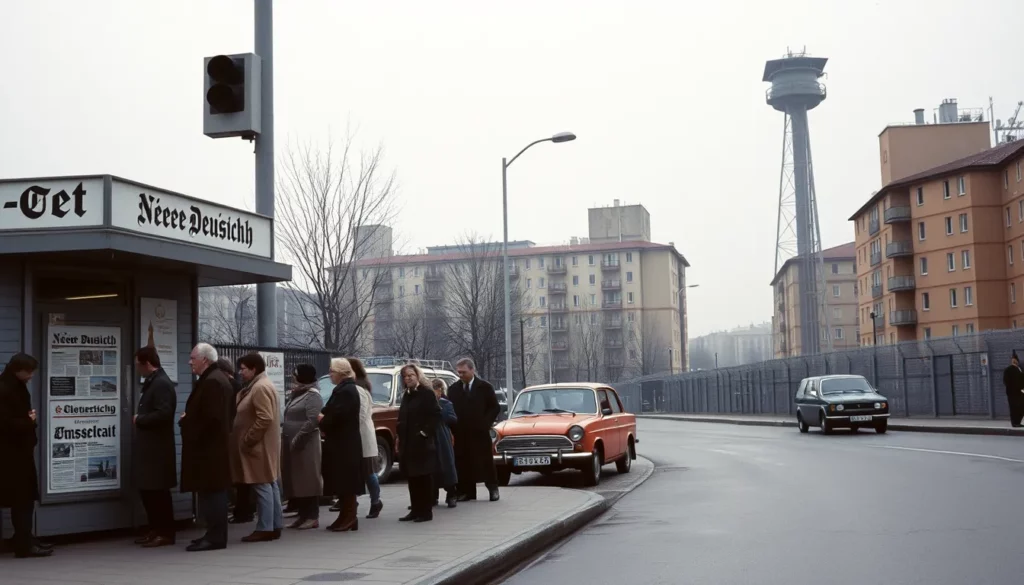
On the morning of 9 November 1989, East Berlin woke to a grey, ordinary Thursday. Shops opened, tram conductors punched tickets, and queues formed outside bakeries and state offices. The newspapers carried the familiar vocabulary of a Communist state in crisis: meetings, resolutions, warnings, and a draft travel regulation that had been published earlier that week. East Germans had heard about the huge demonstrations in Leipzig and Berlin, about citizens fleeing through Hungary, and about promises of reform from the new leadership of Erich Honecker’s successor, Egon Krenz. What they did not know, as they went about their morning routines, was that the SED leadership had approved a change in travel rules that would be announced that evening and would send tens of thousands of people toward the border. This article uses “that morning” to mean the morning of 9 November 1989, before the press conference that transformed the Berlin Wall from an apparently permanent fixture into an open crossing.
What Happened?
The public record for the morning is thin because the decisive decision was not made public until evening. Earlier that week, the Council of Ministers had published a draft travel regulation. It promised East Germans more opportunities to apply for trips abroad, but it still required applications, paperwork, and official approval. For many citizens, the draft confirmed that the government was retreating under pressure while trying to keep control of the process. There was no public announcement on the morning of 9 November that the Wall would be opened.
During the day, the SED leadership approved a new travel regulation. It allowed East Germans to apply for private travel abroad and for permanent exit, and it spoke of permits being issued without delay. A short dispatch from the official news agency ADN was prepared. Günter Schabowski, the Politburo member and government spokesman, was given the text before a scheduled press conference at the International Press Center in East Berlin. The announcement was not planned as a dramatic declaration that the Wall was falling; it was meant to present a controlled reform.
At about 6 p.m., Schabowski faced journalists in a small, stuffy room. He began with the routine business of the Central Committee. Then a reporter asked about the travel rules. Schabowski waved the ADN dispatch and read it out, mumbling at speed. When asked when the new rules would take effect, he shuffled his papers and said that, according to his information, they applied “immediately, without delay.” The phrase “sofort, unverzüglich” was carried by West German radio and television and spread rapidly through East Germany. Crowds began moving toward the border crossings, especially Bornholmer Strasse in Berlin.
- Morning: East Germans went to work and read the draft travel regulation; no public notice of an immediate border opening had been issued.
- Daytime: The SED leadership approved a new travel regulation; Schabowski received the ADN dispatch for the evening press conference.
- About 6 p.m.: Schabowski announced that travel applications would be handled without delay and that permanent exit was possible through all border crossings.
- Evening: West German broadcasts spread the news; East Berliners gathered at border checkpoints, uncertain whether the guards would let them through.
- Late night: At Bornholmer Strasse, shift commander Harald Jäger and his guards, lacking clear orders, began letting people through shortly before midnight. Other crossings followed.
- After midnight: The Wall’s crossings were open, though the concrete barrier itself still stood and was dismantled later.
How It Was Seen at the Time
Contemporaries did not experience the morning as the eve of the Wall’s fall. Many East Germans saw a government in retreat but still capable of control. The draft travel law was met with scepticism: it seemed designed to channel anger into paperwork. The language of the state remained bureaucratic. At the press conference, Schabowski’s words were at first heard as another administrative clarification. Only when the phrase “immediately, without delay” was repeated did the meaning shift from regulation to rupture.
“That comes into effect, according to my information, immediately, without delay.” — Günter Schabowski, 9 November 1989.
At the border, the prevailing mood mixed disbelief, hope, and fear. People had been taught that the Wall was defended by armed guards and that unauthorized crossing could be fatal. Yet the crowds kept coming. The chants “Wir sind das Volk” (“We are the people”) and “Tor auf!” (“Open the gate!”) expressed a demand that had moved from the Monday demonstrations to the checkpoint itself. The evening was not initially understood by most participants as German reunification; it was understood as freedom to travel, and as a test of whether the state would shoot.
Historical Snapshot
| Aspect | Detail |
|---|---|
| Date | 9 November 1989 |
| Place | East Berlin and the inner-German border, German Democratic Republic |
| People | Günter Schabowski, East German journalists, East Berlin citizens, border guards including Harald Jäger |
| What Happened | A press conference announcement that travel rules applied “immediately” sent crowds to the border; guards opened crossings late that night. |
| Why It Mattered | The Berlin Wall ceased to function as a sealed border, accelerating the collapse of the GDR and the end of the Cold War division of Europe. |
What People Knew at the Time
The gap between the morning and the evening is the central fact of 9 November 1989. Most East Germans knew that the state was under enormous pressure and that travel rules were being discussed. They did not know that the border would open that night. The contrast between contemporary knowledge and later reconstruction is stark.
| What People Knew Then | What We Know Now |
|---|---|
| That a draft travel regulation had been published earlier that week and was widely discussed. | That the SED leadership approved a new travel regulation on 9 November and prepared an ADN dispatch for the evening press conference. |
| That mass protests and the exodus through Hungary had forced the government onto the defensive. | That the decision was intended as a controlled reform, not an immediate demolition of the Wall. |
| That the border was still closed on the morning of 9 November. | That Schabowski’s “immediately, without delay” was interpreted by crowds as an opening order. |
| That travel might become easier only after applications and official approval. | That the announcement triggered a mass movement to the border and overwhelmed the guards’ capacity to control it. |
| That German reunification was not on the immediate horizon. | That the opening of the crossings became a decisive step toward reunification in 1990. |
Contemporary Newspaper Coverage
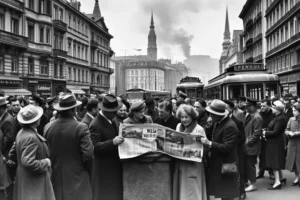
The first official text was not a call to revolution. The ADN dispatch ran to four short paragraphs and was written in the flat, procedural language of a government notice. It announced that travel applications would be handled and that permanent exit was possible through all border crossing points. The SED newspaper Neues Deutschland carried the new rules in similarly bureaucratic form, framing them as an orderly adjustment rather than a surrender.
West Berlin newspapers responded with far more drama. On 10 November, Bild ran the headline “Die Mauer ist weg!” (“The Wall is gone!”), capturing the popular sense that a symbol had collapsed overnight. East German television was slower and more cautious, reflecting the state’s attempt to present the change as reform from above. The contrast between the official dispatch and the western front pages illustrates how the same event could be read as administrative procedure in one setting and historic rupture in another.
“It was a flimsy piece of paper that swept away the Berlin Wall.” — Douglas Hamilton, Reuters correspondent, recalling the ADN dispatch.
Eyewitness Accounts
Reuters correspondent Douglas Hamilton was in the press conference room when Schabowski read the dispatch. He recalled the scene as one of confusion rather than ceremony. Schabowski waved the paper and grumbled, “You’ll all have seen this?” The foreign press shouted back, “No! What is it? Read it out!” The exchange captures how the most consequential announcement of the Cold War’s end began as an afterthought.
“No! What is it? Read it out!” — journalists at the East Berlin press conference, 9 November 1989.
At Bornholmer Strasse, eyewitnesses described a crowd that grew through the evening and pressed toward the barrier. People chanted “Tor auf!” and demanded to be let through. Harald Jäger, the shift commander, later recalled that he had no clear order to use force and that the crowd could not be held back indefinitely. Shortly before midnight, the guards began checking identity cards and letting people pass. The Wall had not been dismantled, but its power to terrify had been broken at that checkpoint.
What People Feared
Fear ran through the day alongside hope. Many East Germans had grown up with the Wall as a lethal border, and they feared that the state would restore order by force. Rumours circulated that the border would be sealed again, that Stasi officers were compiling lists, or that Soviet troops might intervene. At the checkpoints, people feared a stampede, a warning shot, or a last-minute order to close the gates.
- Fear of a crackdown: The memory of earlier suppression made many expect that protests or border crowds would be met with force.
- Fear of reversal: Some believed the announcement was a trap or that the government would clarify that travel still required permission.
- Fear of chaos: Border guards worried about crowds overwhelming checkpoints and about being blamed for violence.
- Fear of the Stasi: Citizens suspected surveillance and feared that those who crossed might face reprisals or lose their jobs.
What People Expected Would Happen Next
On the morning of 9 November, few East Germans expected the Wall to open that night. The more common expectation was a gradual and controlled liberalisation: more travel applications, longer queues, and perhaps permits granted after official review. Even after Schabowski’s announcement, many people went to the border expecting to be turned back. The slogan “Wir bleiben hier” (“We are staying here”), heard at the Monday demonstrations, expressed a demand for reform at home rather than an immediate plan for reunification.
Once the crossings opened, expectations shifted within hours. People began to speak of travel, family visits, and the end of isolation. Few predicted the speed of the GDR’s collapse or that German reunification would follow within a year. The primary sources show a night of improvised decisions, not a master plan. The guards opened the gates because the crowd was there and the orders were unclear; the politicians had intended a reform, not a revolution.
The morning of 9 November 1989 belongs to the history of what people did not yet know. East Germans knew that their state was in crisis, that travel rules were being debated, and that the streets had become bold. They did not know that a press conference would turn a bureaucratic phrase into an opening order. That gap between ordinary routine and sudden rupture is what the primary sources preserve most vividly: the queues, the draft regulation, the scepticism, and then the crowds at Bornholmer Strasse. The Wall fell not because everyone expected it that morning, but because enough people acted once the words “immediately, without delay” reached them.
FAQ
Did East Germans know on the morning of 9 November 1989 that the Berlin Wall would open?
No. Most East Germans went about their morning routines without any public announcement that the Wall’s crossings would open that night. They knew about the draft travel regulation, mass protests, and the refugee exodus, but the decisive press conference took place in the evening.
Was the opening of the Berlin Wall an accident?
It was not simply an accident, but it was improvised. The SED leadership had approved a real change in travel rules, but it intended a controlled reform. Schabowski’s statement that the rules applied “immediately, without delay” was interpreted by crowds as an opening order, and the border guards opened the crossings when they could no longer hold people back.
Did the Berlin Wall physically come down on 9 November 1989?
No. The border crossings were opened that night, but the concrete Wall itself still stood. East and West Berliners crossed through checkpoints, and the Wall was dismantled in stages over the following weeks and months.










Leave a Reply