
Short Answer
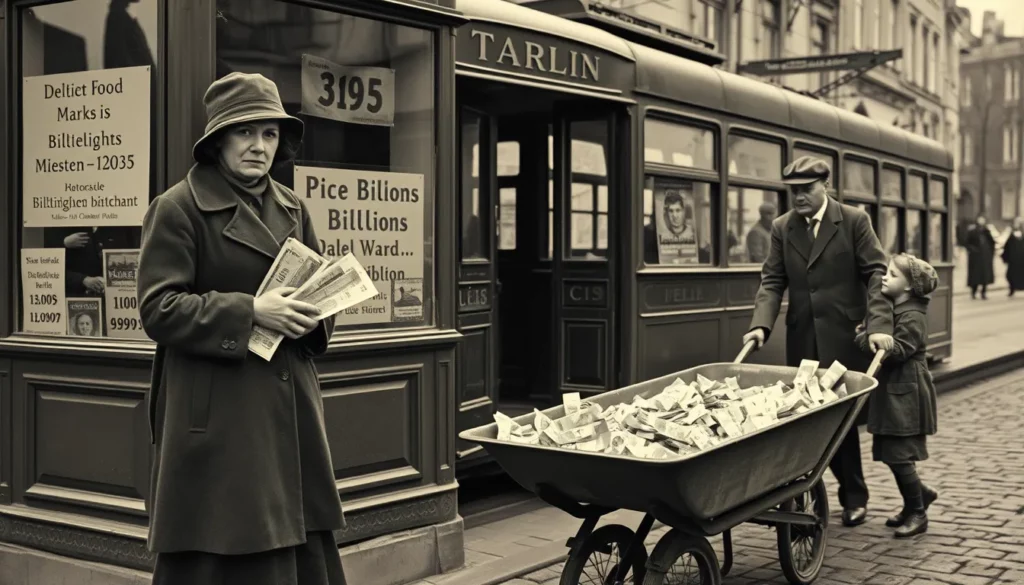
In the autumn of 1923, Berlin housewives waited at tram stops not for husbands but for wages. As soon as a worker stepped off the car, his wife took the bundle of paper marks and ran to the shops, hoping to buy bread, fat, or potatoes before prices rose again. “During the period of rampant devaluation, wages were paid out daily because the money was worthless the next day,” recalled Hermann Barche, then a schoolboy. A letter posted on October 15 by Betty Scholem cost 15 million marks; two days later it would cost 30 million. By December, one U.S. dollar bought 4.2 trillion marks. The Weimar Republic’s currency had become a source of dark comedy and real hunger. This article reconstructs everyday life during the German hyperinflation of 1923—how people earned, spent, queued, bartered, and feared—through the letters, diaries, and eyewitness testimony of those who lived it.
What Happened?
The hyperinflation of 1923 was the culmination of wartime and postwar fiscal choices. Germany had financed World War I largely by borrowing and printing money rather than raising taxes. Defeat in 1918 brought territorial losses, a new democratic constitution at Weimar, and the burden of reparations under the Treaty of Versailles. When the new government fell behind in reparation payments, French and Belgian troops occupied the Ruhr Valley in January 1923. Berlin responded with passive resistance: the government supported striking workers and printed ever more marks to sustain them. The result was a collapse in the currency’s value.
- January 1923: French and Belgian troops occupy the Ruhr; a dollar costs 17,000 marks.
- April 1923: The dollar reaches 24,000 marks.
- July 1923: The dollar reaches 353,000 marks.
- August–September 1923: The dollar leaps from 4.6 million to 98.9 million marks.
- October 1923: The dollar reaches 25.3 billion marks.
- November 1923: The dollar reaches 2.2 trillion marks; the Rentenmark is introduced.
- December 1923: The exchange rate peaks at 4.2 trillion marks to the dollar.
Wages were paid weekly and then daily. Prices changed hourly. A pound of meat reached 3 billion marks; a pound of rye bread cost more than 100 billion marks by November. In November 1923 the government introduced the Rentenmark, a new currency backed by land and industry, and ended passive resistance. Hyperinflation ceased, but savings, pensions, and fixed incomes had been destroyed.
How It Was Seen at the Time
Contemporaries did not experience inflation as an abstraction. They described it as a natural disaster, a sickness, a collapse. Betty Scholem wrote from Berlin that conditions had taken a catastrophic turn. Victor Klemperer, a German scholar and diarist, watched his country come apart step by step. The mood was a mixture of disbelief, exhaustion, and grim humor. People blamed reparations, the government, banks, and profiteers; antisemitic scapegoating also circulated. The middle classes felt especially betrayed, as savings and pensions evaporated. Many believed the state itself might disintegrate.
“Conditions have taken a catastrophic turn here,” wrote Berlin resident Betty Scholem in an October 15, 1923, letter to her son. “This letter cost 15 million” marks to send, she added, and “it will be 30 million beginning the day after tomorrow.”
Victor Klemperer saw his country “collapsing in an eerie, step-by-step manner. … How long will we still have something to eat? Where will we next have to tighten our belts?”
The language of the time was visceral: Teuerung (dearness), Schieber (black marketeers), Raffke (greedy profiteers). Scholem feared political disintegration: “It seems inevitable that we will lose the Rhine and the Ruhr,” she predicted, “that Bavaria will break away, and that Germany will once again fall apart into minuscule petty states.” Revolution seemed likely, too.
Daily Life
Everyday life was organized around the race against prices. Workers were paid daily, sometimes twice daily. Family members met wage earners at the factory gate or tram stop and rushed to buy goods. Food was scarce and expensive. Meat, butter, potatoes, and beer became luxuries. People cultivated allotments, kept rabbits or chickens, and bartered goods and services. Coal was scarce after the Ruhr occupation, so households rationed heat. Clothing and shoes were worn until they fell apart. Queues formed before dawn. Black markets thrived. Some people with foreign currency or goods could live well; most faced daily uncertainty. Contemporary accounts note that those who could worked for food on farms or fed themselves from their allotments, and bartering flourished.
Eyewitness Accounts
Hermann Barche, Schoolboy
Hermann Barche (1913–2001), later a politician, remembered the inflation as a child in a German town. His account captures the daily choreography of survival:
“During the period of rampant devaluation, wages were paid out daily because the money was worthless the next day. When my father came home from work, my mother was already waiting at the tram stop to take the wages and go straight to the shops where she would buy at least the essential groceries.”
Victor Klemperer, Scholar and Diarist
Victor Klemperer recorded the collapse in his diary. His questions were practical and existential: how long would there be food, and where would the next cut come? His testimony shows how inflation invaded the rhythms of thought itself.
“How long will we still have something to eat? Where will we next have to tighten our belts?”
Letters & Diaries
Betty Scholem’s letter of October 15, 1923, is a compact record of both the cost of communication and the psychological toll. Writing to her son from Berlin, she noted that postage alone had reached 15 million marks and would double within two days. She and her husband estimated their expenses in the billions as the monthly rate of inflation approached 30,000 percent. Such letters and diaries are invaluable because they record the inflation not as a statistical series but as a series of small, exhausting calculations.
“This letter cost 15 million” marks to send, she wrote, and “it will be 30 million beginning the day after tomorrow.”
Klemperer’s diary performs a similar function. It moves from the price of meat to the fear of hunger, from public events to private dread.
Numbers at the Time
| Item | Figure | Source/Year |
|---|---|---|
| U.S. dollar, January 1923 | 17,000 marks | Smithsonian Magazine, 1923 |
| U.S. dollar, April 1923 | 24,000 marks | Smithsonian Magazine, 1923 |
| U.S. dollar, July 1923 | 353,000 marks | Smithsonian Magazine, 1923 |
| U.S. dollar, August 1923 | 4.6 million marks | Smithsonian Magazine, 1923 |
| U.S. dollar, September 1923 | 98.9 million marks | Smithsonian Magazine, 1923 |
| U.S. dollar, October 1923 | 25.3 billion marks | Smithsonian Magazine, 1923 |
| U.S. dollar, November 1923 | 2.2 trillion marks | Smithsonian Magazine, 1923 |
| U.S. dollar, December 1923 | 4.2 trillion marks | Smithsonian Magazine, 1923 |
| Postage for a letter, October 15, 1923 | 15 million marks; 30 million two days later | Betty Scholem letter, 1923 |
| Pound of meat, late 1923 | 3 billion marks | Smithsonian Magazine, 1923 |
| Pound of butter, late 1923 | 6 billion marks | Smithsonian Magazine, 1923 |
| Pound of potatoes, late 1923 | 50 million marks | Smithsonian Magazine, 1923 |
| Glass of beer, late 1923 | 150 million marks | Smithsonian Magazine, 1923 |
| Pound of rye bread, November 1923 | More than 100 billion marks | Smithsonian Magazine, 1923 |
What People Feared
Fears were concrete and existential. People feared starvation, freezing, and the complete breakdown of order. Klemperer’s diary asks how long there would be food. Scholem feared political disintegration: “It seems inevitable that we will lose the Rhine and the Ruhr, that Bavaria will break away, and that Germany will once again fall apart into minuscule petty states. Revolution seemed likely, too.” Some fears were rational: the Ruhr occupation, separatist movements, and Hitler’s Beer Hall Putsch in November 1923 showed real threats. Others were exaggerated or scapegoating: rumors blamed Jews for the inflation, part of a longer antisemitic tradition. Many feared that savings would never recover, and for many they did not.
How Historians See It Today
Historians today distinguish between the immediate trigger—the Ruhr occupation and passive resistance—and deeper causes: wartime financing, postwar deficits, reparations, and political choices. Earlier accounts often blamed reparations alone; later scholarship emphasizes that Germany could have stabilized earlier but chose to print money, partly to evade reparations and shield certain groups. The hyperinflation is now seen as a critical moment in the erosion of faith in the Weimar Republic. It wiped out the middle class’s savings, deepened distrust of democratic institutions, and created a reservoir of resentment that extremist parties exploited. Yet historians also stress that Germans coped creatively through barter, networks, and local currencies. The experience shaped memory and policy, contributing to the later Nazi promise of economic stability.
The hyperinflation of 1923 remains a warning about the fragility of money and the social contract. The primary sources—letters, diaries, childhood memories—show not just statistics but the texture of daily life: the rush from tram stop to shop, the wheelbarrow of notes, the fear in a mother’s voice. They reveal how quickly ordinary routines can become desperate calculations, and how economic chaos can corrode trust in democracy. For those who lived through it, hyperinflation was not a prelude to Hitler but a present-tense catastrophe. That double reality—immediate survival and long-term political consequence—is why these sources still matter.
FAQ
How did ordinary Germans cope with hyperinflation?
They spent wages immediately, bartered goods and services, grew food on allotments, used foreign currency or emergency money, and relied on family networks. Many nevertheless lost their savings and suffered severe hardship.
What caused the German hyperinflation of 1923?
Wartime borrowing, postwar deficits, reparations, and the 1923 Ruhr occupation and passive resistance led the government to print enormous quantities of money, causing the mark’s value to collapse.
How did the hyperinflation end?
In November 1923 the government introduced the Rentenmark, backed by land and industry, and ended passive resistance. The new currency stabilized prices, but the damage to savings and trust in the Weimar Republic remained.











Leave a Reply