
Short Answer
Quick Snapshot
Kuwait in 1974 was a small, oil-rich emirate on the Persian Gulf, experiencing a dramatic transformation fueled by skyrocketing petroleum revenues. The year opened with a landmark compensation agreement with foreign oil companies and closed with the nation firmly established as one of the world’s wealthiest per capita societies. Yet this prosperity was punctuated by moments of violence, most notably the February 6 attack on the Japanese embassy in Kuwait City, which brought international terrorism to its shores.
Under the leadership of Emir Sabah Al-Salim Al-Sabah and Prime Minister Jaber Al-Ahmad Al-Sabah, Kuwait navigated a year of economic boom, diplomatic maneuvering, and security challenges. The influx of oil money reshaped cities, attracted foreign workers, and funded ambitious infrastructure projects, while the government consolidated control over its most valuable resource. For ordinary Kuwaitis, 1974 was a year of rising expectations, new consumer goods, and a growing sense of national identity.
Kuwait in 1974
Kuwait occupies a small, arid corner of the Arabian Peninsula, bordered by Iraq to the north and Saudi Arabia to the south, with the Persian Gulf to the east. Its climate is harsh—summer temperatures routinely exceed 45°C (113°F)—and rainfall is scarce, making the country dependent on desalination and imported food. In 1974, the landscape was a stark contrast between the old mud-brick houses of the pre-oil era and the gleaming new concrete towers rising in Kuwait City.
The atmosphere was one of exuberant optimism. Oil revenues, which had surged after the 1973 oil embargo and price hikes, were flooding the treasury. The government was investing heavily in housing, hospitals, schools, and roads, creating a construction boom that attracted laborers from across the Arab world and South Asia. At the same time, traditional Kuwaiti culture—the dhow trade, pearl diving, and Bedouin hospitality—was giving way to a modern, car-centric society, though many customs endured.
Population & Economy
Kuwait’s population in 1974 was approximately 900,000, with Kuwaiti citizens forming a minority—roughly 40%—while the majority were expatriate workers from Palestine, Egypt, India, Pakistan, and other countries. The economy was overwhelmingly dominated by oil, which accounted for over 90% of government revenue and nearly all exports. According to a New York Times report from May 22, 1974, per capita oil income had reached an extraordinary $10,000, transforming the nation’s standard of living almost overnight.
The wealth was not evenly distributed, but the government used its revenues to provide free healthcare, education, and social services to citizens. The cost of living was relatively low for locals, with subsidized housing and utilities, while expatriates often lived in more modest conditions. The economy was also diversifying into banking, construction, and services, but oil remained the engine that drove everything.
Government & Politics
Kuwait was (and remains) a constitutional emirate, with the Emir as head of state and a prime minister appointed by him. In 1974, Emir Sabah Al-Salim Al-Sabah, who had ruled since 1965, presided over a country with a National Assembly, though political parties were banned. The Prime Minister was Jaber Al-Ahmad Al-Sabah, a member of the ruling family who would later become Emir himself. The political climate was stable but cautious, as the government balanced traditional tribal loyalties with modern administrative demands.
The most significant political development in 1974 was the government’s assertion of control over the oil industry. On January 31, Kuwait and the two major foreign oil companies—British Petroleum and Gulf Oil—reached a compensation agreement for the nationalization of Kuwait’s oil concessions, as reported by The New York Times. This move solidified Kuwait’s sovereignty over its most vital resource and set a precedent for other Gulf states.
Industry
The oil industry was the sole economic driver, and 1974 was a banner year. In April, the two foreign companies deposited $1.6 billion into Kuwaiti government accounts in New York—the first installment of the increased revenues from higher oil prices. This windfall funded massive infrastructure projects, including the expansion of the Shuaiba industrial area, new desalination plants, and the construction of modern ports.
Beyond oil, Kuwait was developing a small but growing petrochemical sector, with plans for fertilizer and chemical plants. The government also invested in a national airline, Kuwait Airways, and expanded the banking sector. However, the non-oil economy remained heavily dependent on government spending, and most manufactured goods were imported.
Education
Education was a top priority, and Kuwait had achieved near-universal primary enrollment by 1974. The University of Kuwait, founded in 1966, was expanding its faculties, and thousands of students were studying abroad on government scholarships. The literacy rate was improving rapidly, particularly among younger Kuwaitis, though adult literacy lagged among older generations and the expatriate workforce.
The government built new schools across the country, and education was free from primary through university. Curricula emphasized Arabic, Islamic studies, and modern sciences, reflecting both cultural traditions and the need for technical expertise. Women’s education was also expanding, though female participation in the workforce remained limited.
Transportation
Kuwait’s transportation network was undergoing rapid modernization. The road system was expanding, with new highways connecting Kuwait City to the industrial areas and residential suburbs. The port of Shuwaikh handled increasing cargo volumes, while Kuwait International Airport was being upgraded to accommodate growing air travel. Public buses were the primary mode of transport for many residents, but private car ownership was soaring, leading to traffic congestion in the capital.
The government also invested in a modern telecommunications network, though the country still relied on older systems for international calls. The traditional dhow traffic had largely disappeared, replaced by container ships and oil tankers.
Everyday Life
Daily life in Kuwait in 1974 was a blend of tradition and modernity. Kuwaiti families typically lived in spacious villas with air conditioning, a luxury that had become standard. Meals often featured rice, lamb, fish, and flatbread, with influences from Persian and Indian cuisine. Men wore the traditional dishdasha and ghutra, while women dressed in abayas and veils, though Western clothing was becoming more common among the young.
Entertainment centered on family gatherings, visits to the souq (market), and watching television, which had become widespread. The government sponsored cultural events, and a new national museum was being developed. For expatriates, life was more austere, with many living in labor camps and sending remittances home. The oil boom also brought a new consumer culture, with imported goods from Europe and Japan filling store shelves.
Major Events
The most dramatic event of 1974 was the attack on the Japanese embassy on February 6. Palestinian militants, reportedly from the Popular Front for the Liberation of Palestine, occupied the embassy in Kuwait City, taking the ambassador and ten others hostage. Their goal was to support the Japanese Red Army members and Palestinian guerrillas who were trapped on a ferry in Singapore after a failed attack on an oil refinery. The standoff ended peacefully when the hostages were released and the guerrillas were flown to Aden, as documented in Wikipedia’s article on the incident.
Other significant events included the oil compensation agreement in January and the $1.6 billion payment in April, which underscored Kuwait’s new economic power. The year also saw the birth of future sports figures Khaled Al Fadhli and Jamal Mubarak, though their significance would emerge later.
What Newspapers Were Reporting
International newspapers, particularly The New York Times, covered Kuwait extensively in 1974. Headlines included “COMPENSATION SET ON KUWAIT OIL DEAL” (February 1) and “$10,000 PER CAPITA OIL INCOME TRANSFORMING KUWAIT” (May 22). A May 1 article titled “KUWAIT IS MOVING INTO A NEW ERA” described the April 30 deposit of $1.6 billion as “the payoff for higher oil prices.” These reports highlighted Kuwait’s newfound wealth and its implications for the global economy.
Local newspapers, such as the Arabic-language Al-Qabas and Al-Watan, covered domestic news, including government policies, development projects, and the embassy crisis. The attack was front-page news for weeks, and the government’s handling of it was closely scrutinized.
What People Were Talking About
In the coffeehouses and diwaniyas (social gatherings), Kuwaitis discussed the oil boom and its effects on society. Many were excited about new job opportunities and modern amenities, while others worried about the influx of foreigners and the erosion of traditional values. The embassy attack sparked debates about security and Kuwait’s role in the Arab-Israeli conflict, with some expressing sympathy for the Palestinian cause while condemning the violence.
Among expatriates, conversations centered on wages, working conditions, and the possibility of bringing families to Kuwait. The high cost of living for non-citizens was a common complaint, as was the difficulty of obtaining residency permits. The oil wealth also fueled speculation about future government spending and the potential for corruption.
Historical Photographs
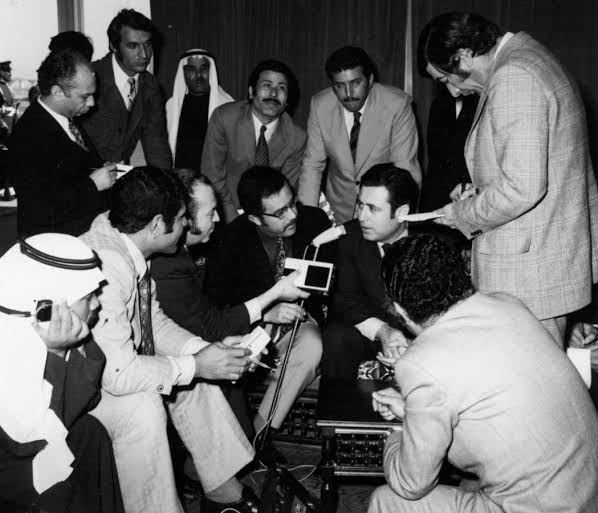
Photographs from 1974 capture Kuwait’s transformation. Images show the skyline of Kuwait City with new high-rise buildings rising beside older low-rise structures. Oil fields with towering derricks and pipelines are common subjects, as are the bustling ports and the modern airport. The Japanese embassy attack was photographed by news agencies, showing the building surrounded by security forces.
Everyday scenes depict Kuwaitis in traditional dress shopping at the souq, children in school uniforms, and families in their new homes. These photographs, preserved in archives like the Kuwait National Museum and the Getty Images collection, provide a vivid visual record of a society in flux.
Documents & Primary Sources
Historians studying Kuwait in 1974 rely on several key primary sources. The New York Times archives contain multiple articles from that year, offering contemporary journalistic accounts. Official government documents, including the compensation agreement with the oil companies, are held in Kuwait’s national archives. The Wikipedia article on “1974 in Kuwait” provides a concise list of events, while the detailed account of the Japanese embassy attack offers a narrative of the crisis.
Other sources include photographs, film footage from newsreels, and personal diaries of expatriates and diplomats. The British National Archives and the U.S. State Department’s Foreign Relations of the United States series also contain diplomatic cables and reports on Kuwait during this period.
1974 Timeline
| Date | Event |
|---|---|
| January 31 | Kuwait and foreign oil companies reach compensation agreement for nationalization. |
| February 6 | Palestinian militants attack the Japanese embassy in Kuwait City, taking hostages. |
| March 21 | Birth of Jamal Mubarak. |
| April 30 | Oil companies deposit $1.6 billion in Kuwaiti government accounts in New York. |
| May 15 | Birth of Khaled Al Fadhli. |
| May 22 | New York Times reports $10,000 per capita oil income transforming Kuwait. |
What Changed Next
The oil boom of 1974 set the stage for Kuwait’s continued growth and modernization. The government’s control over oil revenues allowed for ambitious development plans, including the construction of new cities and industrial zones. However, the wealth also brought challenges, including inflation, labor shortages, and social tensions. The Japanese embassy attack foreshadowed the region’s vulnerability to terrorism, which would escalate in later decades.
By the late 1970s, Kuwait had become one of the world’s richest nations, but the 1980s brought the Iran-Iraq War and the 1990 Iraqi invasion, which devastated the country. The prosperity of 1974, however, laid the foundation for Kuwait’s eventual reconstruction and its modern identity as a wealthy, cosmopolitan state.
FAQ
What was the population of Kuwait in 1974?
The population was approximately 900,000, with Kuwaiti citizens forming a minority (around 40%) and expatriates making up the majority.
What major events happened in Kuwait in 1974?
Key events included the compensation agreement for oil nationalization (January 31), the Japanese embassy hostage crisis (February 6), and the $1.6 billion oil revenue deposit (April 30).
What primary sources are available for studying Kuwait in 1974?
Primary sources include contemporary newspaper articles from The New York Times, official government documents, photographs, newsreels, and diplomatic cables in national archives.
How did daily life in Kuwait in 1974 differ from today?
In 1974, Kuwait was rapidly modernizing but still retained traditional customs. Most citizens lived in villas with air conditioning, but consumer culture was less developed. The oil boom brought unprecedented wealth, yet the country was less cosmopolitan than today.










Leave a Reply