
Short Answer
In the winter of 1830, a group of women in Steubenville, Ohio, put pen to paper and sent a petition to Congress. They were not asking for the right to vote—that would come later—but they were demanding that the government hear their moral voice on the forced removal of Native American tribes. The petition, printed for use across state lines, crossed out the word “Pennsylvania” and added “Ohio,” evidence that women were organizing as a collective force. It was an early tremor in a movement that would shake the nation for nearly a century. By the time the 19th Amendment was ratified on August 18, 1920, women had marched, petitioned, lobbied, and picketed for over seventy years. This article tells that story through the very documents they left behind—petitions, declarations, letters, and photographs—allowing us to hear their voices as they fought for the most fundamental right of democracy.
What Happened?
The women’s suffrage movement in the United States spanned more than seven decades, from the first stirrings of organized women’s activism in the 1830s to the ratification of the 19th Amendment in 1920. Historians generally trace the formal beginning to the Seneca Falls Convention in July 1848, where a group of women and men, including Elizabeth Cady Stanton and Lucretia Mott, issued the Declaration of Sentiments. Modeled on the Declaration of Independence, it listed women’s grievances, with the first being the denial of the right to vote.
But women’s political organizing predated Seneca Falls. As early as 1830, women like those in Steubenville, Ohio, were sending petitions to Congress on issues of the day. This petition, part of a broader movement against President Andrew Jackson’s Indian removal policy, demonstrates that women were already engaging in grassroots democracy, even without the franchise. The petition was not a local oddity; it was printed for use in multiple states and passed from one group of women to another, showing a coordinated network of female activists.
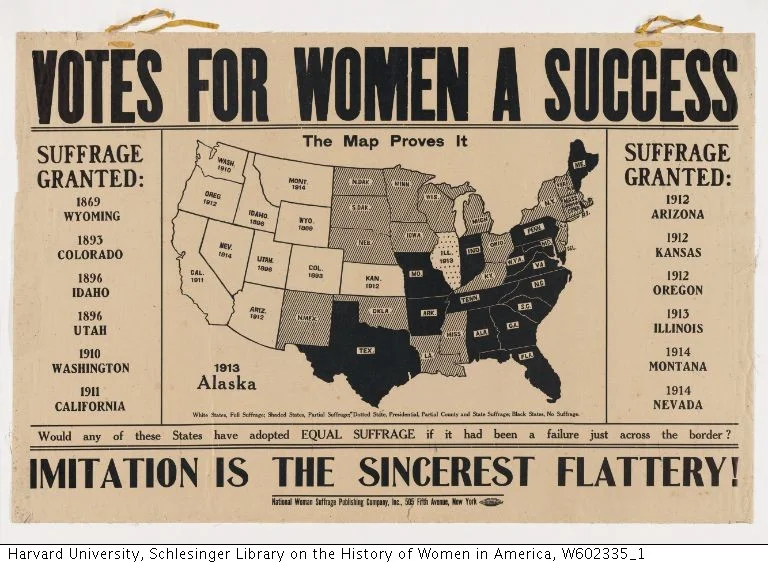
The suffrage movement gained momentum in the late nineteenth and early twentieth centuries. Suffragists employed a variety of strategies: they lobbied Congress, organized parades, and, as the Library of Congress notes, “the first picket line” appeared in February 1917, when women began picketing the White House. These tactics, along with the work of leaders like Carrie Chapman Catt and Alice Paul, pressured the federal government to act. The amendment, first introduced in Congress in 1878, was finally passed by the House and Senate in 1919, and ratified by the required number of states on August 18, 1920.
How It Was Seen at the Time
Contemporaries understood the fight for suffrage as a moral crusade as much as a political one. The women of Steubenville, in their 1830 petition, appealed to Congress’s “morally elevated, honorable body” to consider Indian removal as a moral issue. They argued that as a body of honorable men, Congress should act with compassion and justice—an appeal that implicitly acknowledged women’s moral authority even as they lacked political power.
At Seneca Falls, the Declaration of Sentiments was seen as a radical document. Its demand for the vote was considered “absurd” by many, including some women. Yet the language of the Declaration echoed the American founding, asserting that “all men and women are created equal.” This framing allowed suffragists to claim their cause as an extension of the nation’s core principles.
“They argue that, as a morally elevated, honorable body, Congress should show…” — Memorial from the Ladies of Steubenville, Ohio, 1830.
The mood among suffragists was one of determined optimism, even as they faced ridicule and opposition. The movement’s leaders often described themselves as “suffragists” or “woman’s rights advocates,” and they saw their struggle as a continuation of the American Revolution.
Historical Snapshot
| Aspect | Detail |
|---|---|
| Date | 1830–1920 (movement); peak activism 1848–1920 |
| Place | United States, from local communities to Washington, D.C. |
| People | Elizabeth Cady Stanton, Lucretia Mott, Susan B. Anthony, Carrie Chapman Catt, Alice Paul, and thousands of unnamed women |
| What Happened | Women organized conventions, petitions, pickets, and parades to secure the right to vote |
| Why It Mattered | The 19th Amendment extended the franchise to all women, a landmark expansion of American democracy |
What People Knew at the Time
| What People Knew Then | What We Know Now |
|---|---|
| Suffragists knew they were fighting for a radical change in the legal status of women. | Historians now recognize the movement as the first wave of American feminism, with deep roots in abolitionism and other reform movements. |
| Many contemporaries believed women’s suffrage would overturn social order and destroy the family. | We know that women’s participation in politics did not cause the feared social upheaval; it expanded democratic participation. |
| Women used petitions because they had no vote; petitioning was one of the few political tools available. | Petitions were a key strategy, as shown by the 1830 Steubenville petition, and they helped build a network of female activists. |
Different Perspectives
The Women Who Petitioned
The women who sent petitions to Congress in the 1830s and beyond saw themselves as moral guardians of the nation. They used the language of piety and virtue to claim a public voice, even while they lacked the ballot. Their petitions often emphasized the moral impact of legislation, as seen in the Steubenville women’s appeal on Indian removal.
The Congressmen Who Received Them
Members of Congress received these petitions with varying degrees of seriousness. Some dismissed them as the work of “petticoat politicians,” while others, particularly those sympathetic to reform, treated them as legitimate expressions of public opinion. The fact that Congress kept and archived these petitions suggests they were taken seriously enough to be preserved.
The Anti-Suffragists
Although not directly represented in the sources provided, anti-suffragists argued that women’s place was in the home and that voting would corrupt their moral purity. They often used religious and social arguments. The suffrage movement’s own documents, like the Declaration of Sentiments, were responses to such opposition.
Key Documents
- Memorial from the Ladies of Steubenville, Ohio (February 15, 1830) – An early example of women’s collective petitioning to Congress, protesting Indian removal.
- Declaration of Sentiments (July 1848) – The foundational text of the women’s suffrage movement, modeled on the Declaration of Independence, asserting women’s equality and the right to vote.
- 19th Amendment (ratified August 18, 1920) – The constitutional amendment guaranteeing citizens the right to vote regardless of sex.
Aftermath
Immediately after the 19th Amendment’s ratification, millions of women were eligible to vote in the November 1920 elections. The amendment did not automatically enfranchise all women—many women of color, especially in the South, still faced barriers such as poll taxes and literacy tests. But the amendment marked a historic expansion of democracy. The National American Woman Suffrage Association disbanded, and many activists turned to other reform causes. The primary sources from the movement, including the petitions and declarations, became archival treasures, now held in institutions like the Library of Congress and the National Archives.
How Historians See It Today
Modern historians view the suffrage movement not as a single, unified campaign but as a long, complex struggle with multiple strategies and overlapping reform movements. They emphasize the role of African American women, who were often marginalized within the movement but were active participants. Historians also highlight the importance of primary sources—petitions, letters, and photographs—as windows into the daily strategies and beliefs of the participants. The movement is now seen as the first wave of American feminism, with the 19th Amendment as a landmark, but not the end, of the fight for gender equality.
Common Misconceptions
Timeline
- 1830 – Women in Steubenville, Ohio, petition Congress against Indian removal.
- 1848 – Seneca Falls Convention, issuance of the Declaration of Sentiments.
- 1878 – The woman suffrage amendment is first introduced in Congress.
- February 1917 – The first picket line is held at the White House.
- June 1919 – Congress passes the 19th Amendment.
- August 18, 1920 – The 19th Amendment is ratified.
These primary sources—petitions, declarations, and the records of political action—allow us to hear the voices of the women who fought for the vote. They remind us that democracy is not a gift but a struggle, and that every right we enjoy today was won by ordinary people who spoke up and organized. The archives preserve their words, and they still inspire us to continue the unfinished work of equality.
FAQ
What was the first women's rights convention?
The first women's rights convention was held in Seneca Falls, New York, in July 1848. It produced the Declaration of Sentiments, which declared that 'all men and women are created equal' and listed women's grievances, including the denial of the right to vote.
How did women petition the government before they had the vote?
Women used the right to petition, which was a constitutional right. They organized community groups, printed petitions, and sent them to Congress. An example is the 1830 petition from women in Steubenville, Ohio, protesting Indian removal, which was part of a larger coordinated movement.
What role did picketing play in the suffrage movement?
Picketing was a key strategy in the later years of the movement. The first picket line at the White House occurred in February 1917, organized by suffragists like Alice Paul. These protests drew public attention and pressure on the president and Congress to pass the 19th Amendment.







Leave a Reply