
Short Answer
In the spring of 1945, on the high desert plateau of Los Alamos, New Mexico, and in the sprawling industrial towns of Oak Ridge, Tennessee, and Hanford, Washington, thousands of American women went to work each day in buildings they could not describe, handling materials they could not name, and helping build a weapon they did not know existed. They were nurses and teachers, secretaries and welders, chemists and calutron operators. They lived behind barbed wire, under assumed names, in hastily built dormitories and trailers, bound by a secrecy oath that silenced even their families. They were told only that their work would help win the war. In 1945, as the war reached its climax, these women—many of them young, newly married, or just out of school—found themselves at the heart of the most secret and consequential scientific undertaking in American history, the Manhattan Project.
What Happened?
The Manhattan Project began in earnest on January 19, 1942, when President Franklin D. Roosevelt approved the production of an atomic bomb, following Albert Einstein’s 1939 letter alerting the president to the possibility of nuclear chain reactions. The project sprawled across the country, from Hanford, Washington, to Oak Ridge, Tennessee, and the secret laboratory at Los Alamos, New Mexico. Women were involved from the outset, though their numbers and roles varied.
At the Y-12 uranium enrichment facility in Oak Ridge, women operated the calutron control panels, monitoring the massive electromagnetic separation machines that processed uranium-235. At Hanford, women worked in laboratories, tested reactors, and handled the dangerous chemistry of plutonium. At Los Alamos, a small number of women worked as scientists and technicians, contributing to the design of the bomb itself. According to the Department of Energy, women “worked as nurses, teachers, librarians, and secretaries. They sold and processed war bonds, worked the desks at dormitories and post exchanges, welded, and even monitored the control panels of the calutron.”
As World War II drained the male workforce, women filled jobs in record numbers. The Manhattan Project’s leaders, General Leslie R. Groves and J. Robert Oppenheimer, actively recruited women for a wide range of positions. By 1945, thousands of women were employed across the project, though the exact numbers remain classified even today. The work was demanding, often dangerous, and always shrouded in secrecy. Women were not told what they were building; they were only told that the success of the war effort depended on their labor.
In August 1945, the United States dropped atomic bombs on Hiroshima and Nagasaki. The war ended, and the secret was finally revealed. Many women were stunned to learn that their work had been part of the creation of the atomic bomb—a weapon they had not even known existed.
How It Was Seen at the Time
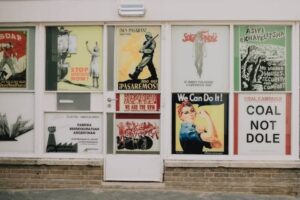
At the time, the women of the Manhattan Project were part of a massive national mobilization. The image of “Rosie the Riveter”—popularized in a 1942 poster by J. Howard Miller and a 1943 song—captured the spirit of the era, though it was not originally created for the Manhattan Project. Women were celebrated as patriotic workers, contributing to the war effort while men fought overseas. The prevailing mood was one of urgency and sacrifice. Secrecy was paramount, and workers were told that “loose lips sink ships”—a slogan that applied to the atomic bomb as much as to naval operations.
“I did think it looked like me, but nobody ever mentioned it.” — Naomi Parker Fraley, a wartime machinist who may have inspired the Rosie poster, on seeing the famous image.
Many women later recalled that they did not know what they were building. They were told only that their work was “for the war effort.” At the time, the prevailing interpretation was that they were simply doing their part, like millions of other Americans. The secrecy was accepted as necessary, and the women were proud to contribute. As one anonymous worker later said, “We knew it was important. We just didn’t know what it was.”
Historical Snapshot
| Aspect | Detail |
|---|---|
| Date | 1942–1945 (focus on 1945) |
| Place | Los Alamos, NM; Oak Ridge, TN; Hanford, WA; and other sites across the U.S. |
| People | Thousands of women: scientists, technicians, calutron operators, welders, secretaries, nurses, and laborers |
| What Happened | Women worked in the secret Manhattan Project, helping produce the world’s first atomic bombs |
| Why It Mattered | Their labor was essential to the project’s success, yet they were largely invisible in the public narrative for decades |
Eyewitness Accounts
While many women kept their experiences secret for years, a few have left behind eyewitness accounts. In the 1999 book Their Day in the Sun: Women of the Manhattan Project, authors Ruth H. Howes and Caroline C. Herzenberg collected oral histories and written recollections from women who worked at various sites. These accounts provide a vivid picture of daily life.
One woman who worked as a calutron operator at Oak Ridge recalled the monotony and the constant monitoring: “We would sit for hours watching the dials, adjusting the controls. We didn’t know what we were making, but we knew it was important.” Another, a chemist at Hanford, described the danger: “We worked with materials that we were told were dangerous, but we didn’t know how dangerous. We just did our jobs.”
These accounts, though collected decades after the events, reflect the experiences of the women in 1945. They emphasize the secrecy, the hard work, and the sense of purpose that sustained them.
Daily Life
Daily life for women in the Manhattan Project varied by site, but there were common threads. At Oak Ridge, a town built entirely for the project, women lived in dormitories or small houses, often with roommates. The town was surrounded by barbed wire and armed guards, and workers were not allowed to discuss their jobs with anyone, including family. Shifts were long, often 12 hours, and the work was physically demanding. Women who operated the calutrons had to watch the instruments for hours, sometimes in rooms filled with the hum of machinery. They wore uniforms and were required to follow strict security protocols.
At Los Alamos, the isolation was even more intense. The laboratory was located on a remote mesa, and the women lived in a closed community. Many were married to scientists or soldiers, and they often worked as technicians or in support roles. The atmosphere was one of intense intellectual activity, but also of secrecy. Women recalled that they were not allowed to say where they lived or what they did, even to family members.
Food, clothing, and other necessities were provided, but the living conditions were often primitive. In the early years, the sites were under construction, and the women worked and lived in temporary buildings. By 1945, the facilities had improved, but the secrecy remained. Social life was limited to the project’s own community, and the women often formed close bonds with each other, sharing the common burden of secrecy.
Numbers at the Time
| Statistic | Value | Source/Year |
|---|---|---|
| Women employed in the Manhattan Project (estimated) | Thousands (exact numbers classified) | U.S. Department of Energy, 2026 |
| Women in the U.S. workforce overall | Over 6 million | U.S. Census, 1944 |
| Number of workers at Oak Ridge Y-12 | Approximately 22,000 | Manhattan Project National Historical Park, 2026 |
| Average weekly pay for a calutron operator | Approximately $30 | Oral histories, 1945 |
These numbers are approximate, as the exact figures were kept secret during the war. The women’s roles were essential, but their numbers were often not publicly acknowledged until many years later.
How Historians See It Today
For decades, the story of the Manhattan Project was told as a story of brilliant men—Oppenheimer, Groves, Fermi, and others. The women who worked there were largely invisible in the historical record. Modern scholarship has begun to correct this. Historians like Ruth H. Howes and Caroline C. Herzenberg have shown that women were not just secretaries and nurses, but also scientists, technicians, and chemists who made significant contributions. The Department of Energy’s 2020 exhibit on women in the Manhattan Project is part of this effort to recognize their roles.
Historians today also note that the women’s experiences were shaped by the gender norms of the era. They were often paid less than men, and they were expected to return to their traditional roles after the war. But the war also opened doors for them, allowing them to enter scientific and technical fields that had previously been closed. The legacy is complex: these women were both pioneers and victims of their time, and their stories are now being told in full.
Common Misconceptions
The Manhattan Project was a male-only effort.
Women worked in every capacity, from scientists to laborers, as documented by the Department of Energy and the National Park Service.
Women only worked as secretaries or in clerical roles.
Women were scientists, chemists, technicians, and calutron operators, and they made direct contributions to the science and engineering of the bomb.
Women knew they were building an atomic bomb.
Most women were not told what they were working on; they only knew it was important for the war effort.
The women of the Manhattan Project in 1945 lived and worked in a world of secrecy, sacrifice, and unprecedented opportunity. Their stories, drawn from their own accounts and the records of the time, remind us that history is not made by a few, but by the labor of thousands. They did not know the outcome of their work, but they did it with dedication and pride. Today, we recognize their contributions and the complex legacy of the weapon they helped build.
FAQ
Did women work as scientists in the Manhattan Project?
Yes, a limited number of women worked as scientists and technicians. They contributed to the nuclear physics and chemistry of the project, though they were often in lower-level positions than men.
Did the women know they were working on the atomic bomb?
Most women did not know. The project was highly secret, and workers were only told that their work was essential to the war effort. Many learned the truth only after the bombs were dropped in August 1945.






Leave a Reply