
Short Answer
In the autumn of 1833, New York City was a city in motion. The industrial revolution was transforming the streets and the skyline, drawing workers from the countryside into factories and warehouses, making a few people very rich while many more struggled in poverty. Yet the newspapers remained a luxury of the merchant class—a six-cent copy, filled with ship arrivals, court actions, and maritime news. Benjamin H. Day, a printer who had grown up poor and apprenticed in the trade, saw something different: a city of working people who wanted to know what was happening in their world. He decided to sell a newspaper for a penny. It was a small coin, but it would change the news, and the world, forever.
What Happened?
Before the American Revolution, newspapers were few in number, expensive, short, small in circulation, infrequently printed, and aimed at a narrow audience. As late as 1765, there were only 23 weekly newspapers in the American colonies and no daily papers at all. At six cents a copy, these papers were out of reach of a popular audience; the contents of their four-page issues—announcements of ship arrivals, piracies, court actions, and maritime news—were of interest only to merchants. It was not until 1783 that the first daily newspaper, the Pennsylvania Evening Post, began to be published.
After the Revolution, political newspapers expressing the viewpoint of a particular political faction began to flourish. But it was in the 1830s that the true revolution occurred, when the development of the steam printing press dramatically cut printing costs and speeded production, enabling the first mass-circulation newspapers.
The first penny newspapers were Horatio David Sheppard’s New York Morning Post and Benjamin H. Day’s New York Sun. Day, born in 1810 in Springfield, Massachusetts, to a hatter, had been pulled out of school when he was fourteen to apprentice to a weekly paper. The work involved long hours setting type, letter by letter, line by line, then pulling the heavy levers of the presses, over and over, hundreds of times a night. It was hard physical labor, and though Day would become a very successful journalist and businessman, he would never stop identifying with the working class. By the age of twenty, Day knew the trade well enough to make a new start, and in 1829, he moved to New York City.
In 1833, Day came up with the plan of selling newspapers to the poor. He did so with the ravenous maw of poverty threatening to swallow him up. New York was undergoing an industrial revolution that was making a few people very rich—and many people very poor.
Two years later, in 1835, James Gordon Bennett founded the New York Herald. Bennett did not invent the cheap popular newspaper, but his innovations—a combination of sensationalism, technological improvements, and comprehensive news coverage—made the Herald the prototype of modern journalism and the best newspaper of its time.
How It Was Seen at the Time
Contemporaries understood the penny press as a revolutionary democratization of information. Bennett championed the masses and created a newspaper for them. Priced cheaply enough for most New Yorkers to afford, the Herald served up information that was useful, educational, and entertaining. Articles covered the whole range of human activity—sex, crime, tragedy, medicine, religion, culture.
“Bennett championed the masses and created a newspaper for them. Priced cheaply enough for most New Yorkers to afford, the Herald served up information that was useful, educational, and entertaining.”
Bennett’s editorials were notorious for their rhetorical extremism, and his public identity was based on negatives—including Anglophobia. Subsequent yellow journalists like Joseph Pulitzer and William Randolph Hearst merely carried Bennett’s techniques to new heights—or depths.
Historical Snapshot
| Aspect | Detail |
|---|---|
| Date | 1833–1835 |
| Place | New York City |
| People | Benjamin H. Day, James Gordon Bennett, Horatio David Sheppard |
| What Happened | The steam printing press made mass production affordable; the first penny newspapers sold for one cent |
| Why It Mattered | Created the prototype of modern journalism and democratized access to news |
What People Knew at the Time
| What People Knew Then | What We Know Now |
|---|---|
| Newspapers cost six cents and were aimed at merchants, covering shipping, court actions, and maritime news | The steam printing press cut costs and speeded production, enabling the penny press |
| Only 23 weekly newspapers existed in the colonies by 1765, with no daily papers | The first daily newspaper, the Pennsylvania Evening Post, appeared in 1783 |
| The Herald was the most successful paper of its time | Bennett’s innovations became the prototype of modern journalism, influencing later publishers |
Contemporary Newspaper Coverage
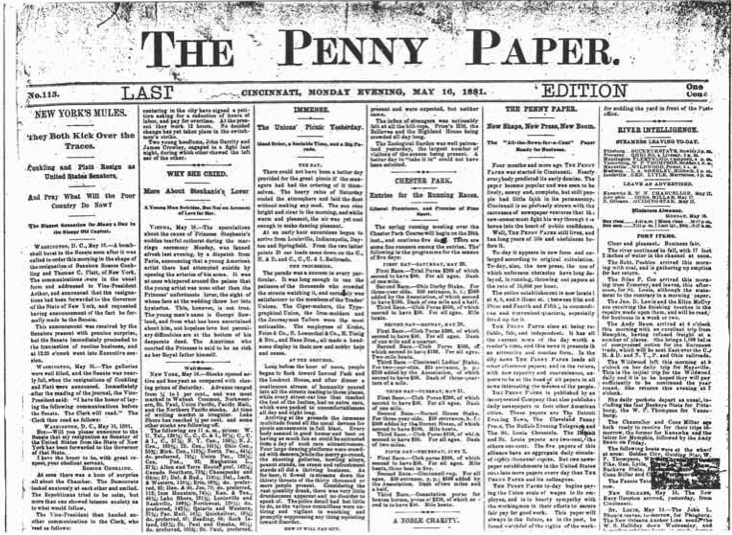
The penny papers themselves were the most vivid record of the era’s transformation. The New York Sun and the New York Herald covered the whole range of human activity—sex, crime, tragedy, medicine, religion, culture—and they were read by the working class. The Herald‘s success was built on Bennett’s combination of sensationalism, technological improvements, and comprehensive news coverage. His editorials were notorious for their rhetorical extremism, and his public identity was defined by negatives, including Anglophobia. He was, for his time, the best newspaper of its time.
Day’s Sun was designed for the working class. Day had been a printer himself, and he never stopped identifying with the working class. His paper was a product of that experience.
Daily Life
To read a penny paper in 1830s New York was to participate in a new kind of public life. The papers were cheap—a penny—and they were read on street corners, in taverns, and at home. They were not just news; they were entertainment, a source of community and connection in a rapidly growing city.
Day’s own experience of the labor was hard. He had been pulled out of school at fourteen to apprentice to a weekly paper, working long hours setting type, letter by letter, line by line, then pulling the heavy levers of the presses, over and over, hundreds of times a night. It was hard physical labor, and it gave him a lifelong identification with the working class.
Numbers at the Time
| Statistic | Value | Source/Year |
|---|---|---|
| Weekly newspapers in the American colonies | 23 | 1765 |
| Price of a newspaper before the penny press | Six cents per copy | 1765–1830s |
| First daily newspaper in America | Pennsylvania Evening Post | 1783 |
| Price of a penny paper | One cent | 1830s |
How Historians See It Today
Modern historians regard the penny press as a pivotal moment in the history of journalism. The New York Herald is now considered the prototype of modern journalism and the best newspaper of its time. Bennett’s innovations—sensationalism, technological improvements, and comprehensive coverage—became the model for the century that followed. Subsequent yellow journalists like Joseph Pulitzer and William Randolph Hearst merely carried Bennett’s techniques to new heights—or depths.
At the time, contemporaries understood the penny press as a democratization of information. Modern scholarship builds on that view but also emphasizes the commercial and technological forces that drove it, and the ways the penny press’s sensationalism anticipated modern media hype. As one historian notes, the penny press was a “precursor to modern media hype.”
The penny press of the 1830s was more than a new way of selling newspapers; it was a new way of understanding the world. For the first time, news was available to the working class, and the working class shaped what the news became. The New York Sun and the New York Herald were not just newspapers; they were the first mass media, the first to recognize that the news belonged to everyone. The primary sources of that era—the stories of Day and Bennett, the papers themselves—teach us that journalism is not simply a product of technology, but of a new political vision. The penny changed news forever, and its legacy is the world we live in today.
FAQ
What was the penny press?
The penny press was a wave of cheap newspapers that appeared in 1830s New York, selling for one cent per copy instead of the usual six cents. The first were Horatio David Sheppard's New York Morning Post and Benjamin H. Day's New York Sun. They were made possible by the steam printing press, which cut costs and speeded production, and they brought news to the working class for the first time.
Who started the first penny newspaper?
The first penny newspapers were Horatio David Sheppard's New York Morning Post and Benjamin H. Day's New York Sun, appearing in the early 1830s. Day, born in 1810 in Springfield, Massachusetts, moved to New York in 1829 and in 1833 came up with the plan of selling newspapers to the poor. James Gordon Bennett followed in 1835 with the New York Herald, which became the most successful penny paper of its time.
Why was the penny press important?
The penny press democratized access to news, making it affordable to the working class. It also introduced a new style of journalism—combining sensationalism, comprehensive coverage, and technological improvements—that became the prototype of modern journalism. The New York Herald, under James Gordon Bennett, became the model for later publishers like Pulitzer and Hearst.












Leave a Reply