
Short Answer
On a quiet Sunday afternoon in 1957, a father in a gray flannel suit knelt in his basement with a tape measure, a sack of cement, and a government pamphlet titled The Family Fallout Shelter. His wife was upstairs, canning vegetables and counting the family’s supply of powdered milk. The children were told not to touch the sandbags stacked against the coal bin. This was not a drill; it was the rhythm of American domestic life in the age of the bomb. Across the country, from suburban split-levels to rural farmhouses, millions of families were preparing for an attack that might never come — but that they believed could come at any moment.
What Happened?
The modern American fallout shelter movement began in earnest in 1951, when President Harry S. Truman created the Federal Civil Defense Administration (FCDA) to protect citizens in the event of nuclear war. The agency’s first instinct was ambitious: build shelters all over the country. But the cost was staggering, and the government quickly backed away from a nationwide public construction program. Instead, it turned to the American family.
The result was a decade-long campaign of domestic preparedness. In 1955, the head of the civil defense effort publicly pushed families to build their own shelters.[2] The message was simple and repeated in pamphlets, radio spots, and school drills: your only hope of salvation is a place to go.[3]
- 1951: President Truman creates the Federal Civil Defense Administration.
- 1955: Civil defense leadership urges families to build home shelters.
- 1957: Government publishes The Family Fallout Shelter, offering detailed plans for basement and backyard shelters.
- 1962: Department of Defense radio announcements instruct Americans on how to reach the nearest shelter in the event of a nuclear flash.
The government’s approach was deliberately homespun. Design historian Sarah A. Lichtman, writing on the era, describes how families planning for the apocalypse “often took a more homespun approach.”[3] The official pamphlets were filled with line drawings of ordinary basements, sandbagged walls, and wooden benches. The shelter was not a military bunker; it was a do-it-yourself project, no more complicated than building a backyard patio.
How It Was Seen at the Time
To contemporaries, the fallout shelter was a rational, necessary household appliance — like a fire extinguisher or a first-aid kit. The language of civil defense was calm, instructional, and unshakeably optimistic. A 1962 public service radio announcement from the Department of Defense, Office of Civil Defense, told listeners: “If you receive warning of an enemy attack get to the nearest fallout shelter promptly. But if you’re caught in the open, and there’s a brilliant nuclear flash in the distance, take cover immediately.”[4]
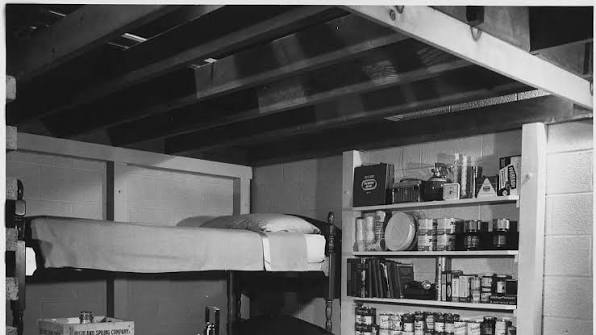
The prevailing mood was one of quiet urgency. The shelters were not meant for a long siege; they were meant for the two weeks of radioactive fallout that would follow a blast. A temporary basement shelter, as depicted in an artist’s rendition from 1957, was a family-sized space with bunk beds, a hand-cranked radio, and a barrel of drinking water.[4] The message was that with enough preparation, a family could survive the unthinkable — and that this preparation was a civic duty.
“Your only hope of salvation is a place to go.” — Civil defense message of the early 1950s, quoted in the design history of the era.[3]
Historical Snapshot
| Aspect | Detail |
|---|---|
| Date | 1951–1962 (peak era of the family shelter program) |
| Place | American suburbs, basements, and backyards |
| People | American families, the Federal Civil Defense Administration, the Office of Civil and Defense Mobilization, the Department of Defense |
| What Happened | The government promoted private family fallout shelters as the primary defense against nuclear fallout, publishing plans and broadcasting instructions. |
| Why It Mattered | It shaped the domestic experience of the Cold War, turning the home into the first line of defense and creating a lasting cultural memory of the bomb. |
What People Knew at the Time
| What People Knew Then | What We Know Now |
|---|---|
| Fallout shelters would protect families from the immediate radiation after a nuclear blast. | Modern analysis shows that a basement shelter would offer limited protection against a direct blast, and that long-term survival in a contaminated area would have been far more difficult than the pamphlets suggested. |
| The government was a reliable source of survival instructions. | Historians now note the government’s shelter program was also a psychological campaign to manage panic, not just a practical engineering project. |
| Two weeks of supplies would be enough to survive the fallout. | Fallout contamination can persist for far longer, and the shelters were rarely stocked for the full duration of the hazard. |
Official Reports
The most important official document of the era was The Family Fallout Shelter, published by the United States Office of Civil and Defense Mobilization.[1] The pamphlet provided detailed plans for several shelter designs, from a simple basement lean-to to a more elaborate underground concrete bunker. It specified materials, dimensions, and ventilation, and it instructed families on how to stock the shelter with food, water, and medical supplies.
The 1962 Department of Defense radio announcement, preserved in the Nebraska Studies archive, is another key official record.[4] It tells citizens to “get to the nearest fallout shelter promptly” and to “take cover immediately” if caught in the open by a nuclear flash. These official materials were the primary channel through which the government communicated the threat of the bomb to ordinary Americans.
What People Feared
The fear was real, but it was also shaped by the government’s own messaging. The civil defense announcements were designed to give people a sense of agency — a task to perform — rather than to panic them. The radio instructions, for example, were spoken in a calm, instructional tone, as if describing a fire drill.[4] But underneath the calm was a deep anxiety: the fear of a sudden, brilliant flash, of fallout drifting in the wind, of being caught “in the open” with nowhere to go.
The shelters were a response to the fear of the bomb, but they also fed it. Every basement shelter was a reminder that the threat was real. The government’s own language — “your only hope of salvation is a place to go” — implied that without a shelter, a family was doomed.[3]
Daily Life
For many families, the shelter was not a separate building; it was a corner of the basement, marked off with sandbags and a few planks of wood. The 1957 artist’s rendition of a temporary basement shelter shows a family room with bunk beds, a table, and a small radio.[4] The daily routine of the shelter era involved stocking canned goods, filling water jugs, and checking the batteries in the radio. In some homes, the shelter was a child’s playroom during the day, with the bunk beds doubling as a fort.
The government encouraged families to treat the shelter as an ordinary room, not a panic room. The pamphlets suggested that families should “live in” the shelter for a few days to get used to it, and that the food should be rotated into the normal kitchen pantry to avoid spoilage. This was a domestic chore, like putting up storm windows, but with the weight of the world on it.
Timeline
- 1945: The atomic bomb is used at Hiroshima and Nagasaki, ending World War II.
- 1951: President Truman creates the Federal Civil Defense Administration.
- 1955: The head of civil defense urges families to build their own shelters.[2]
- 1957: The Family Fallout Shelter is published by the Office of Civil and Defense Mobilization.[1]
- 1962: Department of Defense radio announcements instruct the public on shelter procedures.[4]
Aftermath
The family shelter program gradually faded in the late 1960s, as the nature of the nuclear threat changed. The development of larger thermonuclear weapons and intercontinental ballistic missiles made the idea of a simple basement shelter less plausible. The shelters that were built remained in many basements, becoming storage rooms, wine cellars, or children’s playrooms. The government’s focus shifted toward community shelters and then toward the policy of mutual assured destruction, which made the shelter seem less like a salvation and more like a relic.
How Historians See It Today
Historians today view the family fallout shelter as a cultural artifact as much as a practical defense. The design historian Sarah A. Lichtman, whose work is cited in the JSTOR Daily article, argues that the shelters reveal the “homespun approach” of the era — a way of domesticating the apocalypse and making it manageable.[3] The government’s decision to promote private shelters, rather than public ones, is now seen as a political choice, one that placed the burden of national defense on the family and the individual.
Modern historians also note that the shelters were a form of psychological reassurance. The calm, instructional tone of the government’s radio and pamphlet materials was a deliberate effort to avoid panic. The shelter was a way of saying that the bomb could be survived, that the American home could withstand the apocalypse. That message, however, was built on an optimistic and untested set of assumptions about the effects of nuclear war.
Common Misconceptions
Related Primary Sources
- The Family Fallout Shelter (Office of Civil and Defense Mobilization, 1957) — the complete government pamphlet with plans and instructions.[1]
- 1962 Department of Defense radio announcement, preserved in the Nebraska Studies archive.[4]
- Photographs and artist’s renditions of family shelters, courtesy of the National Archives and Records Administration.[4]
FAQ
Did the government build public fallout shelters for everyone?
No. The government initially considered building shelters all over the country, but the cost was too high. Instead, the Federal Civil Defense Administration promoted private, family-built shelters, publishing plans and instructions for homeowners to build their own.
How long were families expected to stay in a fallout shelter?
The government's instructions suggested a period of about two weeks, based on the assumption that the most dangerous fallout would settle in that time. Families were instructed to stock food, water, and a radio for this period.
Were the shelters meant to survive a direct nuclear blast?
No. The shelters were designed to protect against radioactive fallout, not the blast itself. The government's own pamphlets described them as 'fallout shelters,' and they were intended for use after a blast, not during one.
How many American families actually built shelters?
The exact number is unknown, but historians note that while the program was heavily promoted, only a small percentage of families actually constructed shelters. The majority of Americans did not build them.






Leave a Reply