
Short Answer
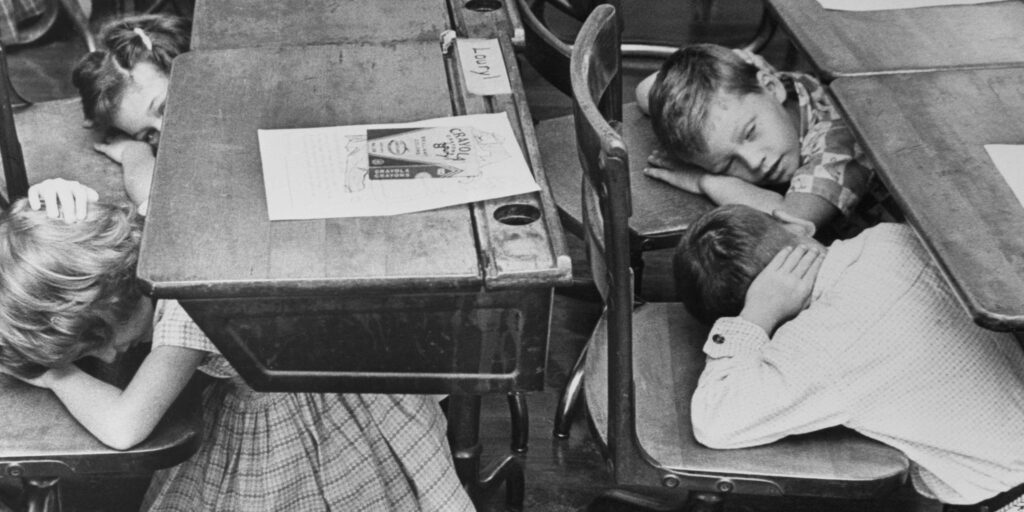
In a classroom in Portland, Oregon, on a December day in 1950, a teacher’s voice cut through the usual hum of arithmetic and reading: “Take cover!” Instantly, rows of children slid from their seats and crouched beneath their wooden desks, arms shielding their heads. A few feet away, an Associated Press photographer captured the moment for a wirephoto that would appear in newspapers across the nation. The caption read: “Students at Ockley Green Public School, Portland, Oregon, practice ‘duck and cover’ drill for possible atomic bomb attack.” This was not an isolated exercise. From Los Angeles to Brooklyn, from small towns to big cities, American schoolchildren were learning to treat a classroom desk as a shield against the flash of an atomic bomb.
What Happened?
Following the Soviet Union’s first atomic bomb test in August 1949, the United States federal government launched a massive civil defense campaign. Schools became a focal point. By 1950, local school boards and civil defense authorities had begun organizing regular drills in which students would practice “take cover” or “duck and cover” procedures—usually by crawling under their desks or against interior walls, with hands covering their heads and necks.
The photographic record captures the practice in several documented instances:
- December 7, 1950 – Students at Ockley Green Public School in Portland, Oregon, practice a “duck and cover” drill for a possible atomic bomb attack, as recorded by an Associated Press wirephoto. The image was widely distributed to newspapers.
- circa 1951 – An “Atom bomb drill at school in Los Angeles, Calif.” is photographed by the Los Angeles Daily News, showing children in a classroom taking shelter under desks.
- September 25, 1954 – Students at Bethesda-Chevy Chase High School in Maryland practice civil defense drills in the school hallway, photographed by Oliver F. Atkins to illustrate an article titled “This School is Ready for the H-Bomb” in The Saturday Evening Post.
- 1962 – At P.S. 58 in Brooklyn, New York, a “take cover” drill is photographed by Walter Albertin for the New York World-Telegram and the Sun, showing children crawling under their desks.
The drills were usually brief, orderly, and often repeated weekly. In many schools, they were integrated into the daily routine, announced by a bell or a teacher’s command. Children were taught that the desk—or a wall, or a basement—could protect them from the blast, heat, and radiation of an atomic weapon.
How It Was Seen at the Time
Contemporaries described these drills in the language of preparedness and optimism. The phrase “take cover” was used interchangeably with “duck and cover,” a term popularized by the 1951 civil defense film Duck and Cover featuring an animated turtle named Bert. The film, produced by the Federal Civil Defense Administration, was shown in schools and encouraged children to “duck and cover” at the first sign of a flash.
News captions of the time conveyed a matter-of-fact tone. The Library of Congress caption for the 1962 Brooklyn photo reads: “P.S. 58 – Carroll & Smith Sts. Bklyn. hold a ‘take cover’ drill practice Here youngsters crawl under their desks.” The word “practice” signals that the drill was routine, not exceptional. In the 1954 Bethesda-Chevy Chase photo, the caption notes that the students were “practicing Civil Defense drills” for an article titled “This School is Ready for the H-Bomb,” suggesting that readiness was a point of pride.
“Students at Ockley Green Public School, Portland, Oregon, practice ‘duck and cover’ drill for possible atomic bomb attack.” — Associated Press wirephoto caption, December 7, 1950
Historical Snapshot
| Aspect | Detail |
|---|---|
| Date | 1950–1962 (peak period 1950–1955) |
| Place | Public schools across the United States, including Portland, OR; Los Angeles, CA; Bethesda, MD; Brooklyn, NY |
| People | Schoolchildren, teachers, civil defense officials, photographers |
| What Happened | Students practiced “duck and cover” drills, crawling under desks or against walls to protect themselves from an atomic bomb blast. |
| Why It Mattered | The drills reflected a national civil defense policy that aimed to reassure the public and prepare for a possible nuclear attack. |
What People Knew at the Time
| What People Knew Then | What We Know Now |
|---|---|
| Atomic bombs were a real threat; drills were a practical response to a possible attack. | Historians recognize the drills were as much about psychological reassurance as physical protection; desks offered little real safety against a nuclear blast. |
| The government promoted civil defense as a way to protect the population. | We now understand that the drills were part of a broader Cold War strategy to maintain morale and public support for military preparedness. |
| Children were taught that “duck and cover” could save lives. | While the drills could protect against some effects of a distant blast, they were largely ineffective against a direct or nearby nuclear explosion. |
Contemporary Newspaper Coverage
Newspapers played a crucial role in normalizing the drills. The Associated Press distributed the Portland photo on December 7, 1950, with a caption that described the drill as a “possible atomic bomb attack” precaution. The New York World-Telegram and Sun staff photographer Walter Albertin photographed the 1962 Brooklyn drill, which was also published in the paper. The Saturday Evening Post featured the Bethesda-Chevy Chase High School in a September 25, 1954 article titled “This School is Ready for the H-Bomb,” with photographs by Oliver F. Atkins. These outlets treated the drills as routine, matter-of-fact exercises, reinforcing the idea that schools were responsible for teaching children how to survive an atomic attack.
“This School is Ready for the H-Bomb” — The Saturday Evening Post, September 25, 1954
Daily Life
For millions of American schoolchildren, the drill became a regular part of the school day. Teachers would announce “Take cover!” and students would scramble under desks, often holding their heads with their hands. In some schools, the drill was performed to the sound of a bell or a siren. The routine was repeated so often that it became a reflex, as familiar as a fire drill. Children were also taught to recognize the “flash” of an atomic bomb and to duck immediately, as seen in the 1951 Los Angeles drill. The photographs show children in classrooms, hallways, and even playgrounds, always with their bodies tucked tightly under desks or against walls. The practice was not confined to the classroom; it extended to school buses and other public places, though the classroom was the most common setting.
How Historians See It Today
Historians now view the duck-and-cover drills as a mix of genuine preparedness and psychological manipulation. While the drills were based on the limited knowledge of the time—that a desk might offer some protection from flying debris or thermal radiation—they also served to normalize the threat of nuclear war and to reassure the public that a nuclear attack was survivable. Scholars note that the drills were part of a larger civil defense program that sought to maintain morale and avoid panic. The photographs from the period are now studied as evidence of how Cold War culture permeated everyday life, turning children into participants in the national defense effort. The primary sources—the photographs, captions, and news articles—remain powerful reminders of how fear and hope coexisted in American schools during the 1950s.
The images of children huddled under desks, captured by photographers like Walter Albertin and Oliver Atkins, are more than historical curiosities; they are documents of a generation taught to believe that a simple act could save them from the ultimate threat. Today, they serve as a reminder of how nations prepare for—and sometimes normalize—the unthinkable.
FAQ
What was the 'duck and cover' drill?
The 'duck and cover' drill was a civil defense exercise in which schoolchildren were taught to quickly get under a desk or table and cover their heads with their hands in the event of an atomic bomb explosion. The practice was based on the idea that even a thin barrier could protect against flying debris and some radiation.
Why did schools practice these drills?
Schools practiced these drills as part of the federal Civil Defense program during the Cold War. The drills were intended to prepare children for a possible Soviet nuclear attack, and also to reassure the public that the United States could survive an attack.
How effective were the drills?
The drills were largely symbolic. While they might have offered some protection against a distant blast or fallout, they were not effective against a direct nuclear strike. Historians view them as a psychological tool to maintain public morale and normalize the threat of nuclear war.








Leave a Reply