
Short Answer
At the dawn of the twentieth century, the United States was a nation in motion. In the crowded tenements of New York and Chicago, children hawked newspapers, ran errands, and played in alleys, their voices mingling with the clatter of trolleys and the cries of street vendors. On the farms of the Midwest, boys and girls rose before sunrise to milk cows, gather eggs, and help with the harvest. In the mining towns of Montana, children grew up amid the headframes and smokestacks, their playgrounds carved from the rocky slopes of the “Richest Hill on Earth.” These children lived in a world where the line between childhood and adulthood was thin, and their everyday lives—marked by school, play, and chores—were recorded in photographs, diaries, and the records of reformers. This article draws on that primary source record to reconstruct what it was truly like to be a child in the early twentieth century.
What Happened?
The turn of the twentieth century was a time of explosive growth for American cities, as historian David Nasaw notes in Children of the City: At Work and at Play. Thousands of young people left farm homes for life in the big city, but even by 1920 the nation’s heartland remained predominantly rural, and most children in the region were still raised on farms. As Pamela Riney-Kehrberg writes in Childhood on the Farm, the experiences of most farm children continued to reflect the traditions of family life and labor, even in an age when middle-class urban Americans were beginning to redefine childhood as a time reserved for education and play.
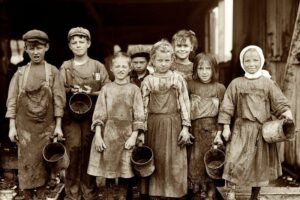
The Library of Congress’s primary source set Children’s Lives at the Turn of the Twentieth Century offers a vivid snapshot of these varied experiences. It includes photographs of a girl’s playground in a city, a group of African American children playing, and a series showing the day’s work of Estelle and Felix Humphrey. It also documents the darker side of childhood: a photograph of Salvin Nocito, a five-year-old spinner, at the Rhodes Manufacturing Company in Lincolnton, North Carolina, and another of a child working in a rickety tenement. In the mining town of Butte, Montana, the Montana Historical Society’s Mining Childhood project shows how children’s lives were shaped by the mining industry, from the 1900s through the 1960s.
The period saw a gradual but significant shift in attitudes toward child labor. While many children continued to work in factories, farms, and streets, reformers began to advocate for compulsory education and child labor laws. The primary sources—photographs, school records, and children’s own diaries—reveal a world where the boundaries between work and play were often blurred.
Historical Snapshot
| Aspect | Detail |
|---|---|
| Date | Roughly 1900–1920, with continuing rural patterns into the 1960s |
| Place | United States: cities (New York, Chicago), rural Midwest, mining towns like Butte, Montana |
| People | Children from immigrant, working-class, and farm families; reformers; teachers |
| What Happened | Children’s lives were defined by a mix of school, play, and labor; urban children often worked as newsies or in factories, farm children did heavy chores, and mining town children grew up around industrial work. |
| Why It Mattered | This era saw the rise of compulsory education and child labor reform, and the primary sources document the lives that motivated those movements. |
Daily Life
For farm children in the Midwest, daily life was a rhythm of chores and seasonal work. Riney-Kehrberg’s study draws on memoirs and diaries to show that children as young as six or seven were expected to help with tasks like feeding animals, weeding gardens, and carrying water. School was often a seasonal affair, with children attending during the winter and summer months when farm labor was less demanding. One memoirist recalled, “We were up at four, milked the cows, and then walked two miles to school.” The Library of Congress’s Children’s Object Book and Muddy Jim and Other Rhymes show how children’s literature of the time mirrored these realities.
In the cities, daily life was a different experience. Children often worked after school and on weekends, as newsies, bootblacks, or in factories. The photograph of Salvin Voss, a five-year-old spinner, is a stark reminder of how young children could be. Yet the same primary sources show that urban children also had time for play—the Library of Congress set includes images of children playing with bicycles and tricycles, and a “Girls’ Playground” photo shows organized recreation.
In mining towns like Butte, Montana, children’s lives were intertwined with the mining economy. The Montana Historical Society’s Mining Childhood project uses photographs and oral histories to show children playing in the shadow of the headframes, while also being expected to take on chores at home. The town’s nickname, “The Richest Hill on Earth,” shaped the children’s sense of identity and community.
Eyewitness Accounts
Primary sources give us direct, personal glimpses into these lives. The Library of Congress’s set includes a series showing the day’s work of Estelle and Felix Humphrey, a photographic record of children engaged in household chores. Another photograph shows a child named Sylvester Rawding in front of a sod house, a testament to the hard work of farm families. The set also includes a photograph of Salvin Voss, labeled “Salvin Nocito, 5 years old,” working in a textile mill.
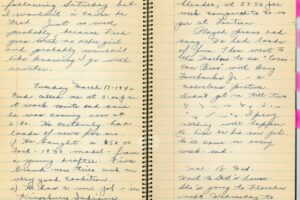
The Montana Historical Society’s lessons, created by Anna Baldwin, use excerpts from the book Mining Childhood to explore how children in Butte experienced their world. One lesson asks students to examine how neighborhoods shape our identity, using historical photographs and text excerpts from children’s letters and diaries. These primary sources allow us to hear the children’s own voices, such as one diary entry that described the thrill of watching the mine’s whistle blow, marking the start and end of shifts.
The photograph of the “Girls’ Playground” from the Library of Congress shows a group of girls in a schoolyard, but also a glimpse of their daily routine. The image is a silent witness to the structured play that reformers encouraged as an alternative to the streets.
Different Perspectives
Urban Children
Urban children, especially those of immigrants, often worked to support their families. As David Nasaw’s Children of the City shows, the streets were a workplace and a playground. Newsboys and newsgirls, bootblacks, and delivery runners were common. These children had a degree of independence, but also faced dangers. The photographs of the Library of Congress show children in tenements and in a skyscraper, indicating the variety of urban environments.
Rural Children
In contrast, rural children on the farm had a different set of responsibilities. They were essential to the family’s survival, and their chores were not just a supplement but a necessity. Riney-Kehrberg notes that by 1920, the Midwest remained predominantly rural, and most children were still raised on farms. Their play was often tied to the land, with games that imitated adult work.
Mining Town Children
Children in mining towns like Butte, Montana, experienced a unique childhood. They lived in a company town where the mine dominated everything. The Montana Historical Society’s project highlights how children’s play often involved the mining landscape, and how the union, community, and work culture shaped their identity. These children were aware of the dangers of the mine from an early age.
What People Knew at the Time
| What People Knew Then | What We Know Now |
|---|---|
| Childhood was often seen as a time of work and preparation for adulthood, especially among working-class and rural families. | Historians now recognize that the turn of the century was a period when childhood was increasingly defined as a time for education and play, but that this was not universal. |
| Reformers were aware of the dangers of child labor, and began to pass laws to limit it. | Modern scholarship, such as that of Nasaw and Riney-Kehrberg, uses primary sources to show the complexity of children’s lives, including their own agency and resilience. |
| Photographs and official reports often highlighted the plight of child workers, but also celebrated the virtue of farm chores. | We now understand that the experiences of children varied greatly by region, class, and ethnicity, and that many children combined work, school, and play in ways that were not always visible in official records. |
How Historians See It Today
Modern historians have used the primary sources of the era to reconstruct the everyday lives of children with a nuance that the contemporaries often lacked. While reformers at the time focused on the evils of child labor, historians like David Nasaw and Pamela Riney-Kehrberg have shown that children were not merely passive victims. They were active participants in their own lives, shaping their own cultures of play and work. The Library of Congress’s primary source set, along with the Montana Historical Society’s project, have made these sources more accessible, allowing students to see the faces and read the words of the children themselves.
The turn of the century was a watershed moment in the history of childhood. The primary sources reveal that while the ideal of childhood as a time of play and education was emerging, the reality for many children was still one of labor and responsibility. The tension between these two views—and the gradual shift toward the modern model—is a central theme of the historiography.
In the end, the primary sources of the early twentieth century do not offer a single story of childhood, but a mosaic of experiences. From the farm to the city, from the schoolroom to the factory, children’s everyday lives were marked by resilience and adaptation. These sources remind us that the history of childhood is not just a story of adults’ plans for children, but also of the children’s own voices, as they navigated a world in the making.
FAQ
Did all American children work in the early 20th century?
No, not all children worked. Many children, especially in middle-class urban families, attended school and had time for play. However, a significant number of children, particularly in rural areas and among immigrant families, worked in factories, on farms, or in the streets. The Library of Congress primary sources show both working children and children in school playgrounds.
What kinds of primary sources are available for studying children's everyday lives in this era?
Primary sources include photographs (like those in the Library of Congress collection), diaries and memoirs, school records, census data, child labor reports, and oral histories. The Montana Historical Society's Mining Childhood project uses photographs and text excerpts from children's diaries to explore growing up in a mining town.






Leave a Reply