
Short Answer
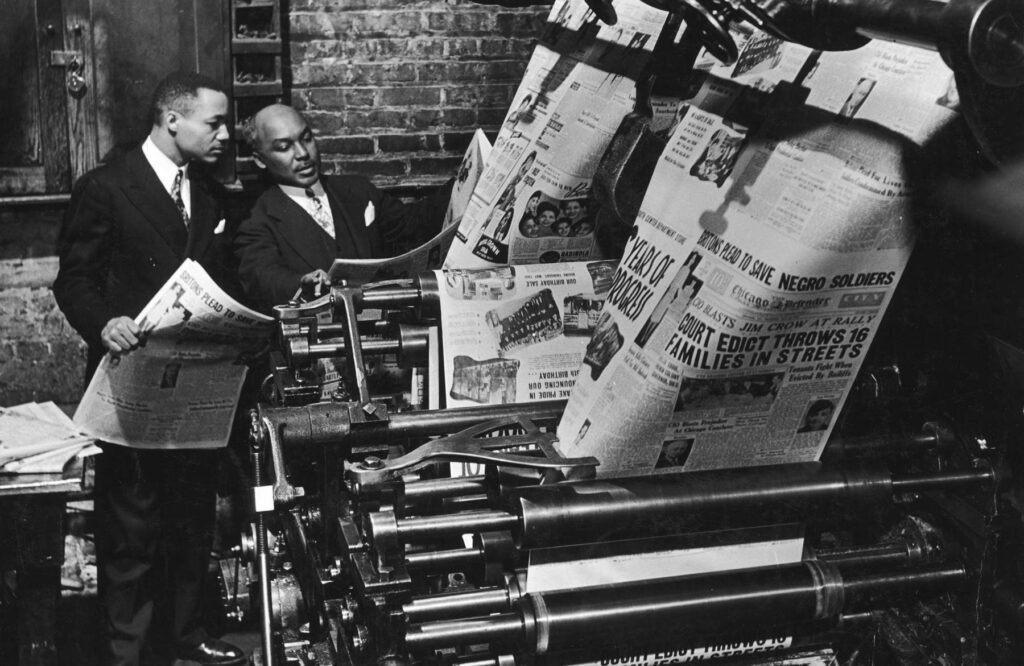
In 1940, an African American family in Pittsburgh, Chicago, or rural South Carolina could not open a mainstream daily and expect to see their lives reflected with dignity. The white press either ignored them or attacked them. The alternative came in the pages of the Pittsburgh Courier, the Chicago Defender, and dozens of other weeklies produced by and for African Americans. These newspapers were not merely sources of news; they were instruments of protest and vehicles of mobilization. By the mid-1940s, their combined circulation had reached into the millions, and their editors had become national figures. The decade witnessed the black press at the height of its power — a period that proved critical to the formation and gathering strength of the civil rights movement that emerged so forcefully in the following decades.
What Happened?
The black press of the 1940s was the culmination of more than a century of African American journalism. The first black newspaper appeared in New York City in March 1827, created explicitly “to counter attacks on blacks by the city’s other papers” (Washburn, 2006). By the 1940s, the Pittsburgh Courier and the Chicago Defender had emerged as the two most influential black newspapers in American history (Washburn, 2006).
The decade was marked by several key developments:
- 1941–1945: Wartime activism. During World War II, the black press pushed for a “Double V” victory — over fascism abroad and racism at home. The Pittsburgh Courier launched the Double V campaign in 1942, which resonated deeply with black readers who saw the contradiction between fighting for democracy overseas while being denied it at home.
- 1940–1948: Political mobilization in the South. In South Carolina, editor John H. McCray used his newspaper to spur black political engagement. McCray employed what communications scholars later identified as a “collective action frame” to emphasize African American agency and self-assertion at a time when accommodation and negotiation remained dominant strategies in the deep South (Bedingfield, 2011).
- 1948: The fight for military integration. President Harry S. Truman announced the integration of the U.S. military in 1948, but the armed forces made limited progress before the summer of 1950. The black press, led by the most influential newspapers, fought for military integration and reported on every setback and breakthrough (Slagle, 2019).
- 1948–1950: Laying the groundwork for the civil rights movement. In the late 1940s and early 1950s, black newspapers helped lay the groundwork for the Civil Rights movement through their uncompromising political activism, their growing visibility, and their recognition for journalistic excellence (PBS).
How It Was Seen at the Time
Contemporaries understood the black press as a weapon. The title of Patrick S. Washburn’s history of the black press, Voice of Freedom, captures the self-conception of these publications. Editors and readers alike saw the black newspaper as a political instrument — a counterweight to a mainstream white press that either ignored or attacked African Americans.
In South Carolina, John H. McCray and his colleagues used their paper to redefine the meaning of full citizenship for Black Carolinians, linking it directly to political confrontation rather than patient negotiation (Bedingfield, 2011). This framing was deliberate. During a period when accommodationism remained dominant in the deep South, the black press in South Carolina emphasized self-assertion and collective action.
“[The newspaper] redefined the meaning of full citizenship for black Carolinians and linked it directly to political confrontation.”
Historical Snapshot
| Aspect | Detail |
|---|---|
| Date | 1940–1950 |
| Place | United States, with major publication centers in Pittsburgh, Chicago, New York, and Southern cities such as Columbia, South Carolina |
| People | Editors and journalists of the Pittsburgh Courier, Chicago Defender, and other black newspapers; civil rights activists such as John H. McCray |
| What Happened | Black newspapers grew into a powerful national voice for African Americans, campaigning for civil rights, military integration, and political engagement |
| Why It Mattered | The black press laid the groundwork for the civil rights movement of the 1950s and 1960s |
Contemporary Newspaper Coverage
The black press’s own coverage of the civil rights struggle in the 1940s was characterized by direct advocacy. The Pittsburgh Courier and Chicago Defender covered the fight for military integration with remarkable intensity, publishing stories on the slow progress of desegregation and the continued resistance of the armed forces (Slagle, 2019).
In South Carolina, McCray’s paper did not simply report on events; it framed them to inspire readers to act. The newspaper’s “collective action frame” emphasized African-American agency and self-assertion, transforming the civil rights struggle from a distant national story into a local, personal call to action (Bedingfield, 2011).
The black press also saw itself as a counterweight to the mainstream white press. The first black newspaper of 1827 had been created to counter attacks on blacks by other papers, and that mission remained central in the 1940s (Washburn, 2006).
Eyewitness Accounts
Journalist Evelyn Cunningham, who worked for the Pittsburgh Courier during the civil rights era, was sent to Montgomery, Alabama, to cover the emerging movement. Her account captures the danger and drama that black journalists faced:
“Hell was breaking loose down south. This young man, this young preacher in Montgomery, was beginning to appear in the papers, and I wanted to get down there. So they sent me down south. I’m in one of those sad little hotels in Montgomery, when I heard a bomb. I dashed over to Dr. King’s house and sure enough the front of the house was demolished. You have no idea of the impact of standing and watching this young man plead with these hundreds of people who were standing in front of his house with Coke bottles and pipes, getting ready to go into town and beat up somebody, to watch him tell them to be calm, be calm, that was not the way.”
Cunningham’s account, though set in the mid-1950s, illustrates the continuity of the black press’s role: the same newspapers that had fought for civil rights in the 1940s were the ones that brought the Montgomery story to the nation.
What People Feared
Black journalists and editors in the 1940s lived with constant fear — of violence, of retaliation, of being accused of disloyalty. The bombing of Dr. King’s house, described by Cunningham, was one example of the violence that black journalists risked by covering the movement. The editors of the black press also feared political repression. During the late 1940s and early 1950s, black newspapers muted their militancy to fend off accusations of communism or subversion (PBS).
There was also a deeper, more existential fear: the fear that the very success of the civil rights movement would make the black press obsolete. As PBS notes, the black press’s greatest achievements — uncompromising political activism, increasing visibility, and journalistic excellence — were also the sources of its setbacks (PBS).
What People Expected Would Happen Next
Many black journalists in the 1940s expected that the black press would continue to lead the fight for civil rights, growing in influence and power. They saw their newspapers as the permanent instrument of the movement — a voice that would eventually force the federal government to act.
Yet some already sensed the irony. As the PBS documentary “The Black Press” put it, the black press was “putting itself out of business.” The more effective the black press became in advancing civil rights, the less the need for a separate black press would become. By the end of the twentieth century, the black newspaper had indeed declined from its peak in the 1940s (Washburn, 2006).
How Historians See It Today
Modern historians view the 1940s as a crucial period in the history of the black press. Patrick S. Washburn’s The African American Newspaper: Voice of Freedom traces the evolution of the black newspaper from 1827 to its decline at the end of the twentieth century, emphasizing that the period from 1910 to 1950 proved critical to the formation of the civil rights movement (Washburn, 2006).
Scholars have also analyzed the rhetorical strategies of the black press. Bedingfield’s study of John H. McCray (2011) demonstrates how the newspaper used a “collective action frame” to transform black political engagement from accommodation to confrontation. This research shows that the black press was not merely a passive recorder of events but an active shaper of political consciousness.
Slagle’s work (2019) on the black press and military integration shows how black newspapers fought for the desegregation of the armed forces and how they reacted when integration arrived. This scholarship highlights the black press’s role in the military, a dimension often overlooked in general histories of the civil rights movement.
Finally, historians note the paradox of the black press’s success. By helping to create the conditions for the civil rights movement, the black press also helped to create the conditions for its own decline. As the mainstream press began to cover African American life more fully, the need for a separate black press diminished. The black press, in effect, put itself out of business.
The black press of the 1940s was a phenomenon of extraordinary power and courage. From its pages, African Americans found not only news of their own communities but also a vision of a future they could fight for. The primary sources — the newspapers themselves, the eyewitness accounts of journalists like Evelyn Cunningham, and the editorial strategies of figures like John H. McCray — reveal a press that understood itself as a political instrument. Its legacy is not merely in the headlines it produced but in the movement it helped to build. The 1940s were the decade when the black press reached its zenith, and the voices that filled its pages — the Pittsburgh Courier, the Chicago Defender, and the scores of local papers across the South — remain essential to understanding how the struggle for civil rights was reported, experienced, and ultimately won.
FAQ
What was the Double V campaign?
The Double V campaign was launched by the Pittsburgh Courier in 1942. It called for a double victory: victory over fascism abroad and victory over racism at home. The campaign was deeply resonant with Black readers who saw the contradiction between fighting for democracy abroad while being denied it in the United States.
Why did the black press decline after the 1940s?
The black press declined because its own success helped create the conditions for its obsolescence. As the civil rights movement gained ground, the mainstream press began to cover African American life more fully, and the need for a separate black press diminished. Historians note that the black press, in effect, 'put itself out of business.'





Leave a Reply