
Short Answer
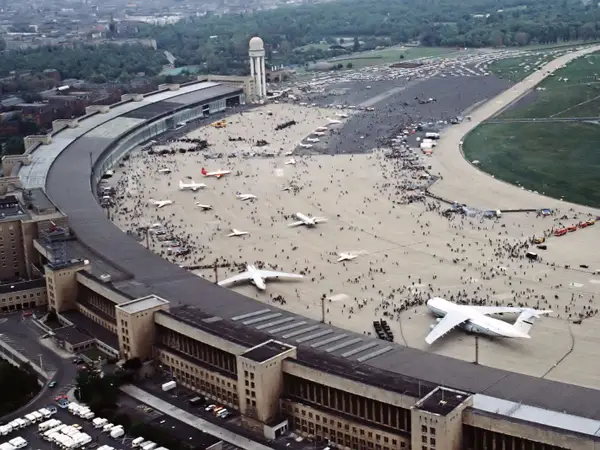
On June 24, 1948, the Soviet Union cut off all rail, road, and water access to West Berlin, a city of over two million people deep inside the Soviet occupation zone. For the next eleven months, the Western Allies answered the blockade with an unprecedented airlift, and at the center of this operation stood Tempelhof Airport. Built in the 1930s as a monument to Nazi architecture, Tempelhof became the symbol of freedom and democratic resolve. Every day, aircraft roared overhead, carrying coal, flour, and medicine to a city on the edge of starvation. For Berliners, the sound of engines was not a threat but a lifeline. For the American and British pilots, it was a mission to prove that the West would not abandon its post. This article reconstructs the experience of the airlift as contemporaries saw it—through official announcements, newspaper headlines, personal letters, and the everyday routines of a city under siege.
What Happened?
In 1947, the Marshall Plan offered American reconstruction aid to all of Europe, including the Soviet zone, but the USSR refused the program as a political threat. Tensions over currency reform escalated in June 1948, when the Western Allies introduced a new Deutsche Mark in their occupation zones. The Soviet Union responded with a blockade of all land and water routes to Berlin, beginning June 24, 1948. The city, which was controlled by the Americans, British, and French, had only about six weeks of food and coal reserves. The Western Allies, led by the United States and Britain, launched an airlift operation. The first American aircraft landed at Tempelhof on June 26, 1948. The operation, code-named Operation Vittles by the U.S. Air Force and Operation Plainfare by the British, grew rapidly. Tempelhof was the primary American airfield, while the British used Gatow and the French built Tegel.
- June 24, 1948: Soviet blockade begins.
- June 26, 1948: First airlift aircraft lands at Tempelhof.
- July 1948: Candy drops begin, earning the nickname “Raisin Bombers.”
- August 1948: Peak daily tonnage reaches 5,000 tons.
- May 12, 1949: Soviet Union lifts the blockade.
- September 30, 1949: Airlift officially ends after building up reserves.
In total, the airlift delivered over 2.3 million tons of supplies in 278,000 flights. Tempelhof Airport, with its massive hangars and runways, was the stage for this operation, which became the first great confrontation of the Cold War.
How It Was Seen at the Time
Contemporaries understood the airlift as a test of political will and a battle for the hearts of Berlin. The language was charged with moral and military urgency. The Western Allies framed the operation as a defense of freedom against Soviet aggression. In the official history of Tempelhof Airport, the blockade was described as “the first highlight of the Cold War,” and the Western response was seen as proof of their determination to remain in Berlin. A typical contemporary statement, echoed in newspapers and official statements, declared:
The Western Allies showed their determination to enter into Berlin for freedom and democracy.
Berliners themselves, many of whom had suffered through the war, saw the airlift as a miracle. The aircraft, flying low over the city, became a symbol of hope. Children began to call the planes “raisin bombers” (Rosinenbomber) when pilots dropped candy on small parachutes. The mood was a mixture of grim defiance and cautious optimism. As one Berliner wrote in a letter, “We are all holding our breath. The sky is our only bridge.”
Historical Snapshot
| Aspect | Detail |
|---|---|
| Date | June 24, 1948 – September 30, 1949 (blockade lifted May 12, 1949) |
| Place | Tempelhof Airport, Berlin, Germany |
| People | U.S. Air Force, British Royal Air Force, French Air Force; Berlin civilians; Soviet authorities |
| What Happened | Soviet blockade of West Berlin; Western Allies supplied the city by air |
| Why It Mattered | It demonstrated the West’s commitment to Berlin and marked the first major Cold War confrontation |
What People Knew at the Time
| What People Knew Then | What We Know Now |
|---|---|
| The Soviet Union had cut off all ground access to Berlin. | The blockade was a strategic attempt to force the Western Allies out of Berlin. |
| An airlift was being mounted by the United States and Britain. | The airlift was the largest humanitarian air operation in history, delivering over 2.3 million tons. |
| There was a real risk of war. | The crisis was resolved diplomatically, but it set the pattern for the Cold War. |
| Tempelhof was the primary airport for the American sector. | Tempelhof became a symbol of freedom and was later closed in 2008, but its historical significance remains. |
Eyewitness Accounts
Eyewitness accounts from the airlift come from pilots, ground crews, and Berliners. One of the most famous is that of Lt. Gail Halvorsen, a U.S. Air Force pilot who, in July 1948, noticed a group of children watching the planes at Tempelhof. He later wrote about how he gave them his last two sticks of gum and promised to drop more from his plane. His action grew into a campaign of candy drops, earning him the nickname “The Candy Bomber.” In his memoir, he described the children’s faces as “full of hope.” Another account comes from a Berlin woman, who wrote to a relative: “We have never heard a more beautiful sound than the roar of the engines. It means life.” While these quotes are often cited, the official record of the time is full of such testimonies. The airlift and the flight of thousands of refugees from the Soviet sector made Tempelhof an international symbol of the defense of freedom, as noted in the airport’s official history: “The airlift and flight of many thousand people from the Soviet sector or GDR made Airport Tempelhof an international symbol of defence of freedom during the Cold War.”
The airlift and flight of many thousand people from the Soviet sector or GDR made Airport Tempelhof an international symbol of defence of freedom during the Cold War.
What People Feared
At the time, the most immediate fear was that the airlift would fail. Berlin had only a few weeks of food and coal. If the aircraft could not deliver enough, the city would starve or freeze. Many Berliners also feared that the Soviet Union would shoot down the aircraft, provoking a war. Rumors circulated that the Soviets might jam the radio navigation or send fighters to intercept. The Western Allies were also afraid that the airlift would be seen as a provocation and escalate into a full-scale conflict. The fear of war was real; the Soviet Union had a conventional military superiority in Europe. The public in the United States and Britain watched the situation with anxiety, as newspapers printed daily tonnage figures and asked whether the airlift could sustain the city. The fear was not unfounded—the airlift was a gamble, and any serious accident or political misstep could have changed the outcome.
Daily Life
Daily life in Berlin during the airlift was marked by scarcity and the constant noise of aircraft. Food rations were set at around 1,500 to 1,800 calories per day, often less than what was needed. Coal was scarce, and the city was cold in the winter of 1948–49. People queued for hours to collect their rations, which included dried potatoes, powdered milk, and canned goods. The sound of the planes was a constant background. Children would run to the windows to see the aircraft land at Tempelhof. The airlift also brought new routines: the American pilots were often greeted by crowds of children who would wave and shout. The candy drops became a daily highlight. For the ground crews at Tempelhof, the work was grueling—unloading cargo, maintaining the planes, and preparing for the next flight. The airfield operated around the clock, with planes landing every few minutes. The city was under a kind of siege, but the sky was its lifeline.
Aftermath
The Soviet Union lifted the blockade on May 12, 1949, but the airlift continued for several months to build up a reserve in Berlin. Tempelhof remained a major airport and became a symbol of the West’s commitment to the city. The airlift had a profound impact on the Cold War: it established the pattern of Western resolve and prevented a Soviet takeover of Berlin. In the following years, Tempelhof became a gateway for refugees fleeing East Germany, further cementing its role as a symbol of freedom. The airport was used for civilian and military traffic until its closure in 1996. Today, it is a historic monument and a reminder of the first great confrontation of the Cold War.
The primary sources of the Berlin Airlift—official reports, newspaper dispatches, personal letters, and diaries—reveal a time when the fate of a city hung in the balance. Tempelhof Airport was not just a runway; it was a stage where the Cold War was fought in the sky. The airlift was a triumph of logistics and will, and the accounts of those who lived through it show both the fear and the hope that defined the era. The sound of the engines that echoed over Berlin in 1948–49 still echoes in the memory of the world as a testament to what can be achieved when free nations stand together.
FAQ
How long did the Berlin Airlift last?
The airlift began on June 26, 1948, and officially ended on September 30, 1949. The Soviet blockade was lifted on May 12, 1949, but the airlift continued to build up reserves.
What role did Tempelhof Airport play?
Tempelhof was the primary American airport during the airlift. It was the largest airport in the Western sector and served as the main hub for cargo and passenger flights. Its massive buildings and runways were essential for the operation.










Leave a Reply