
Short Answer
In the early 1980s, the world was a place of sharp contrasts. In the United States, a new conservatism was taking hold under President Ronald Reagan, while in Britain, Prime Minister Margaret Thatcher pursued similar free-market policies. The optimism of the 1960s had given way to the turbulence of the 1970s, and many people were looking for stability. As the Washington Post noted in 1989, “We, the people, cried at weddings, resented the guy at the supermarket who carried nine items into the eight-items-or-less line… Life went on.” But the decade was marked by profound changes in politics, technology, and culture. The rise of the “yuppie,” the explosion of blockbuster movies, the emergence of cable networks like CNN and MTV, and the looming threat of nuclear war all shaped how contemporaries experienced the 1980s.
What Happened?
The 1980s began with a conservative revolution in the West. Ronald Reagan took office in January 1981, promising to cut taxes, reduce government regulation, and restore American pride. His economic policies, known as “Reaganomics,” emphasized supply-side economics and deregulation. In the United Kingdom, Margaret Thatcher pursued similar free-market reforms. The decade also saw the rise of the “yuppie”—young urban professionals who embraced materialism and consumerism.
Key events unfolded rapidly:
- 1981: The IBM Personal Computer was released in August, and the first Space Shuttle, Columbia, lifted off in April.
- 1984: A gas leak from a pesticide plant in Bhopal, India, killed thousands of people.
- 1985: The Live Aid concert was held in July to fund relief for the Ethiopian famine.
- 1986: The Chernobyl nuclear disaster in the Soviet Union spread radioactive debris across much of the world.
- 1989: The Berlin Wall fell in November, symbolizing the end of the Cold War.
Throughout the decade, the Iran–Iraq War led to over one million deaths, and the Soviet–Afghan War caused 1–3 million casualties. The AIDS crisis emerged as a global health emergency, eventually killing more than 700,000 people in the United States alone. Meanwhile, technology transformed daily life: cable networks like CNN and MTV introduced the music video, and Michael Jackson’s Thriller became the best-selling album of all time.
How It Was Seen at the Time
Contemporaries experienced the 1980s as a time of both optimism and anxiety. The new conservatism promised prosperity, but many worried about nuclear war and social change. The Washington Post captured the everyday mood in 1989: “We, the people, cried at weddings, resented the guy at the supermarket who carried nine items into the eight-items-or-less line, worried that our sex lives weren’t quite what they were supposed to be, turned out the lights after we’d decorated the Christmas tree and just looked at it for a while.” This blend of mundane concerns and larger fears defined the era.
Politically, many saw Reagan and Thatcher as restoring order after the turbulence of the 1970s. The rise of the yuppie was celebrated in some circles and mocked in others. The AIDS crisis brought fear and stigma, while the threat of nuclear war loomed large in public consciousness. As the BBC later noted, the decade saw “politics in the West shift to the right as conservatism and the free market took hold.”
Historical Snapshot
| Aspect | Detail |
|---|---|
| Date | 1980–1989 |
| Place | Global, with focus on the United States, United Kingdom, and Soviet Union |
| People | Ronald Reagan, Margaret Thatcher, Mikhail Gorbachev, Michael Jackson, yuppies |
| What Happened | Conservative revolution, end of Cold War, technological boom, AIDS crisis, Chernobyl |
| Why It Mattered | Shaped the modern world: fall of communism, rise of consumer culture, digital age |
What People Knew at the Time
| What People Knew Then | What We Know Now |
|---|---|
| The Cold War was ongoing, but tensions were easing under Gorbachev. | The Soviet Union would collapse by 1991, ending the Cold War. |
| AIDS was a deadly new disease, but its full scale was unknown. | It would become a global pandemic, with millions infected. |
| Chernobyl was a catastrophic nuclear accident. | Its long-term health and environmental effects are still being studied. |
| The Berlin Wall was a permanent symbol of division. | It fell in 1989, reuniting Germany. |
What People Feared
Nuclear war was the dominant fear of the 1980s. The Reagan Doctrine and the Soviet invasion of Afghanistan heightened tensions, and many believed a superpower conflict was possible. The AIDS crisis also generated panic, as little was known about transmission and treatment. Economic anxieties included inflation and unemployment, though Reaganomics promised relief. The Chernobyl disaster fueled fears about nuclear power, while the Bhopal gas leak raised concerns about industrial safety.
Some fears were rational, others exaggerated. The threat of nuclear war was real, but the Cold War ended peacefully. AIDS was deadly, but public panic often outpaced scientific understanding. The decade was marked by a sense of uncertainty about the future.
What People Expected Would Happen Next
Many contemporaries expected the Cold War to continue indefinitely. The fall of the Berlin Wall in November 1989 came as a shock to most observers. Some predicted that Reagan’s policies would lead to long-term prosperity, while others warned of growing inequality. The rise of personal computers led to predictions of a digital revolution, but few anticipated the internet’s global impact. The AIDS crisis prompted fears of a widespread epidemic, but the development of antiretroviral drugs in the 1990s changed the course.
In hindsight, the decade’s most transformative events—the end of the Cold War and the digital revolution—were largely unforeseen by contemporaries.
Daily Life
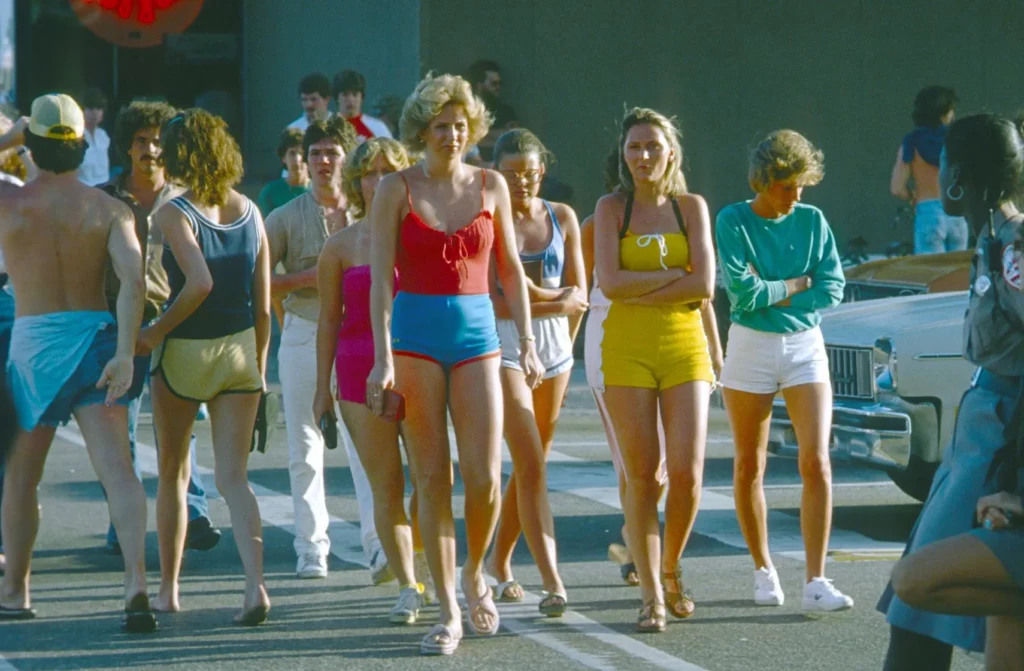
Daily life in the 1980s was shaped by consumerism and new technology. Yuppies embraced designer clothing, BMWs, and gourmet coffee. MTV, launched in 1981, made music videos a cultural phenomenon, and Michael Jackson’s Thriller became a global sensation. Personal computers entered homes and offices, changing work and leisure. The Washington Post described the era’s mundane routines: “We, the people, cried at weddings, resented the guy at the supermarket who carried nine items into the eight-items-or-less line…”
Fashion was bold and colorful, with shoulder pads, neon colors, and leg warmers. Cable television brought 24-hour news and entertainment. The AIDS crisis affected social life, particularly in the LGBTQ+ community, where fear and stigma were pervasive. Despite the materialism, many people found joy in simple moments—decorating Christmas trees, taking vacation photos, and watching sunsets.
How Historians See It Today
Modern historians view the 1980s as a pivotal decade that reshaped global politics and economics. The rise of neoliberalism under Reagan and Thatcher redefined the role of government, while the fall of the Berlin Wall marked the end of the Cold War. The Routledge Handbook of the Global 1980s (2025) describes the decade as one of “enormous global change,” where “a new form of capitalism redefined global economics on both the right and left as market forces were unleashed.”
Historians also emphasize the interconnectedness of the decade—how consumer products, popular culture, and protest movements crossed borders. The 1980s are now seen as the birth of the modern world, with the digital revolution and the end of superpower conflict setting the stage for the 21st century.
In the end, the 1980s were a decade of contradictions—optimism and fear, materialism and anxiety, division and unity. The primary sources of the era—newspapers, diaries, and eyewitness accounts—reveal a world in transition, where people lived their daily lives while witnessing history unfold. As the Washington Post put it, “Life went on.” But it went on in a world that would never be the same.
FAQ
What was the most significant event of the 1980s?
Many historians point to the fall of the Berlin Wall in November 1989, which symbolized the end of the Cold War and the beginning of a new global order. Other major events include the Chernobyl disaster, the rise of personal computers, and the AIDS crisis.
How did people in the 1980s view the future?
Contemporaries were often anxious about nuclear war and the AIDS epidemic, but also optimistic about technological progress and economic growth. The sudden end of the Cold War surprised most observers, who had expected the superpower conflict to continue.












Leave a Reply