
Short Answer
On the morning of October 23, 1956, Budapest’s bridges were ordinary crossings—iron and stone spans over the gray Danube, used by workers, students, and housewives. By that evening, they had become the stage for a nation’s awakening. Ferenc Holl, a 23-year-old locksmith, sat on the riverbank with his girlfriend when he saw a crowd moving across Margaret Bridge. “It was the first demonstration Budapest had seen since the Communist takeover after the Second World War,” he later recalled. The protesters, mostly students, brandished Hungarian flags from which the hated red star had been cut out. They marched toward Hungarian Radio, and when gunfire erupted, the uprising had begun. For the next three weeks, the bridges of Budapest—Margaret, Chain, Liberty, and others—served as the city’s arteries of protest, resistance, and eventually flight. They carried the hopes of a nation, and later, its sorrow.
What Happened?
The Hungarian Revolution began on October 23, 1956, with a peaceful student demonstration in Budapest. Thousands gathered near the Danube, crossing the Margaret Bridge to reach the Parliament and the headquarters of Hungarian Radio. The crowd demanded the withdrawal of Soviet troops, the dissolution of the AVO secret police, and multi-party elections. As the Independent later reported, the protesters were “brandishing Hungarian flags from which the hated red star had been cut out” and chanting “Russians go home!” and “Now or never!”
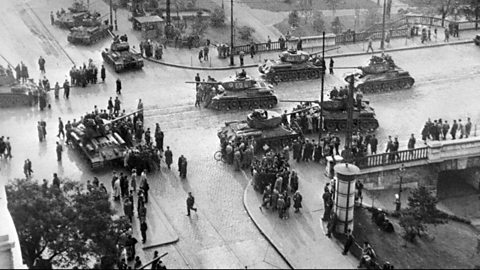
When the demonstrators reached the radio building, they were met with gunfire. The uprising spread rapidly across the city. For a few days, the revolution seemed to succeed—a new government was formed, and Soviet troops began to withdraw. But on November 4, Soviet tanks rolled into Budapest in a massive offensive. The writer James Michener described the moment: “At four o’clock in the morning on a Sunday in November 1956, the city of Budapest was awakened by the shattering sound of Russian tanks tearing the city apart.”
In the ensuing chaos, the bridges of Budapest became crucial. Demonstrators used them to rally and to move between the Buda and Pest sides of the city. When the Soviet attack began, the bridges were also the last escape route for thousands of Hungarians fleeing toward the Austrian border. The most famous crossing was not in Budapest itself but at the small wooden bridge at Andau on the Austrian border, over the Einserkanal. According to the Wikipedia article, that bridge was the escape route for about 70,000 Hungarians during the revolution. On November 21, 1956, Soviet troops blasted the bridge to stop the exodus.
How It Was Seen at the Time
At the time, both Hungarians and outside observers saw the bridges as symbols of freedom. The demonstration crossing Margaret Bridge was widely seen as a moment of national awakening. Ferenc Holl described the scene: “Above it all rose the chants: ‘Russians go home!’ and ‘Now or never!'” The language was one of hope and desperation. James Michener wrote, “There was a bridge at Andau, on the Austrian border, and if a Hungarian could reach that bridge, he was nearly free. It was about the most inconsequential bridge in Europe, but by an accident of history it became, for a few flaming weeks, one of the most important bridges in the world, for across its unsteady planks fled the soul of a nation.”
“It was about the most inconsequential bridge in Europe, but by an accident of history it became, for a few flaming weeks, one of the most important bridges in the world.” — James Michener, The Bridge at Andau (1957)
For the demonstrators, the bridges were not just physical structures but symbols of unity and resistance. The act of crossing the Danube together was a collective assertion of identity against Soviet occupation.
Historical Snapshot
| Aspect | Detail |
|---|---|
| Date | October 23 – November 21, 1956 |
| Place | Budapest, Hungary (especially Margaret Bridge, Chain Bridge); Bridge at Andau (Austrian border) |
| People | Hungarian students, workers, and civilians; Soviet troops; Hungarian secret police (AVO) |
| What Happened | A student demonstration crossed Margaret Bridge, sparking a national uprising against Soviet occupation. Soviet forces intervened on November 4; fighting lasted for weeks, and refugees fled westward over the bridge at Andau. |
| Why It Mattered | The uprising and its suppression became a defining moment of the Cold War, showing both the courage of the Hungarian people and the limits of Western intervention. |
Eyewitness Accounts
The most direct eyewitness account of the bridges comes from Ferenc Holl, a 23-year-old locksmith who was sitting on the banks of the Danube when the demonstration began. He told The Independent in a retrospective interview:
“It was the first demonstration Budapest had seen since the Communist takeover after the Second World War. The protesters, mostly students, were brandishing Hungarian flags from which the hated red star had been cut out. Placards called for the AVO secret police to be disbanded and for Matyas Rakosi, Stalin’s Hungarian henchman, to be hurled into the Danube. Above it all rose the chants: ‘Russians go home!’ and ‘Now or never!'”
Holl joined the crowd and marched to the radio station. He later saw the gunfire and the uprising begin. His account captures the mix of hope and fear that defined the moment. Another eyewitness, James Michener, was not present but compiled interviews from refugees in Austria. He described the bridge at Andau as the final barrier between captivity and freedom:
“At four o’clock in the morning on a Sunday in November 1956, the city of Budapest was awakened by the shattering sound of Russian tanks tearing the city apart. The Hungarian revolution—five brief, glorious days of freedom that had yielded a glimpse at a different kind of future—was over.”
What People Feared
At the time, the primary fear among Hungarians was the return of Soviet tanks and the brutal reprisals of the AVO secret police. Many remembered the Stalinist terror of the previous years, and the uprising was a desperate gamble. On the streets, rumors spread quickly—that the West would intervene, that the Soviet Union was too weak to respond, or that the government would capitulate. As the fighting intensified, people feared not only for their lives but for the future of their nation. The bridges, which had been the stage of hope, became the stage of terror as Soviet tanks crossed them on November 4. After the revolution was crushed, the fear of reprisal drove thousands to flee across the border, many crossing the bridge at Andau. The Wikipedia article notes that the bridge was blasted by Soviet troops on November 21, 1956, cutting off the last easy escape route. For those still in Budapest, the fear of arrest, deportation, and execution was immediate.
Timeline
- October 23, 1956: Student demonstration in Budapest; crowds cross Margaret Bridge; the uprising begins.
- October 24–30: Revolutionary fighters take control of the city; Soviet troops temporarily withdraw.
- November 4: Soviet forces launch a massive attack on Budapest; heavy fighting in the streets.
- November 4–10: The revolution is crushed; many Hungarians flee toward Austria, crossing the bridge at Andau.
- November 21, 1956: Soviet troops blow up the Bridge at Andau to stop the refugee flow.
Aftermath
Immediately after the revolution was suppressed, the Hungarian government was replaced by a pro-Soviet regime under János Kádár. The bridge at Andau was destroyed, but the memory of the escape route endured. In 1996, the bridge was rebuilt as a symbol of tolerance and reconciliation, as noted in the Wikipedia article. In Budapest, the bridges were repaired and returned to everyday use, but they remained as silent witnesses to the events of 1956. The revolution itself became a symbol of resistance for the world, and the bridges—especially the Chain Bridge and Margaret Bridge—became iconic images of the uprising in Western media. The 70,000 refugees who crossed the bridge at Andau were absorbed into the West, many settling in Austria and the United States. The uprising also became a defining event of the Cold War, a reminder of the Soviet Union’s willingness to crush dissent within its sphere of influence.
How Historians See It Today
At the time, many Hungarians and Western observers believed that the uprising was a spontaneous revolt that could be quickly crushed. They also believed that the West might intervene, but no such help came. Historians today view the uprising as a more complex event, rooted in long-standing discontent with Communist rule and the Soviet occupation. The role of the bridges is now seen as both practical and symbolic. They were the physical arteries of the revolution, and the images of refugees crossing the bridge at Andau became iconic. Modern scholarship also emphasizes the international dimension, including the reaction of the United States and the United Nations. The bridges have become a memory of the struggle for freedom, and the Bridge at Andau was rebuilt in 1996 as a symbol of tolerance and reconciliation. The primary sources—the eyewitness accounts, the photographs, the official reports—continue to shape our understanding of the revolution as a pivotal moment in the history of the Cold War.
The bridges of Budapest were never merely structures of iron and stone. In the autumn of 1956, they carried the weight of a nation’s hopes, its fears, and its desperate flight. The primary sources—the voices of the marchers, the refugees, and the witnesses—remind us that history is made by ordinary people who cross bridges, literally and figuratively, toward freedom. The revolution was crushed, but the memory of those who walked across the Danube and the bridge at Andau endures as a testament to the enduring human desire for liberty.
FAQ
Why did the bridges of Budapest become symbols of the 1956 uprising?
The bridges over the Danube were the physical and symbolic connection between the two parts of Budapest. During the uprising, they were the crossing point for the first demonstration, the stage for the revolution, and later the route for refugees fleeing Soviet tanks. The Bridge at Andau, though outside Budapest, became the final symbol of escape and freedom for nearly 70,000 Hungarians.
What happened to the Bridge at Andau?
The Bridge at Andau was a small wooden bridge over the Einserkanal on the Austrian border. It was used by about 70,000 Hungarian refugees during the 1956 revolution. On November 21, 1956, Soviet troops blasted it to stop the exodus. It was rebuilt in 1996 as a symbol of reconciliation.






Leave a Reply