
Short Answer
In the early 1950s, the United States emerged from World War II as the world’s dominant power. The G.I. Bill sent millions of veterans to college and into new suburban homes, while the Cold War cast a long shadow of nuclear anxiety. As the decade unfolded, Americans watched the Korean War, the rise of rock ‘n’ roll, and the first stirrings of the civil rights movement. This article reconstructs the 1950s as contemporaries experienced them, drawing on newspapers, diaries, and official reports.
What Happened?
The decade opened with the Korean War (1950–1953), a conflict that pitted U.S. and United Nations forces against North Korean and Chinese troops. The war ended in a stalemate, but it solidified the Cold War’s global reach. At home, the post-war economic boom transformed American life. The G.I. Bill financed education and home loans, fueling the rise of suburbs like Levittown, New York. Consumer goods—televisions, automobiles, and appliances—flooded the market. In 1954, the Supreme Court ruled in Brown v. Board of Education that racial segregation in public schools was unconstitutional, igniting a civil rights movement that would grow throughout the decade. The Montgomery bus boycott of 1955–1956, led by Martin Luther King Jr., brought national attention to the struggle. Meanwhile, the Cold War intensified: the Soviet Union tested its first atomic bomb in 1949, and in 1957 it launched Sputnik, the first artificial satellite, shocking Americans and sparking the Space Race. The decade also saw the rise of rock ‘n’ roll, with Elvis Presley becoming a cultural icon, and the Cuban Revolution of 1959, which brought a communist government to the Western Hemisphere.
How It Was Seen at the Time
Contemporaries experienced the 1950s as a time of both optimism and anxiety. The economic boom promised a better life, but the threat of nuclear war loomed large. Civil defense drills taught schoolchildren to “duck and cover” under their desks, and fallout shelters were built in backyards. The language of the era reflected these tensions: “Better dead than Red” was a common slogan, and the “Red Scare” led to investigations and blacklists. At the same time, many Americans embraced conformity and suburban domesticity. As Vice President Richard Nixon put it during the 1959 “Kitchen Debate” with Soviet leader Nikita Khrushchev, “We may be ahead of you in rocket thrust, but you are ahead of us in color television.” This mix of pride and fear defined the decade.
Historical Snapshot
| Aspect | Detail |
|---|---|
| Date | 1950–1959 |
| Place | United States, with global events in Korea, the Soviet Union, and Cuba |
| People | President Harry Truman (1945–1953), President Dwight Eisenhower (1953–1961), Martin Luther King Jr., Elvis Presley, Soviet leader Nikita Khrushchev |
| What Happened | Post-war economic boom, Korean War, Cold War tensions, civil rights movement, Sputnik launch, rise of rock ‘n’ roll |
| Why It Mattered | The decade set the stage for the civil rights victories of the 1960s, the Space Race, and the cultural shifts that defined modern America. |
What People Knew at the Time
| What People Knew Then | What We Know Now |
|---|---|
| Americans knew the Korean War was a “police action” against communist aggression, but many were frustrated by the stalemate. | Historians now view the Korean War as a crucial proxy conflict that solidified the Cold War’s global framework. |
| Contemporaries saw the civil rights movement as a series of isolated protests, not a coordinated national struggle. | We now recognize the 1950s as the foundational decade of the civil rights movement, with Brown v. Board and the Montgomery boycott as pivotal moments. |
| The launch of Sputnik was seen as a technological and military threat, prompting a rush to improve science education. | Historians note that Sputnik also had a profound psychological impact, shattering American confidence in technological superiority. |
What People Feared
The dominant fear of the 1950s was nuclear annihilation. The Soviet Union’s atomic bomb test in 1949 and the hydrogen bomb tests of the early 1950s made the threat tangible. Civil defense films like Duck and Cover (1951) instructed children to hide under desks, and many families built fallout shelters. The Cold War also fueled a fear of communist infiltration at home, leading to the McCarthy hearings and the blacklisting of suspected communists in government, entertainment, and education. These fears were not unfounded—the Soviet Union was indeed developing intercontinental missiles—but they also led to overreactions, such as the execution of Julius and Ethel Rosenberg in 1953 for espionage, a case that remains controversial.
Daily Life
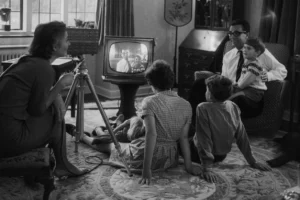
For many white middle-class Americans, daily life in the 1950s revolved around the new suburbs. The G.I. Bill made homeownership affordable, and developments like Levittown offered identical houses for around $8,000. Families bought their first televisions, watched shows like I Love Lucy, and drove new cars on expanding highways. Women were often expected to be homemakers, while men commuted to city jobs. The 1950s also saw the rise of the shopping mall, as car-centric suburbs replaced walkable downtowns. For African Americans, however, daily life was marked by segregation and discrimination, especially in the South, where Jim Crow laws enforced separate facilities and limited opportunities.
Numbers at the Time
| Statistic | Value (Year) |
|---|---|
| U.S. population | 151 million (1950) |
| Median family income | $3,300 (1950) |
| Average new house price | $8,450 (1950) |
| Unemployment rate | 5.3% (1950) |
| U.S. military casualties in Korea | 36,574 dead (1953) |
| Television ownership | 9% of households (1950) to 87% (1960) |
How Historians See It Today
Modern historians view the 1950s as a decade of paradox. On one hand, it was a time of unprecedented prosperity and cultural confidence, often romanticized in popular memory. On the other hand, it was a period of deep social tension, with the civil rights movement challenging segregation, the Cold War creating a climate of fear, and the seeds of the 1960s counterculture being planted. Historians also emphasize that the “affluent society” was not universal; poverty, especially among minorities and rural Americans, persisted. The decade’s legacy is thus more complex than the nostalgic image of “Leave It to Beaver” suggests.
The primary sources of the 1950s—newspapers, letters, diaries, and official reports—reveal a generation caught between hope and dread. They saw the promise of a better life and the threat of annihilation, and they navigated that tension in their daily routines. Their words and actions remind us that history is not a simple narrative, but a lived experience of uncertainty and aspiration.
FAQ
What was the most significant event of the 1950s?
Historians often point to the Korean War and the Brown v. Board of Education decision as pivotal, but the launch of Sputnik in 1957 also had a profound impact on American confidence and the Space Race.
How did the Cold War affect daily life in the 1950s?
The Cold War led to civil defense drills, fallout shelters, and a climate of fear. It also influenced politics, education, and popular culture, with anti-communist sentiment shaping everything from school curricula to Hollywood films.









Leave a Reply