
Short Answer
In the winter of 1932, a young mother in Humboldt County, California, sat down to write a desperate letter to First Lady Eleanor Roosevelt. Her husband, a surveyor, had been out of work for nearly two years. She had managed to keep their family afloat on her meager courthouse salary, but now she was pregnant and facing an impossible choice. “My salary could keep us going,” she explained, “but—I am to have a baby.” The family needed temporary help, she wrote, “after that I can go back to work and we can work out our own salvation. But to have this baby come to a home full of worry and despair, with no money for the things it needs, is not fair.” Her words captured the anguish of millions of Americans who, by 1932, had seen their savings vanish, their jobs disappear, and their futures darken. The Great Depression was not just an economic statistic; it was a daily battle for food, shelter, and dignity.
What Happened?
The Great Depression began with the stock market crash of October 1929, but its full weight fell on ordinary Americans over the following years. By 1932, three years after the initial crash, nearly thirty million Americans had lost their source of income, either through unemployment or the loss of a family breadwinner. In Washington State alone, more than a quarter of the population was out of work. Nationwide, about a quarter of the U.S. workforce was unemployed at the bleakest point in 1933.
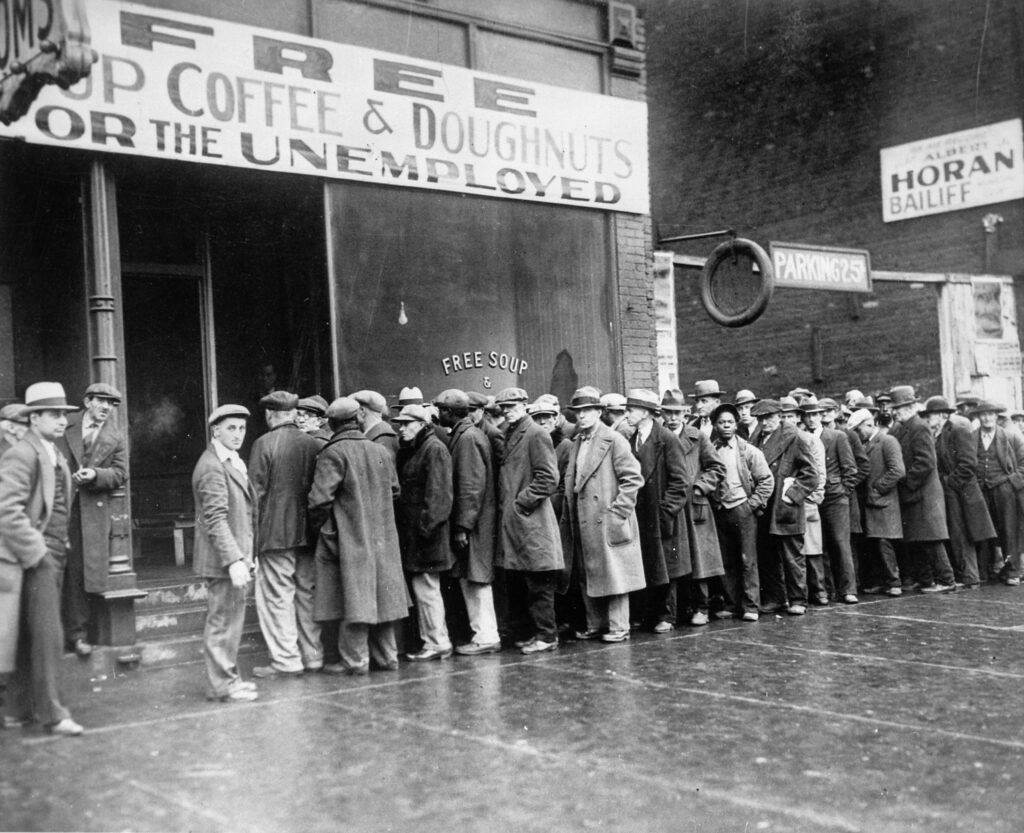
Those who kept their jobs often faced severe cuts. Wages were slashed, hours reduced to part-time, and many workers were forced to accept lower-paying positions. Even the upper-middle-class felt the pinch, as the affluence of the Roaring Twenties gave way to belt-tightening and uncertainty. In cities, breadlines stretched for blocks, and private charities—overwhelmed by the scale of need—could not keep up. In rural areas, farmers suffered uniquely. Crop prices fell so precipitously that many could not earn enough to pay their mortgages, losing their farms to foreclosure. In the Great Plains, one of the worst droughts in history turned the land barren, creating the Dust Bowl and forcing thousands of families to abandon their homesteads.
The crisis was not confined to one region or class. It touched every corner of the country, from industrial strongholds to rural communities. As factories slowed or shut down, workers joined the ranks of the unemployed, seeking help from soup kitchens and relief agencies. The federal government, initially reluctant to intervene, left most of the burden to local charities and state governments, which were quickly overwhelmed.
How It Was Seen at the Time
Contemporaries understood the Depression as a profound and bewildering collapse of the economic institutions on which they depended. The language of the era was filled with fear and desperation. Newspapers spoke of “breadlines,” “Hoovervilles,” and “the dole.” Many people felt a deep sense of shame about accepting charity, even as they had no other choice. The prevailing mood was one of anxiety and uncertainty, as families wondered how long the crisis would last and whether they would ever recover.
“To have this baby come to a home full of worry and despair, with no money for the things it needs, is not fair. It needs and deserves a happy start in life.” — Letter from a Humboldt County woman to Eleanor Roosevelt, 1934
This letter, preserved in the archives, reflects the personal toll of the Depression. It also shows how ordinary people turned to public figures like the First Lady for help, hoping that someone in power might listen. The sense of helplessness was widespread, but so was a stubborn determination to “work out our own salvation,” as the woman put it. Many families relied on ingenuity, mutual aid, and sheer endurance to get by.
Historical Snapshot
| Aspect | Detail |
|---|---|
| Date | 1929–1939 (peak hardship 1932–1933) |
| Place | United States, with severe impacts in urban industrial centers and rural agricultural regions, especially the Great Plains |
| People | Working-class families, farmers, unemployed workers, women, children, and the elderly |
| What Happened | Stock market crash triggered a decade-long economic downturn; unemployment reached ~25% by 1933; wages and hours cut; farms foreclosed; drought created Dust Bowl |
| Why It Mattered | It reshaped American social and political institutions, led to the New Deal, and changed how individuals viewed their relationship to the government and the economy |
Daily Life
Daily life during the Depression was defined by scarcity and improvisation. Families stretched every penny, often eating the same meals day after day—beans, potatoes, and bread. Many grew vegetable gardens and canned produce to last through the winter. Clothing was patched and repurposed; children wore hand-me-downs, and mothers often made dresses from flour sacks. In cities, people waited in long lines at soup kitchens and breadlines, while in rural areas, families bartered goods and services with neighbors.
Work, when it existed, was often part-time or underpaid. Men took on odd jobs, while women took in laundry or sewing. Children contributed by delivering newspapers, shining shoes, or working in fields. The home became a center of production, with families making soap, mending tools, and preserving food. Entertainment was simple and cheap: radio programs, board games, and community gatherings. Despite the hardship, many people found strength in solidarity, forming cooperatives and mutual aid societies to share resources.
Housing varied widely. In cities, families doubled up in apartments, while the homeless built shantytowns known as “Hoovervilles” on the outskirts of towns. These makeshift settlements, named after President Herbert Hoover, whom many blamed for the crisis, were made of scrap wood, tin, and cardboard. In rural areas, some families lived in tents or abandoned cars, especially after losing their farms.
Eyewitness Accounts
Primary sources offer vivid glimpses into the lived experience of the Depression. The letter to Eleanor Roosevelt quoted above is one such account. Another comes from a woman in Seattle, who wrote to the government in 1935 describing her family’s situation: “We have no money for food, and my husband is sick. The relief office says they cannot help us because we own a car.” The car, a symbol of middle-class respectability, was often a disqualifier for aid, even if it was broken down and useless.
Photographs from the era, such as those taken by Dorothea Lange and Walker Evans, capture the faces of the unemployed, the migrant workers, and the Dust Bowl refugees. These images, though not written accounts, serve as powerful primary sources that convey the dignity and despair of ordinary people. One famous photograph, “Migrant Mother,” shows a woman with her children, her gaze fixed on an uncertain future. Such images were widely circulated in newspapers and government reports, shaping public perception of the crisis.
What People Feared
The most immediate fear was starvation and homelessness. With no income and no savings, families faced the terrifying prospect of being turned out onto the street. Many feared losing their homes to foreclosure or eviction, and indeed, thousands did. There was also a deep anxiety about the future—would the Depression ever end? Would children ever have a chance at a decent life? Some feared that the economic collapse would lead to social unrest or even revolution, as it had in Russia. Others worried about the breakdown of the family, as men, unable to fulfill their roles as breadwinners, felt emasculated and sometimes abandoned their families in shame.
Rumors and unfounded panics also circulated. Some people believed that the government was hoarding food, or that banks were hiding money. Anti-immigrant sentiment grew, as some blamed foreigners for taking jobs. Yet these fears were often exaggerated. The real, rational fear was economic insecurity—the inability to provide for oneself and one’s loved ones.
Numbers at the Time
| Statistic | Value (as recorded) | Source/Year |
|---|---|---|
| Unemployment rate (U.S.) | ~25% | HISTORY.com, 1933 |
| Americans who lost income | ~30 million | University of Washington, 1932 |
| Washington State unemployment | Over 25% of population | University of Washington, 1932 |
| Farm foreclosures | Thousands of farms lost | Lumen Learning, early 1930s |
| Dust Bowl drought | One of the worst in history | Lumen Learning, 1930s |
Aftermath
The immediate aftermath of the worst years (1932–1933) saw the election of Franklin D. Roosevelt and the launch of the New Deal. Federal programs such as the Works Progress Administration (WPA) and the Civilian Conservation Corps (CCC) provided jobs for millions of unemployed Americans. The Social Security Act of 1935 established a safety net for the elderly and unemployed. While the Depression did not fully end until the economic mobilization of World War II, the New Deal brought a measure of relief and hope. The crisis also permanently changed American attitudes toward government, which was now expected to intervene in economic downturns and protect citizens from destitution.
How Historians See It Today
Historians today view the Great Depression as a transformative period that reshaped American society and politics. While contemporaries often saw the crisis as a personal failure or a temporary aberration, modern scholarship emphasizes the structural weaknesses in the economy—such as bank failures, income inequality, and overproduction—that made the Depression so severe. Historians also highlight the resilience and agency of ordinary people, who did not simply wait for government help but organized, improvised, and supported each other. The primary sources—letters, diaries, photographs, and oral histories—reveal a complex picture of suffering and survival, one that challenges the stereotype of passive victims. The Depression also accelerated social changes, including the entry of women into the workforce and the migration of rural populations to cities.
The Great Depression was a defining moment in American history, a time when the nation’s economic foundations were tested and ultimately rebuilt. The primary sources from the era—the desperate letters, the stark photographs, the breadlines, and the Hoovervilles—remind us that behind every statistic was a human story of endurance and hope. They teach us that even in the darkest times, people found ways to carry on, to help their neighbors, and to believe that better days would come.
FAQ
What did people eat during the Great Depression?
Families relied on cheap, filling foods like beans, potatoes, and bread. Many grew vegetable gardens and canned produce. Soup kitchens and breadlines provided free meals for the unemployed. Meat was a luxury, often replaced by cheaper cuts or extended with fillers like breadcrumbs.
How did the Great Depression affect family life?
The Depression strained family relationships as unemployment and poverty increased stress. Many families doubled up in housing, and children often left school to work. Women took on extra responsibilities, such as sewing, gardening, and taking in laundry. Despite the hardship, many families reported a sense of solidarity and mutual support.












Leave a Reply