
Short Answer
On the morning of 13 December 1981, Polish television broadcast a man in uniform announcing that the country was under martial law. Within hours, militiamen and ZOMO units appeared at street corners, telephone lines were restricted, and Solidarity activists were being interned. In homes and queues, people exchanged the same anxious questions: would there be food, would there be arrests, would the Soviets intervene, and would anyone dare to strike? The Solidarity era is usually dated from the August 1980 strikes in Gdańsk and Szczecin through the Round Table talks and the June 1989 elections. This article uses that broad scope, with particular attention to the daily experience of 1980–1989: empty shelves, ration cards, black-market bargaining, church services, underground newspapers, factory meetings, and the constant negotiation between official propaganda and private truth. The sources are contemporary decrees, oral history testimony, school and workplace memories, and the material traces of a society living through both mass mobilization and deepening shortage. The result is not a story of politics alone, but of how people cooked, worked, queued, studied, prayed, and waited for a future they could not yet see.
What Happened?
The Solidarity era began with a wave of strikes that exposed the fragility of the Polish People’s Republic. In July and August 1980, rising food prices and wage grievances triggered protests across the country. On 14 August 1980, workers at the Gdańsk Shipyard began an occupation strike. The Inter-Factory Strike Committee, led by Lech Wałęsa, formulated the 21 Demands, including independent trade unions, the right to strike, freedom of speech, and release of political prisoners. On 31 August 1980, the Gdańsk Agreement was signed, and on 17 September 1980 the independent trade union Solidarity was formally founded. By 1981 it claimed roughly ten million members, making it the largest independent social movement in the Soviet bloc.
- 14–31 August 1980: Strikes spread from Gdańsk to Szczecin, Silesia, and other industrial centres; the Gdańsk Agreement legalized independent trade union activity.
- 17 September 1980: Solidarity was established as a nationwide independent union; its membership and moral authority grew rapidly.
- 1981: Shortages worsened and rationing expanded; the union pressed for reforms while the Communist authorities prepared for confrontation.
- 13 December 1981: General Wojciech Jaruzelski declared martial law; Solidarity was suspended, thousands were interned, curfews and travel restrictions were imposed, and ZOMO units patrolled cities.
- 16 December 1981: Security forces pacified the Wujek coal mine; nine miners were killed, an event that became a symbol of state violence.
- 1982–1983: Solidarity continued underground; martial law was suspended at the end of 1982 and formally lifted in July 1983.
- 1988–1989: New strikes forced the authorities into Round Table talks; the June 1989 elections produced a decisive defeat for the Communist regime and opened the way to a non-communist government.
For ordinary people, these events were experienced less as a clean sequence of dates than as a thickening web of uncertainty. The legal existence of Solidarity had made politics visible in factories, schools, and parishes. Martial law pushed much of public life back into private apartments, churches, and underground networks. By the late 1980s, the accumulated exhaustion of shortage and repression had become a political force in its own right.
How It Was Seen at the Time
Contemporaries understood the era in moral and existential terms as much as political ones. For many workers, Solidarity was not merely a trade union but a claim to dignity, truth, and national renewal. The language of the movement drew on Catholic social teaching, workers’ rights, and patriotic memory. Official propaganda, by contrast, described martial law as a necessary shield against chaos and foreign intervention. Ordinary people often navigated between these languages, using irony, rumour, and private conversation to interpret what was really happening.
“If you asked me whether I believed in 1987 or 1988 that the communist system would fall, I did not believe it. I thought I would have to flee Poland.” — Andrzej Długosz, oral history interview, Polish History Museum.
This recollection captures a central feature of the period: even as the regime weakened, many people could not imagine its end. The future was foreshortened by daily necessity. People thought in terms of the next queue, the next ration card, the next passport refusal, rather than the collapse of the system. Yet the same period also produced a powerful language of expectation. Activists spoke of winning through the ballot box, of a Poland governed by truth and law rather than by party decree.
“We wanted to win through democracy, that is, through the ballot box.” — Władysław Ornowski, oral history interview, Polish History Museum.
Schooling and culture were also read politically. Teachers and pupils noticed how textbooks framed the past, and how apparently small rules about dress or appearance could carry ideological weight. The regime’s attempt to shape daily conduct was not lost on those who lived under it, even when they complied outwardly.
Historical Snapshot
| Aspect | Detail |
|---|---|
| Date | 1980–1989, with martial law from 13 December 1981 to July 1983 |
| Place | Polish People’s Republic (PRL), especially industrial cities, shipyards, mines, schools, parishes, and housing estates |
| People | Workers, intellectuals, farmers, teachers, students, clergy, Solidarity activists, Communist officials, SB officers, ZOMO units, and ordinary families |
| What Happened | Mass strikes, legalization of Solidarity, martial law, internment, rationing, underground publishing, strikes in 1988, Round Table talks, and partially free elections in 1989 |
| Why It Mattered | The era reshaped everyday life, weakened the Communist monopoly on public truth, and helped produce the peaceful transition of 1989 |
Daily Life
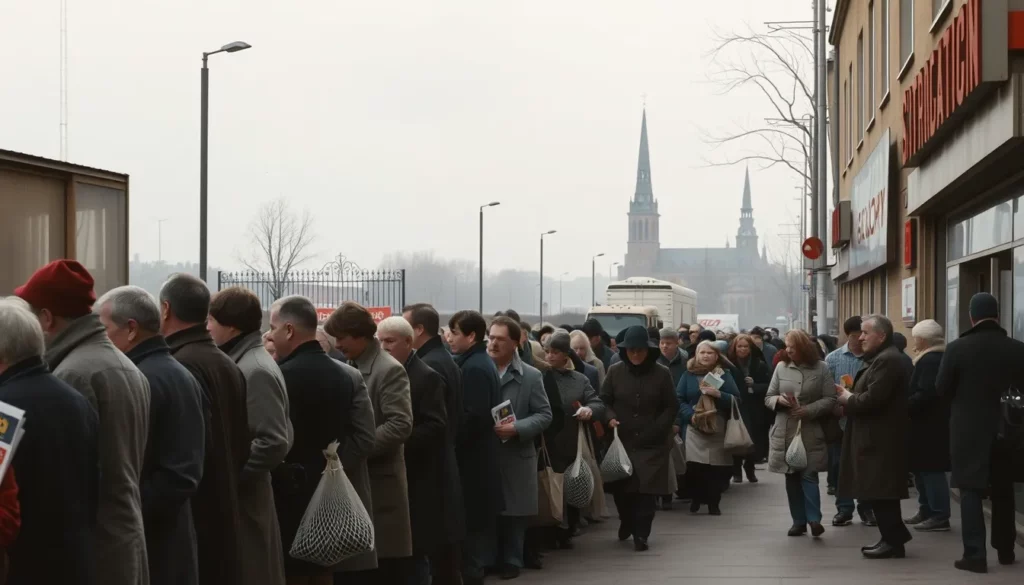
Daily life in the Solidarity era was organized around scarcity. By the early 1980s, meat, sugar, flour, butter, cigarettes, alcohol, and other goods were distributed through ration cards or subject to long queues. Shops might open with little warning and empty within hours. People developed elaborate strategies: queuing for relatives, asking rural acquaintances for meat, buying from private sellers at bazaars, or using foreign currency in Pewex shops. The black market was not a marginal phenomenon but a parallel economy in which nearly everyone participated at some point.
“The 1980s were a time of greyness, hopelessness, and shortages of everything. In the shops there was basically nothing except vinegar and mustard… Meat was a rare thing and was obtained mainly on the black market or through acquaintances in the countryside… The average salary was then 20 dollars a month.” — Andrzej Długosz, oral history interview, Polish History Museum.
Work and school were also shaped by politics. Factories held Solidarity meetings, posted demands, and later became sites of underground organizing. Teachers followed curricula that presented a heavily politicized view of literature and history. Uniforms and rules about appearance were enforced, but pupils and teachers remembered the gap between official discipline and private scepticism. Churches became spaces of relative freedom, especially during Masses for the fatherland, where families gathered and oppositional language could be heard.
Media and travel were tightly controlled. Television offered propaganda, entertainment, and occasional windows onto the outside world, but access to information was slow and uneven. Sports fans might wait days for a newspaper to arrive with results. Passports could be refused for political reasons, and travel abroad was a privilege rather than a right. At the same time, underground publishing produced books, newspapers, and leaflets that circulated hand to hand, creating a second public sphere outside official control.
Eyewitness Accounts
Oral history interviews collected by the Polish History Museum show how the era was remembered through concrete objects and encounters: ration cards, shop shelves, militia cordons, schoolbooks, and the fear of arrest. These are not abstract political memories but sensory records of daily life.
“The demonstration was dispersed by units of the motorized Citizens’ Militia, and I had the opportunity to see the effects of that in the form of people beaten by ZOMO.” — Sławomir Brambor, oral history interview, Polish History Museum.
“I did not receive a passport, because I had a ban on travelling abroad to any country. I did not have a passport, but it quickly turned out that the Security Service proposed that I go to Germany for construction work, but for signing a document of cooperation, for better money than for Arab countries. Of course I refused.” — Władysław Ornowski, oral history interview, Polish History Museum.
“Textbooks were very strongly politically marked… Instead of ‘medieval universalism’ one spoke of ‘cosmopolitanism’, which was a negatively charged expression.” — Magdalena Czarnecka, oral history interview, Polish History Museum.
Such accounts reveal how political pressure entered ordinary institutions. The Security Service did not only arrest activists; it tried to recruit them through work offers and travel permits. Schools did not only teach subjects; they taught categories of loyalty and suspicion. The everyday and the political were never fully separate.
What People Feared
The fears of the Solidarity era were both rational and rumoursome. After August 1980, many Poles feared a Soviet invasion similar to Czechoslovakia in 1968 or Hungary in 1956. The imposition of martial law was interpreted by some as a lesser evil that prevented foreign intervention, and by others as a domestic coup against the nation. Families feared arrest, internment, dismissal from work, passport refusal, and the loss of children’s educational prospects. In the streets, the presence of ZOMO created a more immediate fear of beatings, tear gas, and shooting.
“No one at that time had any awareness whether they would shoot or not.” — Andrzej Długosz, oral history interview, Polish History Museum.
Alongside political fear ran the anxiety of shortage. People worried about winter coal, food for children, medicine, and the next month’s ration. Rumours spread quickly: that a shop had received meat, that a train was carrying sugar, that a factory would be closed. Some fears were exaggerated, but many were grounded in real experience. The state’s inability to guarantee basic supplies did as much to erode its legitimacy as any political argument.
Numbers at the Time
| Figure | Value | Source or Year |
|---|---|---|
| Population of Poland | About 35.6 million | Official statistics, 1980 |
| Solidarity membership | About 9.5–10 million | 1981 estimates |
| Average monthly wage recalled by a witness | About 20 US dollars | Andrzej Długosz, oral history interview, 1980s |
| Persons interned after martial law | About 10,000 | Martial law records, 1981–1982 |
| Miners killed at Wujek mine | 9 | 16 December 1981 |
| Goods commonly rationed | Meat, sugar, flour, butter, cigarettes, alcohol | Rationing regulations, 1981–1989 |
Contemporary Terminology
The language of the period reveals how people divided their world. Some terms were official, some oppositional, and some everyday slang. Many remain intelligible in Poland today; others carry the unmistakable flavour of the late Communist era.
- PRL: Polska Rzeczpospolita Ludowa, the Polish People’s Republic, the official name of the Communist state from 1952 to 1989.
- Solidarność: Solidarity, the independent trade union and social movement founded in 1980; the name itself became a moral and political slogan.
- stan wojenny: Martial law, declared on 13 December 1981 and formally lifted in July 1983.
- ZOMO: Zmotoryzowane Odwody Milicji Obywatelskiej, motorized militia units used for crowd control and pacification; the acronym became associated with beatings and repression.
- SB: Służba Bezpieczeństwa, the Security Service, responsible for surveillance, infiltration, and political repression.
- internowanie: Internment, the detention of activists without trial under martial law.
- kartki: Ration cards or coupons used to buy scarce goods.
- Pewex: State-run hard-currency shops where Western goods could be bought with dollars or other foreign currency.
- czarny rynek: The black market, where scarce goods were sold outside official channels.
- bibuła: Underground printed material, literally “rag” or “paper”; the term covered leaflets, newspapers, and books produced outside censorship.
- drugi obieg: The “second circulation” of independent publishing and culture.
- msza za ojczyznę: Mass for the fatherland, a church service with patriotic and oppositional overtones.
The Solidarity era left behind not only political memories but a grammar of daily survival: the queue, the ration card, the hard-currency shop, the underground leaflet, the militia cordon. Oral histories show that people experienced the period as a mixture of exhaustion and dignity. The primary sources do not permit us to reduce it to a simple story of heroes and villains. They show a society improvising under pressure, using humour, religion, family networks, and small acts of truth-telling to preserve a sense of normal life. That is why the era remains so instructive: it demonstrates how ordinary routines can become sites of political meaning, and how the struggle for freedom is often fought in shops, schools, kitchens, and parish halls as much as in party rooms or negotiating chambers.
FAQ
What was everyday life like in Poland during the Solidarity era?
Everyday life was dominated by shortage and political uncertainty. People queued for food, used ration cards, relied on black-market contacts and rural relatives, and sometimes bought Western goods in Pewex shops with foreign currency. At the same time, factories, churches, schools, and underground publishing created spaces where Solidarity’s language of dignity and truth continued to circulate.
How did Poles cope with shortages during the Solidarity era?
They used a mixture of official and informal strategies: ration cards, queuing networks, workplace contacts, bazaars, black-market purchases, and gifts from relatives abroad. Hard-currency shops such as Pewex offered Western goods but were accessible mainly to those with dollars or foreign connections. Oral histories show that coping with shortage became a daily skill and a source of both solidarity and exhaustion.










Leave a Reply