
Short Answer
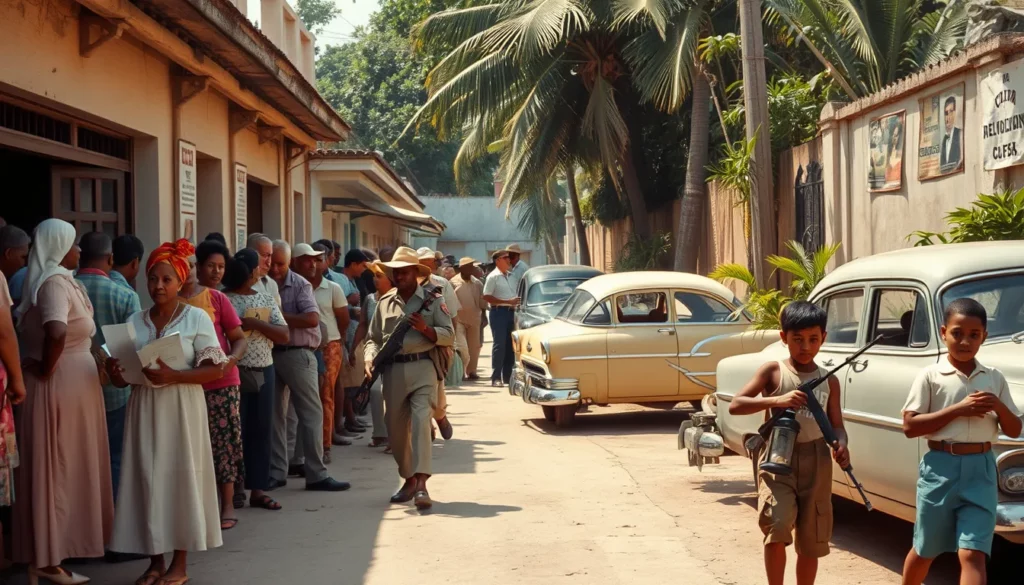
On 1 January 1959, Fulgencio Batista fled Havana before dawn, and within days bearded rebel columns were moving through a country that had known dictatorship, sugar-cane seasons, casual racial exclusion, and sharp inequalities between city and countryside. In Havana, newspapers such as Revolución and the magazine Bohemia carried photographs of victorious barbudos, while crowds filled the streets around the Presidential Palace and Camp Columbia. For many Cubans, the immediate sensation was not that a finished revolution had arrived but that an uncertain one had begun: buses ran late, shops opened and closed by rumor, and families argued over what the rebel victory would mean for rents, wages, land, schools, and the Church. The new government promised to restore the 1940 Constitution, punish Batista’s officials, and carry out agrarian reform. Ordinary people quickly learned that everyday life would become the arena in which those promises were tested. This article focuses on the first decade and a half after 1959, when the revolutionary state reorganized work, food, housing, education, health care, neighborhood life, and public speech, while Cubans negotiated the results in kitchens, queues, workplaces, and letters.
What Happened?
The collapse of the Batista regime was followed by a rapid concentration of power in the hands of Fidel Castro and the 26 July Movement, alongside other anti-Batista groups that were soon sidelined or absorbed. The provisional government began with liberal figures and promises of elections, but the revolution’s direction radicalized during 1959 and 1960. The Agrarian Reform Law of 17 May 1959 dismantled large estates and created cooperatives and state farms; the Urban Reform Law of 1960 reduced rents and transferred much rental property to tenants; and a wave of nationalizations in 1960 took over U.S.-owned sugar mills, banks, and utilities. The United States responded with economic restrictions, and by February 1962 Washington had imposed a full trade embargo. In April 1961, Cuban exiles backed by the CIA landed at the Bay of Pigs and were defeated within days; on 16 April 1961, at the funeral of victims of air raids, Castro declared the socialist character of the revolution. In October 1962, the Cuban Missile Crisis brought the island to the edge of nuclear war.
- 1 January 1959: Batista flees Cuba; rebel forces take power amid popular celebration and uncertainty.
- 17 May 1959: Agrarian Reform Law promises land, security, and rural modernization.
- 1960: Urban reform, nationalizations, the founding of the Committees for the Defense of the Revolution (CDR), and the Federation of Cuban Women (FMC) transform property and neighborhood life.
- 1961: The Literacy Campaign sends thousands of volunteers into rural areas; the Bay of Pigs invasion is defeated; Castro declares the revolution socialist.
- 1962: Rationing through la libreta is introduced; the U.S. embargo tightens; the Missile Crisis raises fears of annihilation.
By the mid-1960s, the revolutionary state had become the central organizer of daily life. Private trade was narrowed, education and health care were expanded, mass organizations mobilized neighborhoods, and political loyalty became a condition of access to many jobs, goods, and opportunities. Everyday existence was no longer merely private: it was measured against the revolution’s promises and dangers.
How It Was Seen at the Time
Contemporaries did not agree on what was happening. For many poor campesinos, urban workers, students, and Afro-Cubans, the revolution appeared as a long-delayed reckoning with inequality: land for those who worked it, schools in the countryside, clinics where none had existed, and an end to the humiliation of Batista’s police. For much of the urban middle class, however, the revolution began as a democratic restoration and then seemed to become something else—a one-party project that closed newspapers, nationalized property, and aligned Cuba with the Soviet bloc. The language of the period was moral and martial: pueblo, patria, yanquis, contrarrevolucionarios, milicias, Venceremos, and Patria o Muerte. The prevailing mood mixed euphoria with suspicion. In 1961, Castro told intellectuals that the revolution could not permit organized opposition:
“Within the Revolution, everything; against the Revolution, nothing.” — Fidel Castro, 1961 speech to intellectuals
Che Guevara’s later formulation of the “new man” captured the ideal that daily labor, sacrifice, and vigilance could produce a different kind of citizen:
“At the risk of seeming ridiculous, let me say that the true revolutionary is guided by a great feeling of love.” — Ernesto Che Guevara, “Socialism and Man in Cuba,” 1965
For supporters, such words explained scarcity as sacrifice; for opponents, they explained why ordinary life was becoming politicized from morning to night.
Historical Snapshot
| Aspect | Detail |
|---|---|
| Date | 1 January 1959 and the first decade and a half of revolutionary rule |
| Place | Cuba, especially Havana, rural Oriente, and provincial towns |
| People | Fidel Castro, Che Guevara, campesinos, urban workers, middle-class families, women’s organizations, Afro-Cuban communities, exiles, U.S. officials |
| What Happened | A nationalist insurrection became a socialist revolution that reorganized property, education, health care, food distribution, neighborhood surveillance, and public speech |
| Why It Mattered | Everyday routines—shopping, working, schooling, worship, travel, and speaking—became markers of loyalty, sacrifice, and survival |
Daily Life
Food was the most immediate measure of revolutionary change. Before 1959, Cuba imported much of its rice, beans, cooking oil, and other staples, while sugar exports paid for them. After 1959, land reform and state control of trade promised to make food affordable and secure, but the combination of nationalization, U.S. sanctions, poor planning, and the priority given to sugar exports produced chronic shortages. In 1962 the government introduced la libreta, the ration book through which families received fixed quantities of rice, beans, sugar, coffee, cooking oil, meat, soap, and clothing at subsidized prices. The bodega, the neighborhood state store, became a daily destination and a place of anxiety: lines formed before dawn, rumors traveled faster than deliveries, and the difference between what was promised and what was available shaped household meals. Urban families planted small gardens, raised chickens, exchanged goods through informal networks, and relied on relatives abroad for medicine, clothing, and occasional food parcels.
Work was reorganized around state enterprises, cooperatives, and mass campaigns. Volunteers cut cane, built schools, painted clinics, and joined militia drills. The workday could include political meetings, revolutionary study, and vigilancia—neighborhood watch organized through the CDRs. Housing changed more slowly than property law: rent reductions helped tenants, but overcrowding, poor maintenance, and the concentration of resources in new projects left many families in cramped quarters. Education and health care were the revolution’s most visible achievements. The 1961 Literacy Campaign sent young volunteers into the countryside with primers and lanterns; official figures claimed illiteracy fell from about 23 percent to under 4 percent. Clinics and vaccination campaigns reached rural areas, and teachers, doctors, and nurses became symbols of the new state’s reach. Clothing was plain and often repaired; shoes were scarce; public transport was crowded and unreliable; and recreation centered on neighborhood celebrations, baseball, cinema, and revolutionary anniversaries. Religious life continued, but the Church, Santería, and other traditions came under pressure as the state promoted secular, collective loyalties.
Eyewitness Accounts
Eyewitness testimony from the early revolutionary years is fragmented but revealing. The most important corpus is the oral-history project conducted by Oscar Lewis and his team in the 1960s, which recorded Cuban families speaking about work, housing, education, sex, religion, rationing, and politics. These interviews do not offer a single verdict. They contain pride in literacy and clinics, anger at shortages and bureaucracy, fear of informers, grief over exile, and a pervasive sense that private life had become public business. A family might praise the revolution for sending a child to school and curse it for the absence of milk. A former servant might celebrate new dignity while mourning a lost employer. A young militia member might describe vigilance as patriotism while a neighbor described the same vigilance as surveillance. Such accounts show how revolutionary policy was experienced unevenly: the same ration book could mean survival for one household and humiliation for another.
Different Perspectives
Urban middle class and exiles
Many middle-class Cubans initially welcomed Batista’s fall but turned against the revolution as newspapers closed, private schools and businesses were nationalized, and political opposition was suppressed. For them, the 1961 socialist declaration confirmed a betrayal of the democratic restoration they had expected. Exile communities in Miami, New York, and Puerto Rico organized against the government and described everyday life in Cuba as a system of scarcity and fear. Their accounts often emphasized lost property, political prisoners, and family separation.
Campesinos and rural poor
For many rural Cubans, the revolution brought land, schools, clinics, and a sense of inclusion that had been unimaginable under Batista. Agrarian reform gave some farmers security, though state farms and cooperatives also limited private control. Campesinos could praise the new schoolteacher while resenting state procurement prices or the confiscation of land deemed excessive. Their testimony often reveals a pragmatic loyalty: support for concrete gains alongside complaints about bureaucracy and neglect.
Afro-Cubans
Afro-Cubans had long faced discrimination in employment, housing, clubs, and education. The revolution declared racism a relic of the old society and opened new opportunities in schooling, health care, and public employment. Many Afro-Cubans remembered the early years as a time of greater dignity and mobility. Yet discrimination did not disappear, and official silence about persistent racial inequality made it difficult to address.
Women
The Federation of Cuban Women, founded in 1960, mobilized women for literacy campaigns, health education, and work outside the home. New laws and social services expanded possibilities for poor women, especially in education and employment. At the same time, shortages made domestic labor harder, and the double burden of work and household management intensified. Women’s testimony often balances gratitude for new opportunities with exhaustion and frustration at the daily struggle to feed a family.
Revolutionary cadres
For party militants, militia members, and young volunteers, everyday life was a battlefield of production and vigilance. They saw rationing as sacrifice, voluntary labor as patriotism, and criticism as counterrevolutionary. Their language drew on anti-imperialism, Martían nationalism, and socialist construction. They believed they were building a new society and that external enemies—the United States, exile groups, internal saboteurs—made discipline necessary.
U.S. observers
American journalists and officials initially viewed the revolution through the lens of the Cold War. Some early reports presented Castro as a democratic reformer; others warned of communist influence. After 1960, U.S. coverage increasingly described Cuba as a Soviet satellite and emphasized executions, expropriations, and emigration. These accounts often ignored rural poverty and racial injustice, but they accurately documented the closure of independent media and the consolidation of one-party rule.
What People Knew at the Time
| What People Knew Then | What We Know Now |
|---|---|
| Many Cubans expected the revolution to restore the 1940 Constitution, hold elections, and punish Batista’s officials. | The revolutionary state became a one-party socialist system; elections were reorganized within a socialist framework, and opposition parties were suppressed. |
| Land reform was widely understood as justice for campesinos and a break with latifundia. | Agrarian reform destroyed large estates but also expanded state farms and cooperatives, creating new dependencies and bureaucracies. |
| Rationing was often described as a temporary emergency caused by U.S. hostility and internal sabotage. | La libreta lasted for decades; shortages became structural features of the centralized economy. |
| Castro’s early denials of communist affiliation were accepted by many Cubans and foreign reporters. | By 1961 Castro had declared the revolution socialist and aligned Cuba with the Soviet bloc; the radicalization was gradual but real. |
These differences do not mean contemporaries were simply deceived. Information was controlled, but Cubans also interpreted events through their own experiences of poverty, patronage, and political violence. What looks inevitable in retrospect was often uncertain at the time.
What the Sources Got Wrong
Contemporary reporting and memoir often misread both the pace and the meaning of change. In 1959, many newspapers and foreign correspondents framed the revolution as a broad democratic restoration. The New York Times and other outlets had already presented Fidel Castro as a democratic nationalist in Herbert L. Matthews’s 1957 interviews, and many 1959 reports took Castro’s denials of communist affiliation at face value. That framing missed the speed with which the 26 July Movement concentrated power, sidelined liberal allies, and built a mass mobilization apparatus. When Castro declared the revolution socialist in April 1961, some readers felt they had been misled; others argued that U.S. hostility had forced radicalization. Both interpretations contain evidence, but early reporting often treated the revolution as a finished event rather than a contested process.
- Prediction of quick normalization: Many observers expected elections, a return to constitutional rule, and rapid economic recovery. Instead, the state expanded, rationing persisted, and emigration grew.
- Overstated immediate Soviet control: Some U.S. reports described Cuba as a Soviet satellite before the 1961 socialist declaration and before major military and economic integration. Soviet influence grew rapidly in 1960–1962, but the earlier claims often ran ahead of evidence.
- The temporary rationing myth: Official and journalistic accounts often presented la libreta as a short-term response to emergency. Later evidence shows it became a durable institution of daily life.
- Silences about race and gender: Contemporary coverage tended to celebrate national unity while overlooking persistent racial inequality and the double burden on women.
These errors matter because they shaped how Cubans and outsiders understood daily life. A revolution that was reported as a democratic restoration was experienced by many as a socialist transformation; a ration book described as temporary became a lifelong habit.
The primary sources of post-1959 Cuba do not yield a single story. They show a society in which a school, a clinic, a ration book, a militia drill, and a neighborhood meeting could all be experienced as liberation by one person and as coercion by another. What remains clear is that the revolution made everyday life historical: the ordinary acts of eating, working, learning, worshipping, and speaking became part of a larger struggle over what Cuba would become.
FAQ
What was everyday life like in Cuba immediately after 1959?
It was a period of intense hope, uncertainty, and rapid change. Poor and rural Cubans saw new schools, clinics, and land reform; middle-class families faced nationalizations, shortages, and political pressure. Newspapers, radio, and mass organizations brought the revolution into homes, workplaces, and neighborhoods, while rationing and surveillance increasingly shaped daily routines.
How did rationing affect daily life in Cuba after 1959?
La libreta, introduced in 1962, set fixed quantities of staple goods at subsidized prices. Families queued at bodegas, relied on informal exchanges and relatives abroad, and learned to plan meals around available supplies. Rationing was presented as a temporary emergency caused by U.S. hostility, but it became a lasting feature of the centralized economy.
Did all Cubans support the revolution after 1959?
No. Support was broad but uneven. Many campesinos, workers, students, and Afro-Cubans saw the revolution as a path to dignity and opportunity. Many middle-class Cubans, Catholics, professionals, and former property owners opposed its radical turn, and thousands emigrated. Others remained ambivalent, praising social gains while criticizing shortages, repression, and bureaucracy.
How did the revolution change education and health care?
The 1961 Literacy Campaign mobilized thousands of volunteers and officially reduced illiteracy from about 23 percent to under 4 percent. The state expanded rural schools, clinics, vaccination campaigns, and medical training. These gains were real and widely remembered, though they were accompanied by political indoctrination, restrictions on private education, and the emigration of many doctors and teachers.



Leave a Reply