
Short Answer
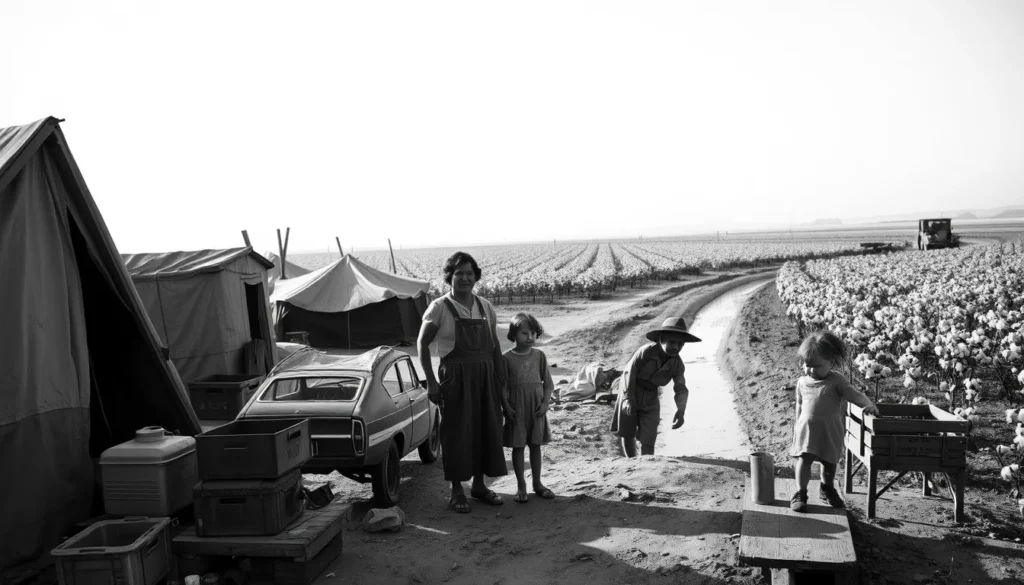
In the winter of 1936, along the ditchbanks outside Bakersfield and in the cotton camps of the southern San Joaquin Valley, families from Oklahoma, Texas, Arkansas, and Missouri built shelters from canvas, tin, and sagebrush. They had come west after drought, debt, and mechanization had stripped the southern Plains of tenant farms and hope. California was advertised as a land of irrigation ditches and year-round crops, but many newcomers found wages of a few cents a pound, no running water, and the suspicion of county officials. Federal photographers arrived with cameras; later, in 1980 and 1981, oral historians recorded aging migrants remembering the camps. This article concerns the California migrant camps of the 1930s, especially the Dust Bowl migration to the Central Valley, as they appear in Farm Security Administration photographs and in later eyewitness oral histories. It is not a history of all California agriculture, but of the camps, the people who lived in them, and the documentary record they left behind.
What Happened?
The migration had roots in the southern Plains. Drought, soil exhaustion, falling cotton prices, and the spread of tractors pushed tenant farmers and sharecroppers off the land. California growers, especially in the Imperial and San Joaquin valleys, needed seasonal hands for peas, cotton, fruit, and potatoes. Federal relief officials, state highway patrols, and local charities watched the influx with alarm. By the late 1930s, hundreds of thousands of people had moved west; exact counts varied, but the 1940 census showed a substantial movement from Oklahoma, Texas, Arkansas, and Missouri into California.
Most newcomers first lived in “squatter camps”—not planned communities but clusters of tents, shacks, converted cars, and tar-paper shelters on private land or public roadsides. Conditions varied. Some camps had a ditch for water and a field for a toilet; others had no sanitation at all. In 1935 the federal Resettlement Administration, later the Farm Security Administration, began building clean, planned migrant camps with stoves, laundry tubs, and camp managers. These federal camps were a minority of all camps, but they became famous because photographers and reporters used them to show what government aid might accomplish.
- 1935: The Resettlement Administration is created; federal photographers begin documenting rural poverty.
- March 1936: Dorothea Lange photographs Florence Thompson and her children at a pea-pickers’ camp near Nipomo, California.
- October 1936: The San Francisco News publishes John Steinbeck’s series “The Harvest Gypsies.”
- Late 1930s: Federal migrant camps open in the Central Valley, including the Arvin/Weedpatch camp in Kern County.
- 1938: The La Follette Committee holds hearings in California on farm labor and civil liberties.
These events did not solve the crisis. Seasonal work remained irregular, wages low, and many families moved constantly. The camps were temporary answers to a structural problem: California agriculture depended on a mobile, disposable labor force.
How It Was Seen at the Time
Contemporaries did not agree on what the migration meant. Growers and local boosters often described the newcomers as a labor supply, but when the harvest ended, county officials and townspeople described them as a burden. Newspapers used the label “Okie” for people from many states, and the word quickly became a slur. Some residents feared disease, crime, and permanent dependency; public health officials sometimes found poor sanitation but not the epidemics that alarmists predicted. New Dealers and documentary photographers saw the camps as evidence of a national failure. Migrants themselves saw California as a last chance and often resented being treated as a “problem.”
Destitute pea pickers in California. Mother of seven children. Age thirty-two. Nipomo, California.
That caption, written for Dorothea Lange’s photograph, shows how federal agencies framed the migration: as destitution requiring documentation and relief. It also shows the limits of that framing, since the family was not simply a case file but a specific household with its own history.
Historical Snapshot
| Aspect | Detail |
|---|---|
| Date | 1935–1940, with the peak migration in the late 1930s |
| Place | California’s Central Valley, especially Kern, Tulare, Imperial, and San Joaquin counties |
| People | Dust Bowl migrants from Oklahoma, Texas, Arkansas, and Missouri; Mexican and Filipino farm workers; growers; FSA photographers; camp managers |
| What Happened | Families lived in squatter and federal camps while working seasonal crops; photographers and oral historians documented their lives |
| Why It Mattered | The camps exposed the fragility of agricultural labor and helped shape New Deal relief, labor organizing, and the iconography of the Great Depression |
Daily Life
Daily life in the camps was organized around work and water. Families rose before dawn to wait for growers’ trucks or labor contractors. Workers were paid by the hour or by the pound; a fast picker might earn a dollar or two on a good day, while a slow one earned far less. Meals were monotonous: beans, potatoes, rice, canned goods, and relief commodities. Clothing was patched and handed down; flour sacks became dresses and shirts. In squatter camps, children played among ditches and cars, and mothers washed clothes in tubs or in irrigation canals.
Federal camps were different. They had platforms for tents, communal water taps, latrines, showers, and a camp manager. Residents elected committees, held church services and dances, and posted notices on bulletin boards. Photographs from Shafter and other camps show morning services, children at play, and bulletin boards advertising work and meetings. Yet even the best camp was temporary. The goal was to survive the season and move on.
Contemporary Newspaper Coverage
The most influential newspaper coverage came from the San Francisco News, which in October 1936 published John Steinbeck’s seven-part series “The Harvest Gypsies.” Steinbeck described squatter camps, low wages, and the humiliation of relief investigations. The series was reporting, but it was also advocacy; Steinbeck used scenes and dialogue that would later appear in The Grapes of Wrath (1939). Local papers in Kern and Tulare counties often took a harder line, warning of “Okie” invasions and demanding that migrants be moved on. The tone ranged from sympathy to hostility, and both extremes shaped public opinion.
Eyewitness Accounts
The best-known eyewitness account of the camps is not a migrant’s memoir but a photographer’s recollection. Dorothea Lange, who worked for the Resettlement Administration and later the Farm Security Administration, described her encounter with Florence Thompson at Nipomo in March 1936. Lange wrote that she did not ask the woman’s name or history; Thompson told her she was thirty-two and that the family had been living on frozen vegetables from the fields and birds the children killed. Lange’s account is a primary source about how the photograph was made, and it also reveals the power imbalance between photographer and subject.
I did not ask her name or her history. She told me her age, that she was thirty-two. She said that they had been living on frozen vegetables from the surrounding fields, and birds that the children killed. She had just sold the tires from her car to buy food.
Oral histories recorded decades later add another kind of eyewitness evidence. The California Odyssey Project at CSU Bakersfield interviewed 57 people between 1980 and 1981, producing roughly 2,300 pages of transcripts. These narrators remembered the camps as children and young adults; their testimony is valuable but shaped by memory, later life, and the interview setting.
What the Sources Got Wrong
Contemporary sources made errors that later evidence exposed. Lange’s caption called the Nipomo family “destitute pea pickers,” but Florence Thompson and her children were not pea pickers; they had been traveling through the area when their car broke down, and the pea crop had been ruined by frost. Thompson was of Cherokee ancestry, a fact largely absent from the 1930s caption and later iconic uses of the image. The photograph was also one of several exposures, not a spontaneous single shot; Lange took multiple frames and later recalled arranging the group.
The label “Okie” was another error of description. It was applied to migrants from Oklahoma, Texas, Arkansas, Missouri, and other states, even though most were not from Oklahoma. Newspapers and local officials sometimes exaggerated the threat of disease and crime. Federal camp reports and public health surveys often showed that the biggest problems were bad water, poor sanitation, and lack of medical care—not the epidemics that had been feared.
How Historians See It Today
Historians today treat the FSA photographs as both documents and arguments. The images were made by government photographers who believed in New Deal reform; they selected subjects, framed shots, and wrote captions to persuade viewers. That does not make them false, but it means they are not a random sample of camp life. “Migrant Mother” became the iconic image of the Depression, yet it represents one family at one moment, not the millions of migrants or the many Mexican, Filipino, and other workers who made up California’s agricultural labor force.
Modern scholarship has also shifted the story away from Steinbeck’s white “Okies” toward a multiracial labor system. Historians use the California Odyssey Project, FSA/OWI photographs, camp records, and county welfare files to reconstruct daily life. They argue that the camps were sites of both suffering and community, and that federal aid was important but limited. The oral histories are now read as memory sources—valuable, but not transparent windows onto the past.
The photographs and oral histories of California’s 1930s migrant camps preserve a contradiction. They show people stripped to the essentials—work, food, shelter, dignity—and they show a government and a public trying to decide whether to help or to expel them. The images are powerful because they are specific: a mother, a tent, a bulletin board, a child in a cotton field. The oral histories are powerful because they are later, imperfect, and human. Together they teach that the camps were not a natural disaster but a product of land, labor, and policy—and that the way a society documents the poor is never neutral.
FAQ
What were California migrant camps in the 1930s?
They were temporary settlements where seasonal farm workers lived during harvests. Some were unofficial squatter camps of tents and shacks; others were planned federal camps built by the Resettlement Administration and Farm Security Administration.
Who lived in the camps?
Many residents were Dust Bowl migrants from Oklahoma, Texas, Arkansas, and Missouri, but California's agricultural labor force also included Mexican, Filipino, and other workers. The camps were racially and ethnically mixed, though segregated in practice in many places.
What is the 'Migrant Mother' photograph?
It is Dorothea Lange's March 1936 portrait of Florence Thompson and her children at a pea-pickers' camp near Nipomo, California. It became the most famous image of Depression-era poverty, though its caption and later uses simplified the family's actual circumstances.
Are the FSA photographs reliable historical sources?
They are primary sources, but they were made by government photographers with reformist aims. Photographers selected subjects, framed scenes, and wrote captions, so the images document real conditions while also shaping how viewers understood them.
What are the California migrant camp oral histories?
The California Odyssey Project at CSU Bakersfield recorded 57 interviews between 1980 and 1981 with people who had migrated to the southern San Joaquin Valley in the 1930s. The transcripts preserve memories of work, camps, family life, and discrimination.








Leave a Reply