
Short Answer
Quick Snapshot
Petrograd in 1917 was the renamed imperial capital of Russia, spread across the Neva delta and dominated by the Winter Palace, the Admiralty, and the long axis of Nevskii Prospekt. The city enters this article as the revolutionary capital during the third winter of the First World War; the scope is the February Revolution, the bread queues and strikes that preceded it, and the abdication of Tsar Nicholas II, with later 1917 events noted where they directly affected the city.
In late February (old style), bread shortages, war weariness, and strike action brought crowds onto the streets. On 23 February, International Women’s Day, marchers demanded bread and an end to the war. Within days the Petrograd garrison mutinied, the Petrograd Soviet was formed, and Nicholas II abdicated on 2 March. The Romanov dynasty fell, and an unstable dual power of Provisional Government and Soviet emerged.
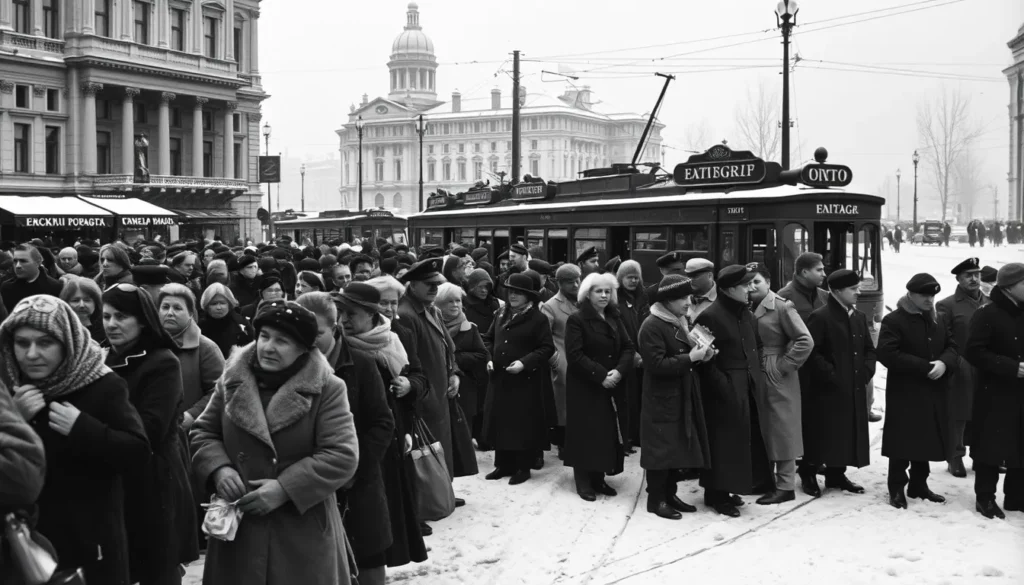
The city was crowded, cold, and anxious. Queues outside bakeries, soldiers in greatcoats, tram stoppages, and heated street meetings formed the everyday texture of a capital living through the collapse of an old regime.
Petrograd in 1917
Petrograd lay at the mouth of the Neva, its islands and canals linked by bridges and its central streets lined with imperial ministries, banks, hotels, and fashionable shops. Beyond the ceremonial center, the Vyborg Side and other industrial districts held dense workers’ quarters, factories, barracks, and railway yards. The city had been renamed from St Petersburg in 1914 to sound less German, but in 1917 many inhabitants still used the older name in private.
Winter intensified the crisis. Snow, frost, fuel shortages, and ice on the Neva made movement and delivery difficult, while the war economy pulled workers and refugees into an already overcrowded city. The atmosphere was volatile: patriotic processions of 1914 had given way to grumbling queues, strike meetings, and rumors about the court. Petrograd was also a city of newspapers, posters, and rumor, though wartime censorship and the rapid changes of late February meant that what people read often lagged behind what they saw in the street.
Dates in this article follow the Julian calendar used in Russia at the time, with Gregorian equivalents where helpful. The February Revolution therefore began on 23 February old style, which was 8 March in Western Europe.
Population & Economy
Petrograd’s population stood at roughly 2.3 million in 1917, swollen by wartime migration from the countryside and by refugees from the western provinces. The city was Russia’s administrative, financial, and industrial center. Its economy depended on metalworking, munitions, shipbuilding, textiles, food processing, printing, and the railway network, but the war distorted every branch. War contracts enriched some firms and kept skilled workers employed, while factories outside war production suffered from shortages of fuel and raw materials.
Living standards fell. Real wages eroded, rents and food prices rose, and overcrowding became severe. Peasants hoarded grain, the railways gave priority to military traffic, and Petrograd received only about half the grain needed to feed its people in early 1917. Bread rationing was announced amid shortages, and queues became a daily ordeal. The cost of living was measured less in stable prices than in time spent waiting, in black-market purchases, and in the fear of missing a ration.
| Indicator | Approximate 1917 condition |
|---|---|
| Population | About 2.3 million |
| Major employment | Metalworks, munitions, textiles, transport, government |
| Food supply | Bread shortages, rationing, long queues |
| Housing | Overcrowded workers’ districts and requisitioned space |
Government & Politics
Before February, the city was governed by a city governor, A. P. Balk, alongside the imperial ministries, police, and security services. The State Duma sat in Petrograd, but Nicholas II distrusted it and spent much of his time at army headquarters in Mogilev. When the Duma was prorogued on 26 February, a Duma committee continued to meet and sought to manage the crisis. On 27 February the Petrograd Soviet of Workers’ and Soldiers’ Deputies was formed, giving organized workers and mutinous soldiers a rival center of authority.
The result was dual power. The Provisional Government, formed on 2 March, drew on liberal Duma politicians such as Pavel Miliukov and Alexander Kerensky, while the Petrograd Soviet commanded much of the loyalty of soldiers and workers. Soviet Order No. 1, issued on 1 March, instructed military units to elect committees and obey the Soviet in political matters, undermining officers’ authority. Nicholas II abdicated on 2 March and his brother Grand Duke Michael refused the throne the next day. The monarchy was gone, but the question of who actually governed Russia remained open.
Industry
The Putilov Engineering Works was the city’s most famous industrial giant, employing tens of thousands of workers and producing artillery, shells, and railway equipment for the war. The Vyborg Side held metal and machine works, while textile mills, shipyards, chemical plants, printing houses, and food-processing enterprises employed men and women across the city. War production created labor shortages and drew women into factories, but it also sharpened disputes over wages, hours, and food.
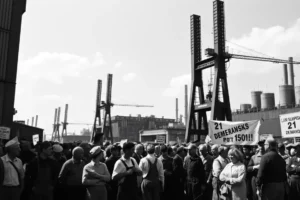
Strikes were frequent. In January 1917, the anniversary of Bloody Sunday brought some 140,000 workers out on strike. In February, Putilov workers and others joined street demonstrations, and factory committees became schools of politics. Employers and government officials saw strikes as disloyal; workers saw them as survival. The industrial districts supplied the crowds that filled the center, and the factories became bases for the Soviet and later for Bolshevik organization.
Education
Petrograd was Russia’s leading educational center. It had the Imperial Petrograd University, the Technological Institute, the Polytechnic Institute, medical and women’s higher courses, military academies, and a dense network of gymnasia, commercial schools, and parish schools. Literacy was rising but remained uneven, especially among older workers and recent rural migrants. Workers’ evening courses, reading rooms, and factory libraries gave some laborers access to newspapers, pamphlets, and political debate.
The war disrupted schools and universities through conscription, shortages, and the use of buildings for hospitals or barracks. Yet students and educated professionals were highly visible in 1917: as newspaper readers, as clerks and engineers, as soldiers, and as political activists. Education did not determine loyalty, but it shaped how quickly rumors, decrees, and slogans circulated through the capital.
Transportation
People moved through Petrograd by tram, horse-drawn cab, on foot, and by rail. Trams were crowded and sometimes halted by strikes or demonstrations; in late February crowds stopped public transport and filled the central streets. The Neva bridges were strategic points, and workers from the Vyborg Side crossed into the center to join protests. Railways linked Petrograd to the front, to Moscow, and to the grain-producing provinces, but military traffic and administrative chaos disrupted food deliveries.
The main stations, including the Nikolaevskii, Moskovskii, Varshavskii, and Baltic stations, were arteries of war and revolution. Soldiers arrived and departed, refugees passed through, and news traveled along the rails. Nicholas II’s own train was diverted from the capital in late February and reached Pskov instead, a practical detail that symbolized how the old regime had lost control of movement and communication.
Everyday Life
Daily life centered on survival. Workers rose early to queue for bread, sometimes standing for hours in cold and snow. Housing was crowded: families rented rooms or corners, workers lived in barracks and dormitories, and the influx of refugees strained every arrangement. Food was plain and scarce—rye bread, cabbage soup, porridge, potatoes, tea—and meat, sugar, and fats were irregular luxuries. Clothing was patched and heavy: coats, felt boots, shawls, and caps against the northern winter.
Entertainment continued amid hardship. Cinemas, theaters, cafes, taverns, and churches drew people when money and time allowed, and public readings and meetings became important social events. Women bore much of the burden of queuing and managing households, while soldiers and workers debated peace, bread, and land. Letters from the front, rumors about the court, and news of strikes circulated through courtyards, kitchens, and factory floors. The revolution was made of these small conversations as much as of great speeches.
Major Events
The defining event was the February Revolution. On 23 February, crowds marking International Women’s Day demanded bread and peace. Strikes spread, trams stopped, and clashes with police increased. On 26 February troops fired on demonstrators, but on 27 February garrison units refused orders and joined the uprising. The Petrograd Soviet formed that evening, and the Duma committee asserted authority. Nicholas II abdicated on 2 March, ending more than three centuries of Romanov rule.
Petrograd remained a revolutionary cockpit for the rest of 1917. The April Crisis, the June offensive, the July Days, and the Kornilov Affair all shook the city. On 25 October old style, Bolshevik-led forces seized the Winter Palace and key points in the capital, overthrowing the Provisional Government. The October Revolution was not the end of the story, but it made Petrograd the birthplace of the Soviet state.
What Newspapers Were Reporting
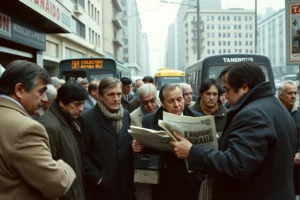
Petrograd’s press was diverse and partisan. Liberal and conservative papers such as Rech’ and Birzhevye Vedomosti reported strikes, bread shortages, and official appeals for calm, while the socialist press and the newly formed Izvestiia Petrogradskogo Soveta published Soviet decrees and soldiers’ resolutions. After February, newspapers carried the abdication manifesto, Order No. 1, government declarations, and fierce arguments over war aims and land reform.
Reports often lagged behind events. Early coverage described queues, rationing, and disturbances as temporary disorders; later issues announced the formation of the Provisional Government and the Soviet. Censorship, paper shortages, and the sheer speed of events made the press both essential and unreliable. Readers learned to compare newspapers with street rumor, and rumor often won.
What People Were Talking About
People talked about bread, peace, and the war. Workers asked why they queued while grain was hoarded and railway cars went to the front. Soldiers asked whether they would be punished for mutiny and whether the war would continue. Middle-class families debated whether a constitutional monarchy could save Russia, while socialists argued over soviets, provisional government, and revolution. The court and the empress were the subject of dark rumor, including accusations of German influence and court intrigue.
Diaries and memoirs capture the shock. A. P. Balk, the city governor, wrote on 27 February:
“We have lost power.”
Nicholas II, isolated at Pskov, recorded on 2 March:
“All around is treachery, cowardice and deceit.”
Such words reveal how quickly authority dissolved—not only in institutions but in the confidence of those who held office.
Historical Photographs
Photographs from Petrograd in 1917 survive in archives, newspapers, and later collections. They show crowds on Nevskii Prospekt, women and workers in bread queues, soldiers in greatcoats, barricades, tram stoppages, and street meetings. Some images capture the February days themselves; others record the Provisional Government, Soviet meetings, and the October seizure of the Winter Palace. Photographers worked under difficult and dangerous conditions, and many images were staged, cropped, or selected for political effect.
Visual evidence is valuable for clothing, gestures, urban space, and the material texture of revolution: the press of bodies, the signs, the snow, the imperial facades. It is less reliable for precise chronology or crowd size. Historians therefore read photographs alongside written sources, asking who took them, for whom, and what lay outside the frame.
Documents & Primary Sources
Historians of Petrograd in 1917 rely on diaries, letters, newspapers, decrees, police reports, memoirs, maps, and photographs. Key documents include Nicholas II’s diary and abdication act, the Petrograd Soviet’s Order No. 1, Duma committee records, Provisional Government decrees, and the files of the city governor and police. Newspapers such as Rech’, Birzhevye Vedomosti, and Izvestiia Petrogradskogo Soveta provide daily chronology and political argument.
Archives in Russia and abroad hold essential collections: the Russian State Historical Archive, the State Archive of the Russian Federation, the Hoover Institution, and the International Institute of Social History, among others. Personal letters and memoirs often describe the same events differently from official reports, and comparison is essential. The sources are fragmentary, but together they allow a close reconstruction of how the capital experienced the fall of the tsar.
1917 Timeline
| Date (O.S. / N.S.) | Event in Petrograd |
|---|---|
| 9 Jan / 22 Jan | Anniversary of Bloody Sunday marked by strikes; about 140,000 workers involved. |
| 18 Feb / 3 Mar | Putilov workers strike; tensions rise over wages and food. |
| 23 Feb / 8 Mar | International Women’s Day; crowds demand bread and peace. |
| 24 Feb / 9 Mar | General strike spreads; trams stopped and demonstrations grow. |
| 25 Feb / 10 Mar | Clashes with police; Nevskii Prospekt filled with crowds. |
| 26 Feb / 11 Mar | Duma prorogued; troops fire on demonstrators. |
| 27 Feb / 12 Mar | Garrison mutiny; Petrograd Soviet formed; Duma committee acts. |
| 1 Mar / 14 Mar | Soviet Order No. 1 issued; Nicholas II reaches Pskov. |
| 2 Mar / 15 Mar | Nicholas II abdicates. |
| 3 Mar / 16 Mar | Grand Duke Michael refuses the throne. |
| 3-5 Jul / 16-18 Jul | July Days; armed demonstrations and crackdown on Bolsheviks. |
| 25 Oct / 7 Nov | Bolshevik-led forces seize power in Petrograd. |
What Changed Next
The fall of the tsar did not bring peace or plenty. The Provisional Government continued the war, food shortages persisted, and dual power became unstable. In October 1917 the Bolsheviks seized power in Petrograd, promising peace, bread, and land. The new regime faced civil war, foreign intervention, and economic collapse. Petrograd’s population fell sharply during the Civil War as people fled, died, or moved to the countryside; in 1918 the capital was moved to Moscow, and in 1924 the city was renamed Leningrad.
The events of 1917 in Petrograd thus marked a double rupture: the end of Romanov autocracy and the beginning of a Soviet order that would transform Russia and the world. The bread queues, street meetings, and mutinies of February were not mere prelude; they were the moment when the old regime lost the confidence of its soldiers and its capital.
Sources
- Peter Waldron, “The End of Tsarism,” in Russia’s Home Front in War and Revolution, 1914-22, Book 3 (Slavica Publishers, 2018), https://slavica.indiana.edu/content/RGWR/INTRO427.pdf
- BBC Bitesize, “Reasons for the February Revolution, 1917: Revolution from below,” https://www.bbc.co.uk/bitesize/guides/ztyk87h/revision/5
- Tsuyoshi Hasegawa, The February Revolution: Petrograd, 1917 (University of Washington Press, 1981).
- Orlando Figes, A People’s Tragedy: The Russian Revolution, 1891-1924 (Jonathan Cape, 1996).
- R. Sh. Ganelin, “Revoliutsiia v Petrograde: Den’ za dnem,” in Pervaia mirovaia voina i konets Rossiiskoi imperii, vol. 3 (2014).
FAQ
What was the population of Petrograd in 1917?
Estimates place the population at roughly 2.3 million, swollen by wartime migration and refugees.
What major events happened in Petrograd in 1917?
The February Revolution brought bread protests, strikes, garrison mutiny, the formation of the Petrograd Soviet, and the abdication of Nicholas II in March. In October, Bolshevik-led forces seized power in the city.
What primary sources are available for studying Petrograd in 1917?
Key sources include diaries such as those of Nicholas II and city governor A. P. Balk, newspapers, Soviet decrees including Order No. 1, Duma and police records, letters, memoirs, maps, and photographs held in Russian and international archives.
How did daily life in Petrograd in 1917 differ from today?
Daily life was shaped by war, fuel and food shortages, overcrowded housing, and political uncertainty. People relied on trams and railways rather than cars, queued for rationed bread, and received news through newspapers, posters, letters, and rumor.




Leave a Reply