
Short Answer
Quick Snapshot
This article concerns Buenos Aires, the Argentine capital, in 1982 and specifically how its residents experienced the Falklands/Malvinas War. It is not a military history of the islands; the focus is the city, its streets, newspapers, households and public mood during the conflict with Britain.
In April 1982 Buenos Aires erupted in patriotic rallies after Argentine forces took the Falkland Islands, known in Argentina as Las Malvinas. By June, after the surrender at Stanley/Puerto Argentino, the same city was somber, bitter and anxious. Between those poles lay censorship, casualty rumours, inflation, school and workplace routines, and the ordinary business of life in a capital of roughly 11 million people in Greater Buenos Aires.
Primary sources — newspaper archives, UPI wire copy, the chronicles of Andrew Graham-Yooll, photographs and later oral histories — show a city that was both mobilised and exhausted. The war was far away in the South Atlantic, but in Buenos Aires it was present in radio communiqués, kiosk crowds, family conversations and the knowledge that the military junta was nearing the end of its power.
Buenos Aires in 1982
Buenos Aires lies on the western shore of the Río de la Plata, a broad, brown river that separates Argentina from Uruguay. The Federal Capital is a flat city of grid streets, port districts, government buildings and dense apartment blocks, surrounded by the much larger conurbation of Greater Buenos Aires. In 1982 the city was the political, cultural and media centre of the country, and its winter weather — cold, damp and often gray — coloured the mood of June.
The capital was still governed under the state of exception established after the 1976 coup. The military junta known as the Proceso de Reorganización Nacional held national power, but daily life was municipal and neighbourhood-based: buses, schools, markets, cafés, offices and factories. The war did not bring fighting to the streets of Buenos Aires, but it brought mobilisation, propaganda, censorship and grief.
Population & Economy
The Federal Capital had about 2.9 million residents in the 1980 census; Greater Buenos Aires was commonly described in 1982 as a metropolis of some 11 million. The city was Argentina’s largest consumer market and its administrative and financial hub. Population in the capital itself had slipped slightly from the 1970 census, while suburban growth continued.
The economy was under severe strain. Argentina’s foreign debt, fiscal deficits and inflation — annual inflation in 1982 was around 165% — squeezed wages and savings. Food, rent, transport and school costs were daily concerns. The 1982 war added uncertainty to an already depressed industrial and commercial climate, and real wages fell. For many households, the war was experienced alongside the older, more persistent emergency of making ends meet.
Government & Politics
National power in 1982 rested with the junta: General Leopoldo Galtieri of the army, Admiral Jorge Anaya of the navy and Brigadier Basilio Lami Dozo of the air force. Galtieri served as president. The City of Buenos Aires had no elected mayor; it was run by a de facto municipal intendant appointed by the military government. Osvaldo Cacciatore had held that office since 1976, associated with highway construction, urban demolition and the authoritarian remaking of the capital.
Political parties were proscribed or constrained, and public protest was dangerous. In late March 1982, just before the South Atlantic crisis, demonstrations demanding peace, bread and work were suppressed in Buenos Aires and other cities. The invasion of the Malvinas briefly gave the junta a patriotic stage, but the defeat of June 1982 shattered its legitimacy. Galtieri resigned on 17 June, and the transition toward a new military president, Reynaldo Bignone, began.
Industry
Buenos Aires was an industrial and commercial centre rather than a single-plant town. The port and customs handled imports and exports; meatpacking, grain trading, food processing, textiles, metallurgy, chemicals, printing and engineering employed large numbers in the capital and its suburban belt. Banking, retail, government service and the professions also shaped employment.
The war disrupted shipping, insurance, credit and confidence. Factories in Greater Buenos Aires faced shortages and uncertain demand, while small workshops and shops felt the pinch of inflation. The city’s newspaper industry was itself an important trade: La Nación, Clarín, La Razón, Crónica and the English-language Buenos Aires Herald were produced by printers, journalists and distributors working under censorship and deadline pressure.
Education
Buenos Aires had a dense educational network: state primary and secondary schools, private and religious schools, bilingual institutions and technical schools. The University of Buenos Aires was the largest and most prestigious university, with faculties spread across the city. Literacy was high, and schooling was part of ordinary family life even amid economic crisis.
The military government kept universities under political control. Student activism was risky, curricula were policed and many academics worked in a climate of fear. In 1982 the war added new rituals to school life: patriotic lessons, collections for soldiers, and official explanations of the Malvinas cause. Teachers and pupils, like other residents, followed the communiqués and tried to make sense of distant battles.
Transportation
Buenos Aires moved by colectivo, the city’s ubiquitous buses, supplemented by the subte underground, commuter railways, taxis and private cars. The underground network linked the centre with neighbourhoods and rail termini; trains brought workers and shoppers in from the suburbs. The port, Ezeiza airport and the great avenues — including the wide Avenida 9 de Julio — made the capital a transport hub for the country.
Wartime did not stop the city’s transport system, but it altered routines. Security checks, official movements and the concentration of journalists around the Sheraton Hotel and government offices created temporary disruptions. For most residents, the colectivo and the kiosk remained the practical points where news was encountered and discussed.
Everyday Life
Daily life in 1982 mixed ordinary urban routines with war fever. Families rose early, queued for transport, worked in offices, shops and factories, and ate at home or in neighbourhood restaurants. Beef, pasta, milanesas, empanadas, bread, mate and strong coffee were staples. Apartment living was common in the centre; suburban houses and modest barrios housed workers and migrants from the provinces and neighbouring countries.
Clothing followed the season and the occasion: suits and ties for many men in offices, coats and scarves in the winter chill, school uniforms for children. Entertainment included cinema, radio, television, football and tango, but in June the World Cup in Spain drew less attention than usual as defeat in the South Atlantic dominated the airwaves. Public life was cautious: people gathered at newsstands and in cafés, swapped rumours, attended Mass and worried over casualty lists.
Major Events
The central event was the Falklands/Malvinas War. On 2 April 1982 Argentine forces landed in the islands, and crowds gathered in the Plaza de Mayo in a surge of nationalist euphoria. Britain dispatched a task force; on 2 May the Argentine cruiser General Belgrano was sunk, and on 4 May HMS Sheffield was hit. In late May British forces landed at San Carlos and fought at Goose Green. On 14 June Argentine troops surrendered at Stanley, which Argentina called Puerto Argentino.
Buenos Aires itself was not a battlefield, but it was the war’s political and emotional stage. The junta censored news and staged patriotic ceremonies; families waited for letters and casualty reports. In mid-June Pope John Paul II visited the city on a peace mission, a gesture that underlined the gap between religious appeals and military logic. The surrender brought grief and anger, and within days the junta began to unravel.
What Newspapers Were Reporting
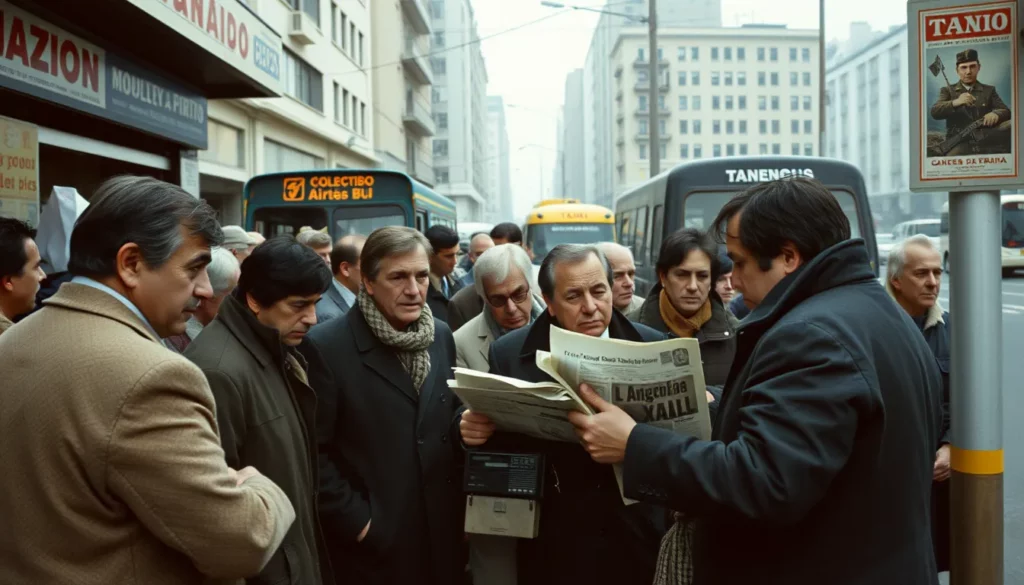
Newspapers were central to how Porteños experienced the war. La Nación, Clarín, La Razón, Crónica and the Buenos Aires Herald carried official communiqués, maps of the South Atlantic, patriotic commentary and human-interest stories about soldiers. Censorship meant that defeats and losses were often delayed, softened or framed as temporary setbacks. The English-language Buenos Aires Herald, read by diplomats and the British community, was closely watched.
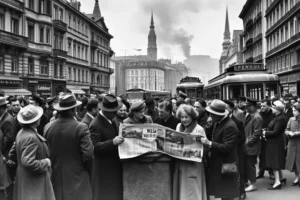
UPI’s correspondent Digby A. Solomon captured the turn in mood on 14 June 1982. At a newsstand, one taxi driver shouted:
They lied to us … All we have are a lot of dead kids.
Solomon reported that the city’s earlier war fever had been replaced by bitterness and dejection, and that even Argentina’s football fans paid little attention to the World Cup match on television. Such wire copy, alongside local clippings, is a key source for the atmosphere of the surrender.
What People Were Talking About
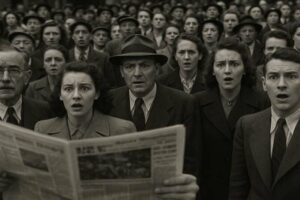
Conversations in Buenos Aires turned on rumours: where the British fleet was, whether Argentine troops had enough food and ammunition, how many young conscripts had died, and whether the junta had told the truth. People asked why Latin American and Soviet support had not materialised, and whether the war would reach the mainland. Andrew Graham-Yooll, reporting for The Guardian, described a city swinging between euphoria and depression, with journalists, officials and ordinary residents caught in the same anxious echo chamber.
There was also anger at the military government. The UPI report quoted a middle-aged man saying that the officers had been hurting Argentines for too many years and should let civilians fix the mess. Posters showing a tired soldier in a foxhole urged sacrifice for the nation. In homes, the talk was more practical: prices, work, school, and the safety of sons and nephews sent south.
Historical Photographs
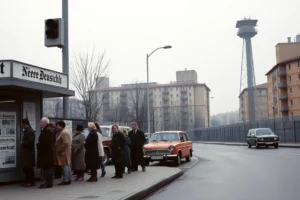
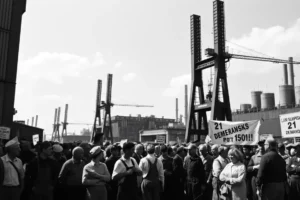
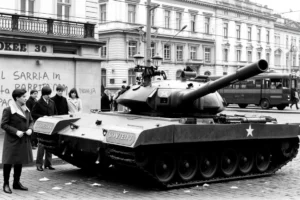
Photographs of Buenos Aires in 1982 document the war’s emotional theatre. They show crowds packed into the Plaza de Mayo in early April, flags and banners, soldiers and police, and Galtieri on the balcony of the Casa Rosada. Other images record newspaper kiosks surrounded by listeners, queues for papers, street posters, the Pope’s visit and the gray winter streets of June. Press photographers and wire services such as UPI produced many of the most widely circulated images.
Archival collections in Argentina and abroad preserve these photographs: the Archivo General de la Nación, newspaper archives, the Museo Malvinas e Islas del Atlántico Sur, and international photo agencies. They are not neutral illustrations; they show how the junta staged patriotism and how ordinary people gathered, waited and grieved. Later oral-history projects add photographs taken by families and local photographers.
Documents & Primary Sources
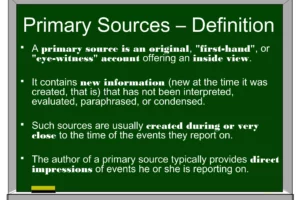
Historians studying Buenos Aires in 1982 use a wide range of primary sources: the 1980 national census, municipal records, military communiqués and decrees, police reports, newspaper and magazine runs, radio scripts, posters, maps, letters and diaries. The UPI archive preserves wire dispatches from the surrender. Andrew Graham-Yooll’s chronicles, first published as reporting and later as a book, blend eyewitness observation with the perspective of an English-language journalist in the city.
Oral histories with veterans, nurses, journalists, housewives and workers are essential because they capture what formal records omit: fear, rumour, humour, grief and the texture of daily life. Human-rights archives and later truth commissions document the longer authoritarian context. Together these sources allow a history of the war as Porteños lived it, not only as a sequence of military decisions.
1982 Timeline
| Date | Event in or affecting Buenos Aires |
|---|---|
| Late March 1982 | Protests for peace, bread and work are suppressed in Buenos Aires and other cities. |
| 2 April 1982 | Argentine forces land in the Malvinas/Falklands; crowds rally in the Plaza de Mayo. |
| 3 April 1982 | South Georgia is seized; Britain prepares a task force. |
| 2 May 1982 | ARA General Belgrano is sunk; anxiety and casualty rumours spread. |
| 4 May 1982 | HMS Sheffield is hit; war news dominates the press and radio. |
| 21 May 1982 | British forces land at San Carlos; the land war intensifies. |
| 28 May 1982 | Battle of Goose Green; reports of losses reach the capital. |
| 11-12 June 1982 | Pope John Paul II visits Buenos Aires and appeals for peace. |
| 14 June 1982 | Argentine surrender at Stanley/Puerto Argentino; Buenos Aires turns somber. |
| 17 June 1982 | Galtieri resigns as president and junta leader. |
| 1 July 1982 | Reynaldo Bignone becomes president as military rule enters its final phase. |
What Changed Next
The defeat destroyed the junta’s remaining legitimacy. Galtieri fell within days, and the military government under Reynaldo Bignone began preparing a transition to civilian rule. The 1983 elections brought Raúl Alfonsín to the presidency and opened investigations into the dirty war, including the landmark Trial of the Juntas. For Buenos Aires, the end of the dictatorship meant a public life that was freer but still shadowed by economic crisis and the memory of war.
The Malvinas cause remained central to Argentine politics, while veterans and families pressed for recognition and care. The city’s newspapers and cultural life returned to open political debate, and human-rights organisations gained space. The events of 1982 did not end Argentina’s claim to the islands, but they discredited the generals and helped make democracy the next destination.
Sources
- Andrew Graham-Yooll, Buenos Aires, otoño 1982: La guerra de Malvinas según las crónicas de un corresponsal inglés (Marea, 2017). https://www.editorialmarea.com.ar/catalogo/derechos-humanos-3/buenos-aires-oto-o-1982-11
- Digby A. Solomon, Sadness replaces war fever in Buenos Aires, UPI Archives, 14 June 1982. https://www.upi.com/Archives/1982/06/14/Sadness-replaces-war-fever-in-Buenos-Aires/7851779291412/
- Jimmy Burns, The Land That Lost Its Heroes: The Falklands, the Post-War and Argentina (Bloomsbury, 1987).
- Lawrence Freedman, The Official History of the Falklands Campaign, Volume I: The Origins of the Falklands War (Routledge, 2005).
- Martin Middlebrook, The Falklands War, 1982 (Allen Lane, 1985).
FAQ
What was the population of Buenos Aires in 1982?
The Federal Capital had about 2.9 million residents according to the 1980 census; Greater Buenos Aires was commonly estimated at around 11 million.
What major events happened in Buenos Aires in 1982?
The city saw patriotic rallies after the 2 April invasion, censorship and wartime propaganda, the Pope's peace visit in June, and public grief after the 14 June surrender. Galtieri resigned on 17 June.
What primary sources are available for studying Buenos Aires in 1982?
Key sources include newspaper runs such as La Nación and Clarín, UPI wire dispatches, Andrew Graham-Yooll's chronicles, the 1980 census, municipal records, photographs, posters and oral histories.
How did daily life in Buenos Aires in 1982 differ from today?
People relied on colectivos, the subte, radio, newspapers and landline communications; there was no internet or mobile phone. Inflation was extreme, political life was authoritarian, and the Malvinas War dominated public debate.



Leave a Reply