
Short Answer
In the early spring of 1943, the residents of White Bluffs and Hanford, two small farming towns along the Columbia River in Washington, were given thirty days to pack their belongings and leave. The government offered them a small sum of money and told them nothing more. By the time they were gone, thousands of workers were pouring into the region, erecting a vast secret industrial complex that would stretch across 600 square miles. These workers did not know that they were building the world’s first full-scale plutonium production plant—a critical piece of the United States’ race to build an atomic bomb. They knew only that they were part of a top-secret war project that demanded absolute discretion. By 1945, the Hanford Engineer Works, as it was officially called, would produce the plutonium used in the Trinity test and in the bomb dropped on Nagasaki, Japan, on August 9, 1945. The story of Hanford in 1945 is a story of colossal engineering, patriotic urgency, and the quiet, everyday labor of thousands of Americans who never learned the true purpose of their work until the world’s first atomic bomb exploded over a desert in New Mexico.
What Happened?
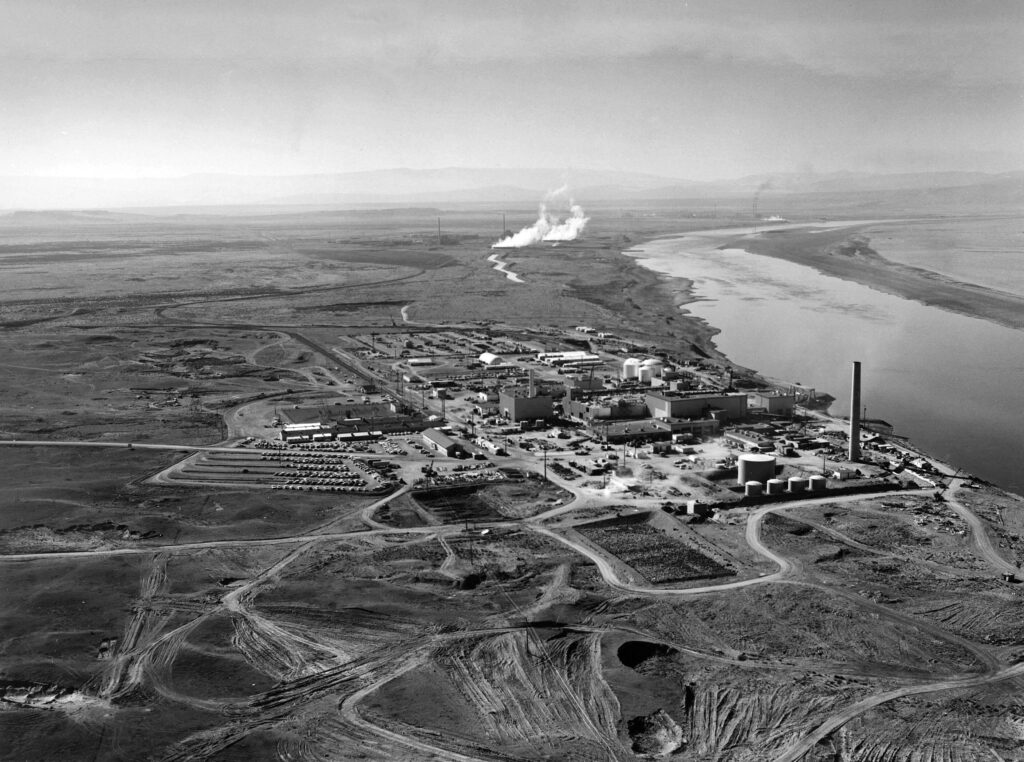
The Hanford Site was selected in December 1942 by Colonel Franklin T. Matthias, who scouted the region for the Manhattan Project. The location met all the requirements: an abundant supply of cold Columbia River water for cooling reactors, ample hydroelectric power, a mild climate, excellent transportation facilities, and distance from major population centers. In February 1943, Matthias set up a temporary headquarters, and by late March he received his assignment to build the production facilities.
The core of the project was three water-cooled production reactors, designated B, D, and F, built about six miles apart on the south bank of the Columbia River. Four chemical separation plants, where plutonium was extracted from the irradiated uranium, were constructed in pairs at two sites nearly ten miles south of the reactors. A facility to produce uranium slugs and perform tests was built about twenty miles southeast of the separation plants near Richland.
Construction proceeded with wartime urgency. The B Reactor, the first of the three, was completed and went critical in September 1944. The other two followed soon after. By early 1945, the Hanford plant was producing plutonium at an industrial scale. This plutonium was shipped to Los Alamos, New Mexico, where it was used to create the implosion-type atomic bomb. On July 16, 1945, the Trinity test at Alamogordo, New Mexico, demonstrated the power of a plutonium bomb. Three weeks later, on August 9, a plutonium bomb was dropped on Nagasaki, Japan, causing the Japanese surrender that ended World War II.
How It Was Seen at the Time
To the outside world, Hanford was a closely guarded secret. The government had evacuated the original residents of White Bluffs and Hanford in 1943, offering them only a small amount of money and thirty days to leave. The workers who came to build and operate the plant were told only that they were contributing to a top-secret war effort. Many knew nothing about atomic energy or nuclear fission; they simply performed their assigned tasks—operating pumps, monitoring instruments, or handling materials—without understanding the larger purpose.
The prevailing mood was one of patriotic duty and intense secrecy. The official record notes that the site was chosen for its isolation, and the project was conducted with the same wartime urgency as the uranium facilities at Oak Ridge. The public knew almost nothing of Hanford until the atomic bomb was revealed in August 1945. When the news broke, the world was stunned. The Hanford workers, like the rest of the country, learned that they had been part of a project that would change the course of history.
Historical Snapshot
| Aspect | Detail |
|---|---|
| Date | 1943–1945 |
| Place | Hanford Site, Washington State, along the Columbia River |
| People | Colonel Franklin T. Matthias, DuPont engineers, thousands of construction and operations workers |
| What Happened | Construction and operation of the world’s first plutonium production reactors (B, D, F) and chemical separation plants |
| Why It Mattered | Produced the plutonium for the Trinity test and the Nagasaki atomic bomb |
What People Knew at the Time
| What People Knew Then | What We Know Now |
|---|---|
| Workers knew they were building a large, secret industrial plant for the war effort. | It was the Manhattan Project’s plutonium production site, part of the atomic bomb program. |
| Residents of White Bluffs and Hanford knew they had to leave their homes in 1943, but not why. | The land was needed for a top-secret government project that would change the world. |
| The public knew nothing about Hanford until the atomic bomb was dropped on Nagasaki. | Hanford’s plutonium was used in the Nagasaki bomb and the Trinity test. |
Daily Life
The construction of Hanford was a massive undertaking. Temporary quarters for construction workers were hastily erected, and the work was around the clock. The site was a sea of mud in the winter and dust in the summer. Workers were assigned to specific tasks without being told the overall purpose. The secrecy extended even to the materials they handled; they were often referred to by code names, such as “slugs” for uranium fuel elements.
The isolation of the site meant that workers lived in dormitory-like conditions, with few diversions. The towns of White Bluffs and Hanford were abandoned, and the new community of Richland was built to house the workforce. The workers’ days were long, and the pressure was intense. Yet, the mood was one of determination and pride in contributing to the war effort. Many did not know exactly what they were making, but they knew it was vital.
Numbers at the Time
| Statistic | Value |
|---|---|
| Size of Hanford Site | ~600 square miles (1,554 km²) |
| Number of production reactors | 3 (B, D, F) |
| Distance between reactors | ~6 miles apart |
| Number of chemical separation plants | 4 (in two pairs) |
| Distance from reactors to separation plants | ~10 miles south |
| Evacuation notice for White Bluffs and Hanford | 30 days |
How Historians See It Today
Modern historians have corrected a long-standing misconception about the Manhattan Project. As historian Richard Rhodes wrote, “I treated plutonium production as a black box, inadvertently contributing to the myth that the atomic bomb was the work of 30 theoretical physicists at Los Alamos.” In reality, the Hanford Engineer Works was a colossal industrial enterprise that required the efforts of thousands of workers, engineers, and scientists. The production of plutonium was as crucial as the theoretical work at Los Alamos, and the two were intimately connected.
Today, historians emphasize the scale and the human cost of the project, including the displacement of the original residents and the environmental legacy of the site. The Hanford site is now a national park, preserving the B Reactor as a monument to this pivotal moment in history. The primary sources—official records, the accounts of workers, and the memories of the evicted residents—remind us that the atomic bomb was not just a scientific feat but also an industrial and human one.
The Hanford Site in 1945 was a place where secrecy and necessity collided. The workers and residents of the region lived through a transformation that they could not fully understand at the time. The primary sources—the evacuation orders, the construction records, and the personal accounts—reveal the quiet heroism and the sacrifices that made the atomic bomb possible. They also remind us that the atomic age was not born in a single laboratory, but in the vast, secret factories of places like Hanford, where the ordinary people of America played a part in a history they could not see.
FAQ
What was the Hanford Site?
The Hanford Site was a 600-square-mile industrial complex in Washington state built during World War II to produce plutonium for the Manhattan Project. It housed the world's first full-scale nuclear reactors and chemical separation plants, which produced the plutonium used in the Trinity test and the Nagasaki atomic bomb.
Why was Hanford chosen for plutonium production?
The site was selected because it offered an abundant supply of cold Columbia River water for cooling reactors, ample hydroelectric power, a mild climate, good transportation, and isolation from major population centers, as noted by the National Park Service.
How did the local residents react to the evacuation?
Residents of White Bluffs and Hanford were given 30 days to evacuate in early 1943, offered a small sum of money. Many were farmers and ranchers who had to abandon their homes and livelihoods. The evacuation was done under strict secrecy, and the residents were not told the reason.





Leave a Reply