
Short Answer
The Great Depression of the 1930s was not only a crisis of banks and factories; it was a crisis of kitchens and kitchens and backyards. As unemployment lines lengthened and relief offices swelled, women across North America reached for pens and paper. They wrote to government officials, kept private diaries, and sent letters to relatives and friends. These documents—often hurried, sometimes despairing, but always determined—captured the texture of everyday life in a world turned upside down. From the humid Florida towns where women pleaded with New Deal agencies, to the tenements of Chicago and Cleveland, to a lone Saskatchewan farm where a woman chronicled the relentless struggle, these voices speak directly to us across the decades. They tell us not only what happened but how it felt to live through it.
What Happened?
The Great Depression began with the stock market crash of October 1929, but its deepest impact on women unfolded over the following years. By 1933, unemployment in the United States reached roughly 25 percent, and women—especially working-class women—found themselves on the front lines of poverty. Yet women’s work did not disappear; it multiplied. Women managed shrinking budgets, fed families on scraps, took in laundry, and sought any paid labor they could find. They also wrote.
In Florida, women wrote letters to government agencies, often to the New Deal agencies established after 1933. These letters, later collected in the volume Looking for the New Deal: Florida Women’s Letters During the Great Depression, provide a direct window into their struggles. In the industrial cities of Chicago, Cleveland, Philadelphia, and South Bend, researchers interviewed 1,340 working-class women as part of a major study of employment histories and Depression-era experiences. The sociologist Lois Rita Helmbold later analyzed these interviews and the letters of domestic workers, revealing a stark racial divide in the Depression’s impact. In Canada, on a Saskatchewan farm, a woman kept a diary and wrote letters that were later used in a thesis titled “Times are hard”: A Saskatchewan Farm Woman’s Experience of the Great Depression. The phrase “times are hard” echoed across the continent.
How It Was Seen at the Time
Contemporaries understood the Depression as a time of overwhelming hardship, but also as a test of moral and personal endurance. The language of the letters and diaries is often fatalistic, yet not without a sense of agency. Women wrote to officials to ask for work, to beg for relief, or to explain why they could not pay a bill. They used phrases like “hard times” and “in dire straits,” but they also described their own strategies: sewing, gardening, taking in boarders, and moving in with relatives.
“Times are hard” — this simple phrase, repeated in countless letters and diaries, became the refrain of the era, capturing both the economic catastrophe and the quiet resilience of those who endured it.
The prevailing mood was one of uncertainty and fear, but also of a stubborn belief that hard work and honesty would eventually prevail. Many women wrote not to complain but to ask for a chance to work, to prove that they were worthy of help.
Letters & Diaries
The core primary sources for this topic are the letters and diaries themselves. The Florida women’s letters, collected in Looking for the New Deal, were often written to government agencies like the Federal Emergency Relief Administration or the Works Progress Administration. They are not polished literary works but urgent requests for help—for food, for rent, for a job. They reveal the bureaucratic and personal challenges of applying for relief, and they show how women negotiated with officials.
In the Midwest, the interviews and letters analyzed by Lois Helmbold in Making Choices, Making Do: Survival Strategies of Black and White Working-Class Women during the Great Depression provide a different window. These include letters from domestic workers, many of whom were Black women, describing their search for work and their strategies for survival. Helmbold’s research shows that Black women lost work more rapidly and in greater proportions than white women, and that they faced a more limited set of options.
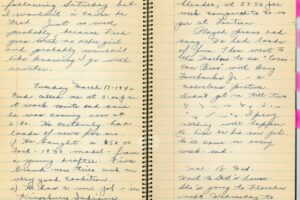
On the Canadian prairie, the Saskatchewan farm woman’s diary and letters, preserved in Christine Georgina Bye’s thesis, reveal the isolation and the unrelenting work of rural life. The diary entries detail the daily chores, the weather, the debts, and the family’s efforts to keep the farm alive. These are the voices of ordinary women, and their power lies in their specificity—the price of bread, the name of a landlord, the date of a letter to a government office.
Different Perspectives
Black and White Working-Class Women
Helmbold’s study of 1,340 women in Chicago, Cleveland, Philadelphia, and South Bend reveals a profound racial divide. She found that Black women lost work more rapidly and in greater proportions than white women. The benefits that white women accrued because of structural racism meant they avoided the utter destitution that more commonly swallowed their Black peers. When a white woman was let go from a job, she was more successful in securing a less desirable job, while Black women faced a near-total absence of opportunities. This difference is visible in the letters and interviews: Black women describe longer periods of unemployment, more desperate measures, and a greater reliance on informal economies.
Urban and Rural Women
Urban women in the industrial Midwest and Florida towns faced different challenges than rural women on the Saskatchewan prairie. Urban women could seek work in factories, laundries, or domestic service, but they faced crowded and eviction. Rural women, like the Saskatchewan farm woman, dealt with drought, crop failure, and isolation. Her diary speaks of long winters, the struggle to keep the family fed, and the burden of debt. Both groups, however, shared the task of stretching scarce resources and the need to document their lives in writing.
What People Feared
The letters and diaries are filled with fears—fears of eviction, of starvation, of losing children to the state, and of being denied relief. Women wrote of their terror that their families would be broken apart. The Florida women’s letters often pleaded for help before a landlord evicted them or before they lost their children to the courts. The fear of being judged “unworthy” of relief was also pervasive. Many women wrote to assure officials that they were clean, honest, and hardworking, even as they asked for help. There was also a fear of the future: would the Depression ever end? Would their husbands ever find work again? The diary entries from Saskatchewan reveal a fear of the bank foreclosing on the farm, a fear that was often realized.
Numbers at the Time
| Aspect | Detail |
|---|---|
| Women interviewed in Helmbold’s study | 1,340 (Chicago, Cleveland, Philadelphia, South Bend) |
| Black women’s job loss | Lost work more rapidly and in greater proportions than white women |
| White women’s advantage | Could secure less desirable jobs when let go |
| Duration of the Depression | Roughly 1929–1939 |
| Unemployment in the U.S. (peak) | About 25% (1933) |
These figures come from the sources listed above. The 1,340 figure is from Helmbold’s study, and the racial disparity is a direct finding. The unemployment rate is well-established general knowledge. The letters and diaries themselves do not contain statistical tables, but they provide the human context behind these numbers.
How Historians See It Today
Modern historians, building on the work of scholars like Lois Rita Helmbold and the analysis of the Saskatchewan thesis, have moved away from viewing women as passive victims of the Depression. Instead, they emphasize women’s agency and the strategies they developed. Helmbold’s book, published in 2022, is a comparative study that uses the voices of the women themselves to show how Black and white working-class women made choices and made do. The Florida letters, collected in Looking for the New Deal, are now seen as a crucial primary source for understanding how women interacted with the state. Historians today note that the Depression was not a monolithic experience; it was shaped by race, geography, and class. The diaries and letters allow us to see those differences with an intimacy that official records cannot provide.
The enduring significance of these primary sources lies in their ability to make the Great Depression personal. They remind us that history is not just a sequence of economic events, but a story of human endurance. The letters and diaries of women—whether in Florida, Chicago, or Saskatchewan—show us that even in the darkest times, people documented their lives, sought help, and fought to maintain their dignity. They are not just records of the past; they are voices that still speak to us today, telling us that hardship is met with resilience, and that the written word can be a lifeline.
FAQ
What were common survival strategies for women during the Great Depression?
Women used a variety of strategies, including taking in laundry, sewing, gardening, bartering, moving in with relatives, and seeking relief from government agencies. They also wrote letters to officials to ask for work or aid, as seen in the Florida women's letters. In the Helmbold study, women made do with less, and Black women often had to rely on more desperate measures due to structural racism.
How did the experience of Black and white women differ during the Depression?
According to Lois Rita Helmbold's study, Black women lost work more rapidly and in greater proportions than white women. White women were more successful in securing less desirable jobs when let go, while Black women faced a more limited range of options. The primary sources show that structural racism shaped the survival strategies and outcomes for these women.









Leave a Reply