
Short Answer
As the clock struck midnight on January 1, 1900, Americans stood at the threshold of a new century, their eyes fixed on both a triumphant past and an uncertain future. In the cities, electric lights hummed over streets crowded with trolleys and newly arrived immigrants; in the countryside, kerosene lamps still flickered in farmhouse windows where families had gathered to read the day’s news by firelight. The nation was a study in contrasts: Andrew Carnegie and John D. Rockefeller had turned “rags to riches” into a national myth, while millions of laborers toiled for a dollar or two a day in factories that never slept. The 2nd Industrial Revolution was pulling thousands from rural communities into urban centers, and with that migration came both opportunity and dislocation. As one contemporary observer noted, Americans faced the new century “with optimism, tempered by a vague sense of anxiety,” aware that a cultural revolution was at hand. This article reconstructs what it was actually like to live in that moment—the work, the wages, the leisure, and the fears—using the voices and records of the people who were there.
What Happened?
The year 1900 was not marked by a single cataclysmic event, but by the steady, relentless churn of daily life in a nation transforming itself. The most significant development was the continued acceleration of the Second Industrial Revolution, which reshaped where Americans lived and how they worked. Thousands of Americans were migrating from farms to cities, drawn by the promise of factory wages and the excitement of urban life, even as rural communities struggled with fluctuating agricultural prices and the isolation of farm life. The rise of a new wealthy industrial class and a growing middle class stood in stark contrast to the millions of laborers who worked 14 to 16 hours a day for just $1 to $2, a disparity that fueled the rise of the first major labor unions. Meanwhile, technology was rapidly changing everyday existence: electric streetcars, telephones, and mass-produced goods were becoming common in cities, while rural areas remained dependent on rail travel and mail-order catalogs. The nation was also grappling with the social consequences of immigration, as waves of newcomers from Europe and Asia arrived to work in mills, mines, and factories, creating both cultural vibrancy and nativist backlash. By the end of the year, the United States had asserted itself as a world power, having recently acquired overseas territories after the Spanish-American War, and was beginning to debate its role on the global stage. For the average American, however, the year was defined less by geopolitics than by the daily grind of work, the cost of bread, and the simple pleasures of a Sunday afternoon.
How It Was Seen at the Time
Contemporaries understood their era as one of unprecedented progress, but also of deep unease. The dominant narrative was one of invention, industry, and expansion—a story told in newspapers, at world’s fairs, and from pulpits across the country. The “rags to riches” mythos had become reality for enough people, such as Andrew Carnegie and John D. Rockefeller, to encourage multitudes more, as one historical account put it. Yet this optimism was shadowed by anxiety about the pace of change, the concentration of wealth, and the breakdown of traditional communities. Many Americans worried about the influx of immigrants, the rise of monopolies, and the growing power of labor unions, which were seen by some as a threat to social order and by others as the only defense against exploitation. The prevailing mood was captured in the words of a contemporary observer who described the nation as moving “quickly toward the unknown,” with a sense that “a cultural revolution was at hand.” People spoke of the new century with a mixture of hope and dread, wondering what the 1800s had brought and what the 1900s would demand. As one writer reflected, “What did the 1800s bring us? What have we achieved, where are we going?” The answer, for most, was uncertain.
Historical Snapshot
| Aspect | Detail |
|---|---|
| Date | January 1 – December 31, 1900 |
| Place | United States of America (urban and rural communities) |
| People | Industrial laborers, farmers, new immigrants, rising middle class, wealthy industrialists like Carnegie and Rockefeller |
| What Happened | The Second Industrial Revolution accelerated rural-to-urban migration; laborers worked 14-16 hour days for $1-$2; first labor unions rose; technology transformed daily life |
| Why It Mattered | Set the stage for the Progressive Era, labor reforms, and America’s emergence as a world power |
Daily Life
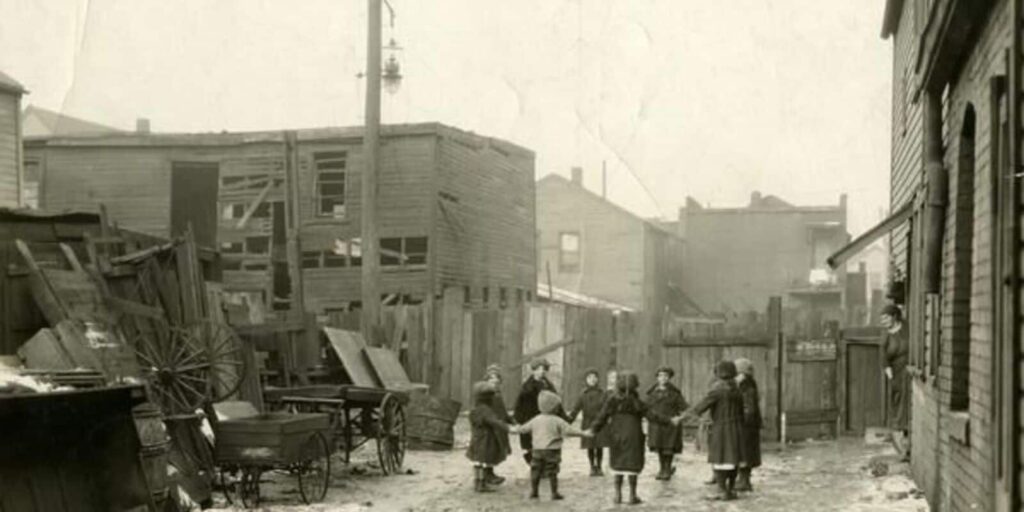
Daily life in 1900 was defined by the rhythms of work and the stark divide between urban and rural existence. In the cities, factory workers often rose before dawn and returned home after dark, their days consumed by 14 to 16 hours of labor in mills, foundries, and garment shops. Wages averaged $1 to $2 per day, which barely covered rent, food, and fuel for a family. Women and children worked alongside men in many industries, despite growing calls for reform. The urban landscape was crowded, noisy, and filled with the smells of coal smoke and horse manure, but it also offered new forms of leisure: saloons, vaudeville theaters, and amusement parks. Saloons, in particular, were the most numerous business in many urban neighborhoods, outnumbering dry goods stores and grocers. They attracted customers with free food or even a free vaudeville show, making them centers of working-class social life. In rural areas, life was quieter but no less demanding. Farmers worked from sunup to sundown, tending crops and livestock, and their fortunes depended on commodity prices that had only recently stabilized after years of volatility. By 1900, agricultural prices had become a bit more stable, permitting many rural dwellers to take advantage of special “excursion rates” that offered discounted rail travel to nearby cities for shopping or entertainment. Traveling shows continued to reach even the most isolated rural areas, bringing music, drama, and novelty acts to farm communities. Clothing was practical and often homemade in rural areas, while city dwellers followed fashions that were increasingly mass-produced. Food was seasonal and local, with meat, potatoes, and bread forming the staple diet of most families. The pace of life was slower than today, but the hours of work were longer, and the margin between comfort and poverty was thin.
Numbers at the Time
| Statistic | Value (1900) | Source |
|---|---|---|
| Average daily wage for laborers | $1 – $2 per day | HistoryNet |
| Typical workday length | 14 – 16 hours | HistoryNet |
| Most numerous business in urban neighborhoods | Saloons | Humanities LibreTexts |
| Rural-to-urban migration | Thousands of Americans moving from farms to cities | HistoryNet |
| Agricultural commodity prices | Becoming more stable by 1900 | Humanities LibreTexts |
What People Feared
The anxieties of 1900 were many and varied. Among the working class, the greatest fear was unemployment or injury, since a single accident or layoff could plunge a family into destitution. The lack of safety regulations in factories and mines meant that death or disability was a constant threat, and there was no workers’ compensation to fall back on. Many Americans also feared the growing power of monopolies and trusts, which seemed to crush small businesses and manipulate prices. The concentration of wealth in the hands of a few industrialists like Carnegie and Rockefeller was seen by many as a threat to democracy itself. Immigration stirred deep fears among native-born Americans, who worried that newcomers would drive down wages, spread radical ideas, or overwhelm American culture. These fears were often expressed in nativist rhetoric and led to calls for restrictive immigration laws. There was also a more diffuse anxiety about the pace of change—the sense that the old ways of life were disappearing and that the future was unknowable. As one contemporary put it, Americans faced the new century with “optimism, tempered by a vague sense of anxiety.” Some fears were rational, such as the fear of industrial accidents; others were unfounded, such as the belief that immigrants were inherently dangerous. But all of them shaped the politics and culture of the era.
What People Expected Would Happen Next
Looking forward from 1900, many Americans expected continued progress and prosperity. The rapid advances of the previous decades—electricity, the telephone, the automobile, the airplane (which was still a dream)—led many to believe that the new century would bring even greater wonders. The “rags to riches” myth encouraged the belief that anyone could rise through hard work, and the expanding middle class seemed to confirm this promise. Many expected that technology would continue to make life easier, that cities would grow even larger, and that the United States would become an even more powerful nation on the world stage. At the same time, there were those who predicted social upheaval. Labor leaders and socialists argued that the gap between rich and poor would inevitably lead to conflict, and they called for radical reforms. Some feared that the trusts and monopolies would eventually control every aspect of American life, strangling competition and democracy. The rise of the American Socialist Party and the popularity of leaders like Eugene Debs reflected this expectation that capitalism, left unchecked, would produce crisis. In hindsight, we know that the Progressive Era would bring significant reforms—labor laws, antitrust legislation, and women’s suffrage—but few in 1900 could have predicted exactly how the next two decades would unfold. The future was a subject of both hope and dread, and the primary sources capture that ambivalence perfectly.
How Historians See It Today
Modern historians view 1900 as a pivotal moment in American history, a bridge between the 19th and 20th centuries. Contemporary observers saw their era as one of progress and possibility, but they also recognized the deep social tensions that were building. Historians today emphasize the structural inequalities that underlay the era’s prosperity: the exploitation of labor, the brutal conditions in factories and mines, the racism and nativism that shaped immigration policy, and the concentration of wealth that undermined democratic ideals. The “rags to riches” myth, so powerful in 1900, is now understood as more of an exception than the rule, with social mobility actually declining during this period. Historians also point to the ways in which the events of 1900 set the stage for the Progressive Era, the labor movement, and America’s emergence as a global power. The primary sources from the time—newspapers, diaries, government reports—reveal a society that was self-aware about its contradictions, even if contemporaries could not foresee the solutions that would eventually be attempted. The historiographical shift has been from a celebratory narrative of progress to a more critical analysis of power, class, and race, but the voices of ordinary people from 1900 remain essential to understanding the full complexity of the era.
Common Misconceptions
Related Primary Sources
- U.S. Census of 1900 – Detailed population data, including immigration, urbanization, and occupational statistics.
- Newspaper archives from 1900 – Local and national papers covering politics, labor strikes, and social events.
- Diaries and letters of immigrants and laborers – Personal accounts of daily life, work, and aspirations.
- Photographs from the Library of Congress – Images of urban streets, factories, farms, and families.
- Labor union records – Documents from the American Federation of Labor and other unions detailing working conditions and demands.
FAQ
What were typical working conditions in 1900?
Laborers typically worked 14 to 16 hours a day for $1 to $2, with no safety regulations or workers' compensation. Factories were often dangerous, and child labor was common. These conditions led to the rise of the first labor unions.
How did rural life differ from urban life in 1900?
Rural life was centered on farming, with long hours and dependence on commodity prices. However, by 1900, agricultural prices had stabilized, and rural residents could take advantage of discounted rail travel to cities. Urban life offered more jobs and entertainment, but also crowding, pollution, and higher costs of living.
What role did saloons play in 1900 society?
Saloons were the most numerous business in many urban neighborhoods, serving as social centers for working-class men. They often offered free food or vaudeville shows to attract customers, making them important community gathering places.












Leave a Reply