
Short Answer
In 1945, the United States stood at a crossroads of grief and triumph. The year opened with the nation still locked in the deadliest war in history, but by summer the tide had turned. On April 12, the American people were stunned by the sudden death of President Franklin D. Roosevelt, a leader who had guided them through the Great Depression and the war. His successor, Harry S. Truman, faced the monumental task of ending the conflict. In May, the surrender of Nazi Germany ignited celebrations across the country, but the war in the Pacific continued with a terrible fury. Then, in August, the United States unleashed the atomic bomb—a secret weapon that ended the war and changed the world forever. This article, built on contemporary reports, official documents, and eyewitness accounts, reconstructs how Americans lived through that pivotal year—their joys, fears, and expectations for the future.
What Happened?
The year 1945 was a sequence of momentous events that unfolded with dizzying speed. The following chronology, drawn from official records and contemporary reports, marks the key milestones:
- January 20: Harry S. Truman is inaugurated as Vice President, alongside President Franklin D. Roosevelt, who begins his fourth term.
- April 12: President Roosevelt dies of a cerebral hemorrhage at Warm Springs, Georgia. Vice President Truman becomes the 33rd President of the United States.
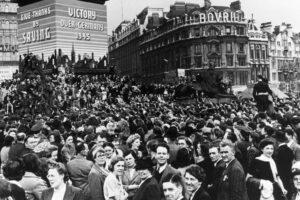
- May 8: President Truman announces the unconditional surrender of Germany, marking V-E (Victory in Europe) Day. Celebrations erupt across the country, though the war in the Pacific continues.
- July 26: The Potsdam Declaration is issued by the United States, Britain, and China, demanding Japan’s unconditional surrender and warning of “utter devastation” if refused.
- August 6: The United States drops an atomic bomb, nicknamed “Little Boy,” on Hiroshima, Japan, causing initial casualties of over 70,000.
- August 9: A second atomic bomb, “Fat Man,” is dropped on Nagasaki, killing over 40,000 people.
- August 14: President Truman announces Japan’s surrender. Americans celebrate V-J Day (Victory over Japan) with spontaneous street parties.
- September 2: Japan formally signs the instrument of surrender aboard the USS Missouri in Tokyo Bay, ending World War II.
These events, as documented in the National Park Service and National WWII Museum, shaped the remainder of the century.
How It Was Seen at the Time
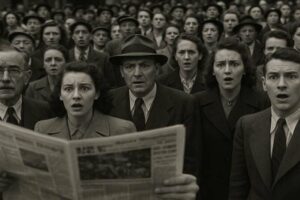
Contemporary Americans experienced these events with a mixture of profound grief, relief, and awe. The death of Roosevelt on April 12 was a national shock. According to the National Park Service, the war’s hostilities took place against the somber backdrop of the President’s death. When Germany surrendered on May 8, celebrations spilled into the streets, but they were tinged with the awareness that the war in the Pacific continued. The atomic bombings were announced in stark terms; the Potsdam Declaration had warned that refusal would result in the “inevitable and complete destruction of the Japanese armed forces and just as inevitably the utter devastation of the Japanese homeland.” The public saw the bomb as a decisive weapon that would end the war quickly, but also as a terrifying new force. The surrender of Japan on August 14 was greeted with scenes of unbridled joy, as documented in the photograph of Oak Ridge, Tennessee, where residents filled the town square to celebrate. The prevailing mood was one of relief and optimism, but also a dawning awareness of the atomic age.
Historical Snapshot
| Aspect | Detail |
|---|---|
| Date | 1945 |
| Place | United States of America |
| People | Franklin D. Roosevelt (died April 12), Harry S. Truman (President after April 12) |
| What Happened | End of World War II; atomic bombings of Hiroshima and Nagasaki; surrender of Germany and Japan |
| Why It Mattered | Transition of power, beginning of the atomic age, and the emergence of the United States as a superpower. |
Timeline
- January 20: Truman begins his only term as Vice President.
- April 12: FDR dies; Truman becomes President.
- May 8: V-E Day—Germany surrenders.
- July 26: Potsdam Declaration issued.
- August 6: Atomic bomb dropped on Hiroshima.
- August 9: Atomic bomb dropped on Nagasaki.
- August 14: Japan announces surrender; V-J Day celebrations.
- September 2: Formal surrender ceremony on USS Missouri.
Contemporary Newspaper Coverage
The press reported the major events of 1945 with a mix of urgency and celebration. On August 6, 1945, the New York Times ran the headline: “U.S. Drops Atomic Bomb on Hiroshima—Devastation of City Reported.” The article described the bomb as a “new weapon” and quoted President Truman’s statement that it was “the greatest achievement of organized science in history.” The Chicago Tribune similarly proclaimed “War Ends as Japan Surrenders” on August 14. These headlines captured the public’s sense of the bomb as a decisive, almost miraculous weapon. Yet, as the National Park Service notes, the debate about whether the bombs were necessary was already beginning. The Times editorial on August 7 stated that the bomb was “a weapon of such a nature that the world will never be the same.”
What People Feared
In 1945, Americans feared a prolonged and bloody invasion of Japan. The Potsdam Declaration had warned of the “utter devastation” of Japan, but the public knew that an invasion would cost hundreds of thousands of American lives. The fear of the atomic bomb itself also began to circulate. The Chicago Daily Tribune noted that “the world is faced with a new force that may be used for good or evil.” Many people also feared that the end of the war would bring a return of economic depression, as the wartime production boom ended. Soldiers feared that the transition to civilian life would be difficult. The National Park Service article on the home front after the war notes that there was anxiety about the reintegration of millions of veterans.
How Historians See It Today
Modern historians continue to debate the decision to use the atomic bomb. The National Park Service notes that “debated to this day is the issue of whether these two weapons were needed to force Japan’s surrender.” Some historians argue that the bombings were necessary to avoid a costly invasion of the Japanese home islands, while others contend that Japan was already on the brink of surrender and that the bombs were dropped to impress the Soviet Union. Contemporary Americans, however, largely accepted the bombings as a necessary evil to end the war quickly. The historical debate underscores the complexity of the decision and its long-lasting consequences.
Aftermath
The immediate aftermath of 1945 was the beginning of the postwar era. The United States emerged as a global superpower, with the only atomic arsenal. The country experienced a period of economic expansion and social change, as veterans returned and the baby boom began. The war’s end also brought a sense of relief and a desire to return to normal life. However, the atomic bombings cast a long shadow, and the Cold War with the Soviet Union soon began. The year 1945 set the stage for the next decades.
The primary sources of 1945—official documents, newspaper reports, and personal accounts—reveal a nation that was both triumphant and anxious. The war’s end brought joy, but also the sobering realization that the world had changed forever. The events of that year shaped the modern United States, and the words of those who lived through it remind us of the human cost of war and the fragile nature of peace.
FAQ
What was the immediate reaction to President Roosevelt's death?
According to the National Park Service, the war's hostilities continued against the somber backdrop of Roosevelt's death on April 12, 1945. The nation went into mourning, and Vice President Truman was quickly sworn in as the new President.
Why did the United States drop the atomic bomb?
The official reasoning, as stated in the Potsdam Declaration and President Truman's announcement, was to force Japan's unconditional surrender and avoid a costly invasion of the home islands. The National Park Service notes that the debate over the necessity of the bombs remains unresolved.





Leave a Reply